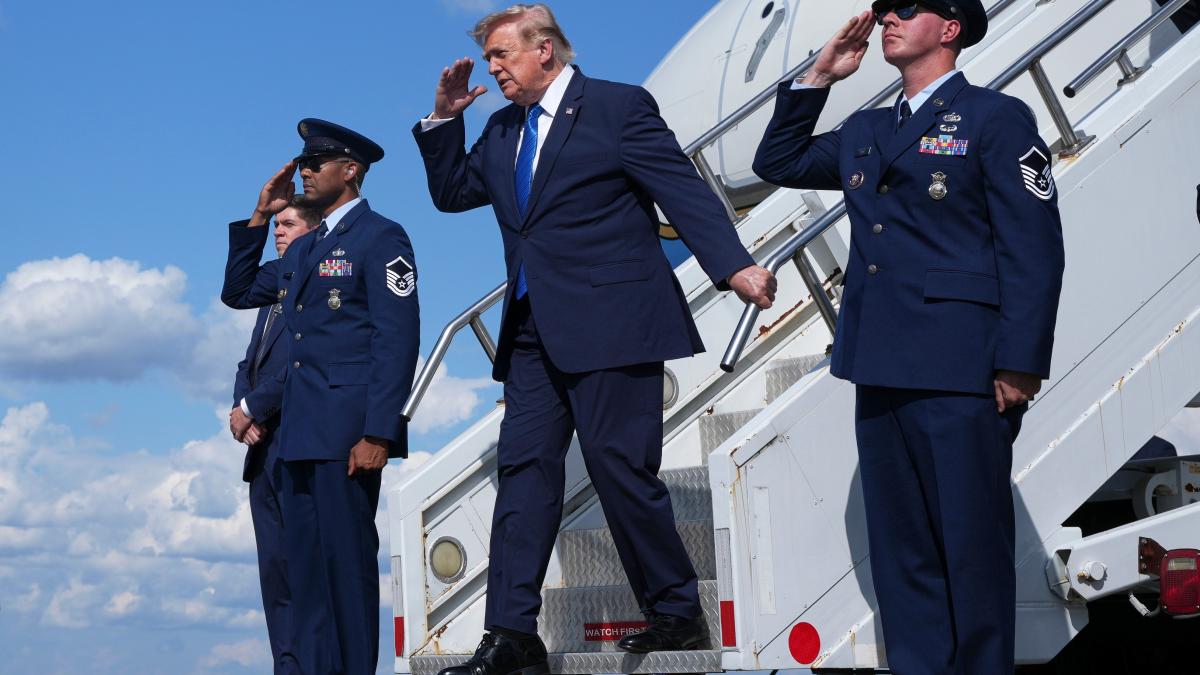
Amid an ongoing Middle East conflict, U.S. President Trump initially threatened a 'largest offensive since World War II' against Iran but reversed course on August 2, announcing a temporary halt to military strikes at the request of Persian Gulf allies. Negotiations between the two nations will resume on August 3. With signs of de-escalation, international crude oil prices sharply declined at Monday’s (August 3) market open, with Brent crude futures plunging 6% to $83.99 per barrel. Meanwhile, spot gold prices rose slightly by 0.7% to $4,067.06 per troy ounce.
Speaking aboard Air Force One, Trump told accompanying reporters that U.S. forces had been 'locked and loaded, ready to go,' preparing for a major strike on Iran last Saturday. However, he decided to pause the operation following intervention by allies. 'We were fully ready, but when allies ask you to stop, you have to say: Okay, let’s see what happens,' Trump added. He said Saudi Crown Prince Mohammed bin Salman had called him, stating that an agreement on Strait of Hormuz navigation and Iran’s ultimate denuclearization was 'imminent.'
According to the Associated Press, this marks another instance in the five-month U.S.-Iran standoff where Trump has followed his pattern of issuing devastating threats, only to call them off at the last minute. U.S. Defense Secretary Pete Hegseth later confirmed on social platform X that the Pentagon remains at 'locked and loaded' maximum alert.
### The On-Again, Off-Again U.S.-Iran Conflict
Since ordering an attack on Iran on February 28, Trump has repeatedly threatened large-scale offensives—none of which have materialized—plunging both nations into a cycle of intermittent fighting and negotiations:
- **February 28**: The U.S. and Israel launched a surprise attack on Iran, killing Supreme Leader Ali Khamenei. However, Iran’s regime did not collapse as expected, and the Revolutionary Guard quickly blockaded the Strait of Hormuz, disrupting the global economy. - **April 7**: The U.S. and Iran agreed to a two-week ceasefire. Trump announced the deal less than two hours before his self-imposed 'final deadline.' He had previously demanded Tehran’s surrender, threatening attacks on bridges and power plants, claiming it would mean 'the end of a civilization.' - **April 21**: One day before the ceasefire expired, Trump announced an indefinite extension of the truce, citing requests from mediators to pause attacks and allow Iranian leaders time to propose new terms. - **May 18**: After issuing stern threats against Iran, Trump decided to pause a planned large-scale military strike, citing 'serious negotiations' underway. He said, 'They may reach some kind of agreement. If we can achieve that without bombing them, I’d be very happy.' - **June 11**: Trump threatened further escalation, declaring the U.S. would 'devastate Iran tonight' and 'fully control' its oil and gas industry. Hours later, he posted on social media: 'Breakthrough in talks, air strike plan canceled.' - **June 17**: Trump signed a preliminary agreement with Iran, calling for a permanent halt to hostilities, reopening of the Strait of Hormuz, and launching 60 days of negotiations toward a final deal on Iran’s nuclear program. He did not rule out abandoning the agreement, stating: 'This is just a memorandum of understanding. If I’m not satisfied, we’ll resume firing on them.' - **July 7**: After Iran attacked commercial ships in the Strait of Hormuz, Trump ordered a new round of strikes on Iran. He again threatened to 'completely resolve' the issue, declaring the ceasefire void. - **July 27**: Trump announced he had paused two weeks of intense U.S. airstrikes on Iran to continue negotiations. During the 13-day bombing campaign, U.S. forces targeted key Iranian military and commercial sites, while Iran responded with missile and drone attacks on countries hosting U.S. troops across the Middle East. - **August 1**: Trump told media he would 'devastate Iran,' but later posted on social media that he canceled the planned strike, as Middle Eastern allies had reached an agreement to end the war: 'Based on this request, for the sake of the world’s future and Iran’s prosperity, I agreed to cancel the attack—provided a swift agreement is reached.'
The UK’s Financial Times, citing informed diplomats, reported that senior officials from Qatar, Saudi Arabia, and the UAE coordinated efforts, making urgent calls to Washington warning that renewed U.S. bombing would trigger a full-scale Iranian retaliation—including from proxies like Yemen’s Houthi rebels and Iraqi militias—potentially paralyzing shipping through the Bab al-Mandab Strait and the Suez Canal, plunging the entire Middle East into irreversible chaos.
### Iran’s Dual Strategy: Negotiating a 'New Route' While Expanding the Battlefield
Despite Washington’s peace overtures, Tehran has maintained a firm stance. Iranian Foreign Minister Abbas Araghchi confirmed on August 3 during a cabinet meeting that negotiations with Oman on a new Strait of Hormuz navigation mechanism had entered the 'final stage.' However, Iranian Foreign Ministry spokesperson Esmaeil Baghaei emphasized that the talks with Oman were bilateral and 'do not equate to negotiations with the U.S., nor guarantee immediate full reopening of the Strait.'
Baghaei explicitly stated Iran would not allow vessels to pass through the 'southern route' adjacent to Oman’s coastline, calling it 'unsafe and damaging to Iran’s national security.' A new alternative route must be agreed upon. He clarified that establishing a new route is separate from full reopening and stressed: 'The situation in the Strait of Hormuz cannot return to its pre-war state.'
Iranian President Masoud Pezeshkian called on the U.S. to uphold the memorandum of understanding signed on June 17. That agreement set a 60-day negotiation period to gradually restore Strait navigation and initiate final peace talks, but was later scrapped due to disagreements over navigation details and route authority.
### Think Tank: Iran Shifts from Passive to Active, U.S. Negotiation Credibility in Crisis
Ellie Geranmayeh, analyst at the European Council on Foreign Relations (ECFR), told the Financial Times that Iran is no longer passively responding to U.S.-Israeli strikes but is now launching preemptive attrition warfare: 'Tehran is sending Washington a message—that although the war was initiated by the U.S. and Israel, its conclusion will not be decided unilaterally by you.'
Vali Nasr, Iran strategy expert at Johns Hopkins University, analyzed that Iran is systematically pushing the battlefield away from its territory, forcing U.S. troops to withdraw from the Persian Gulf, Syria, and Iraq, retreating to Jordan and Israel. Recent Iranian attacks on a U.S. base in Jordan and suspected drone strikes on a U.S.-flagged vessel in Egypt’s Damietta port indicate Tehran’s strategy of elongating the frontlines and exhausting U.S. and global supply chains.
Regarding Trump’s erratic decision-making, Trita Parsi, vice president of the Quincy Institute for Responsible Statecraft in Washington, warned in an interview with Al Jazeera: 'This pattern of extreme threats followed by self-proclaimed concessions is exhausting. If this continues, all U.S. credibility at the negotiating table will be depleted—enemies will no longer believe your threats, nor your offers and promises.'
Daniel Shapiro, a former Pentagon official under the Biden administration, also stated: 'No one believes anything Trump says—neither allies nor adversaries like Iran.'
The Wall Street Journal noted that when Trump attacked Iran in February, polls showed many Americans did not believe Iran’s nuclear threat was imminent. Trump then tried to reassure the public, insisting oil price hikes would be short-lived and the conflict would end within four to six weeks. Now, the war has entered its sixth month, and Trump’s domestic and international support has significantly declined. Although Trump repeatedly threatens massive offensives, even his supporters now believe the U.S.-Iran conflict may ultimately be resolved diplomatically.
Meanwhile, seven major OPEC+ members, including Saudi Arabia and Russia, issued a joint statement on August 2, announcing a modest daily oil output increase of about 188,000 barrels starting in September to stabilize markets. This move will reverse the 1.65 million barrel voluntary production cut agreement reached in 2023. Jorge Leon, analyst at Rystad Energy, bluntly stated: 'As long as the Strait of Hormuz remains blocked, the impact of nominal production increases by oil-producing nations on easing the global energy crisis will be extremely limited.'
FACT BOX
- Source: PR Times
- Category: News
- Organizations: OPEC+ / Rystad Energy