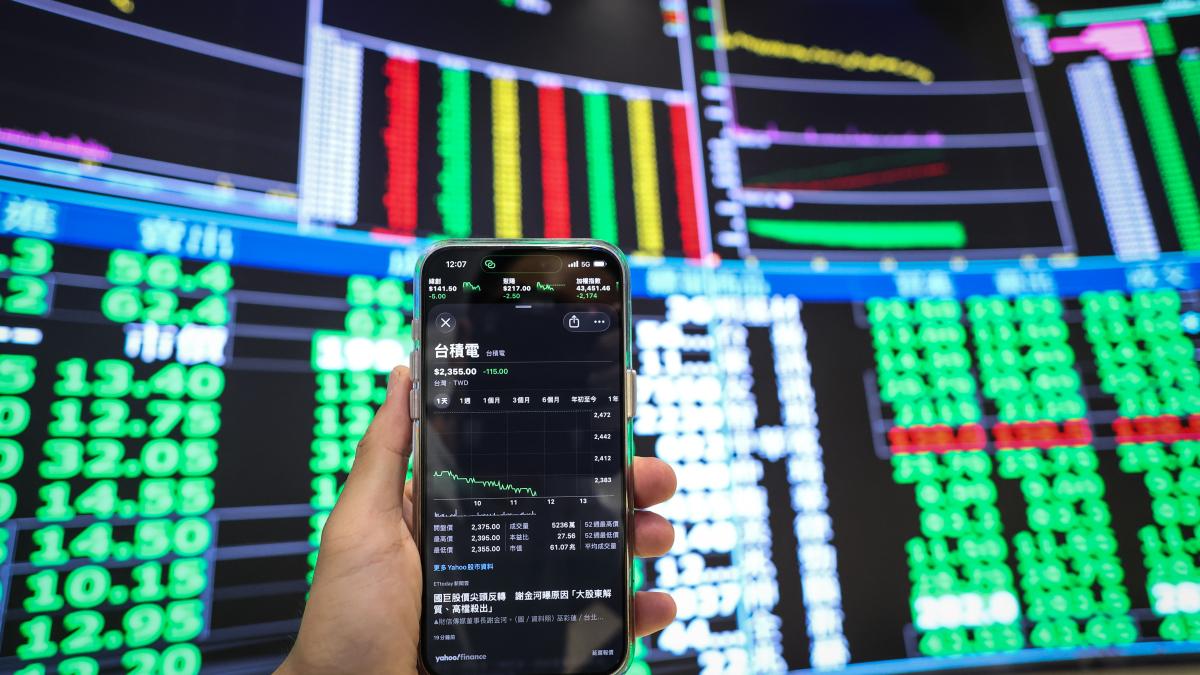
Amid recent extreme volatility in Taiwan's stock market, legislator Wang Shih-Chien posted on Facebook stating that many citizens have reported to him that after suffering losses from sharp stock declines, they are unable to sell their shares once stocks are placed under 'trading suspension,' worsening their losses. Wang criticized the current mechanism for relying on a 30-year-old framework, while today's daily trading volume routinely reaches NT$400–500 billion, making the market scale incomparable to the past. He argued that the current system is severely disconnected from modern market realities.
Wang pointed out that 30 years ago, Taiwan's daily stock trading volume was only a few hundred billion NT dollars, whereas today it routinely hits NT$400–500 billion. Despite this massive growth in market size and structure, the capital market is still being regulated under a 30-year-old framework, which is fundamentally out of touch. He further emphasized that mature global markets such as the U.S., Japan, and South Korea do not implement long-term trading suspensions. Instead, international best practices use short-term 'circuit breakers' during trading hours to cool markets, rather than Taiwan's system of segmented trading lasting over ten days.
Wang stressed that the victims of this outdated system are not only individual investors but also large, fundamentally sound listed companies with market capitalizations in the tens of billions. Due to rigid quantitative indicators, even high-quality firms can be placed under trading suspension, severely disrupting their capital-raising plans and normal operations. He criticized the current mechanism as an inflexible intervention that restricts market freedom, cuts liquidity, and exacerbates investor losses.
Wang proposed three concrete reform recommendations to the Financial Supervisory Commission (FSC):
First, comprehensively review the trading suspension mechanism and consider relaxing the segmented trading restrictions during sharp price movements, returning the right of autonomous loss-cutting to investors.
Second, study the implementation of an internationally aligned 'intraday circuit breaker mechanism.' If market cooling is needed, follow mature markets by pausing trading for a few minutes before resuming, rather than imposing 10+ day trading suspensions.
Third, introduce flexibility into the suspension criteria. Regulation should not rely solely on rigid price fluctuation data but should incorporate company market capitalization and fundamental health to prevent high-quality firms from being unfairly penalized.
Wang stated he will continue monitoring the regulatory authorities to ensure a clear reform timeline is established, aiming to restore trading freedom and liquidity to the market as soon as possible.
Prior to Wang's statement, FSC Securities and Futures Bureau Deputy Director Huang Hou-Ming stated at a press briefing on the 30th that the Taiwan Stock Exchange and GreTai Securities Market are currently reviewing whether adjustments are needed for trading suspension criteria and the T+2 settlement cycle. They will formally announce findings after evaluation, aiming to better align with market structure and investor needs.
The FSC acknowledged that Taiwan's capital market has grown significantly in recent years, with increased trading activity, rising stock indices, and higher price levels, making it necessary to periodically review and adjust current monitoring and suspension standards.
Regarding concerns about an imminent margin call crisis, Huang explained that the current maintenance margin is calculated on an 'entire account' basis, not individually per stock. As of July 29, the overall market-wide account maintenance rate stood at 161.63%, well above the 130% margin call threshold, indicating substantial buffer remains.
FACT BOX
- Source: PR Times
- Category: News