In 2025, Taiwan officially enters a super-aged society. According to statistics, the average household size in Taiwan has dropped to 2.52 people. Combined with a mix of small apartments, townhouses, and multi-level homes, as well as hot, humid climates and diverse flooring materials, home cleaning scenarios have become increasingly complex. This shift has moved the cleaning appliance market from single-function competition toward more nuanced demands for specific use cases and user experience.
To bridge the gap between market needs and product development, Roborock, a global leader in smart cleaning, adopts a user-driven approach to product iteration. Real-world feedback and diverse living environments are integrated into R&D decisions from the earliest stages. Taiwan’s diverse housing types and consumers’ high expectations for quality and experience make it a vital market for Roborock to validate technological value and assess product direction within its global strategy.
From Global Expansion to Local Deepening: Roborock Leads Sales in Over 10 Core Markets, with Taiwan’s Diverse Housing as a Key Validation Ground
As Roborock expands globally, localization has become a critical factor for deepening market penetration. Rather than replicating a single product model across regions, Roborock tailors its products based on local housing types, climate, and lifestyle habits. For example, larger homes in Europe and North America demand longer battery life and superior pet hair pickup. In contrast, compact homes in Japan and South Korea prioritize slim designs to clean under furniture and tatami mats. In Southeast Asia’s hot and humid climate, mold prevention and drying functions are key development priorities.
Li Ping, Roborock’s Asia-Pacific Regional Head, stated, "Taiwanese consumers have high standards for product quality and user experience and are eager to embrace innovative technologies. Therefore, Roborock incorporates Taiwan’s market feedback early in product decision-making, using it as a key basis to validate technological value, assess R&D investments, and guide product iteration."
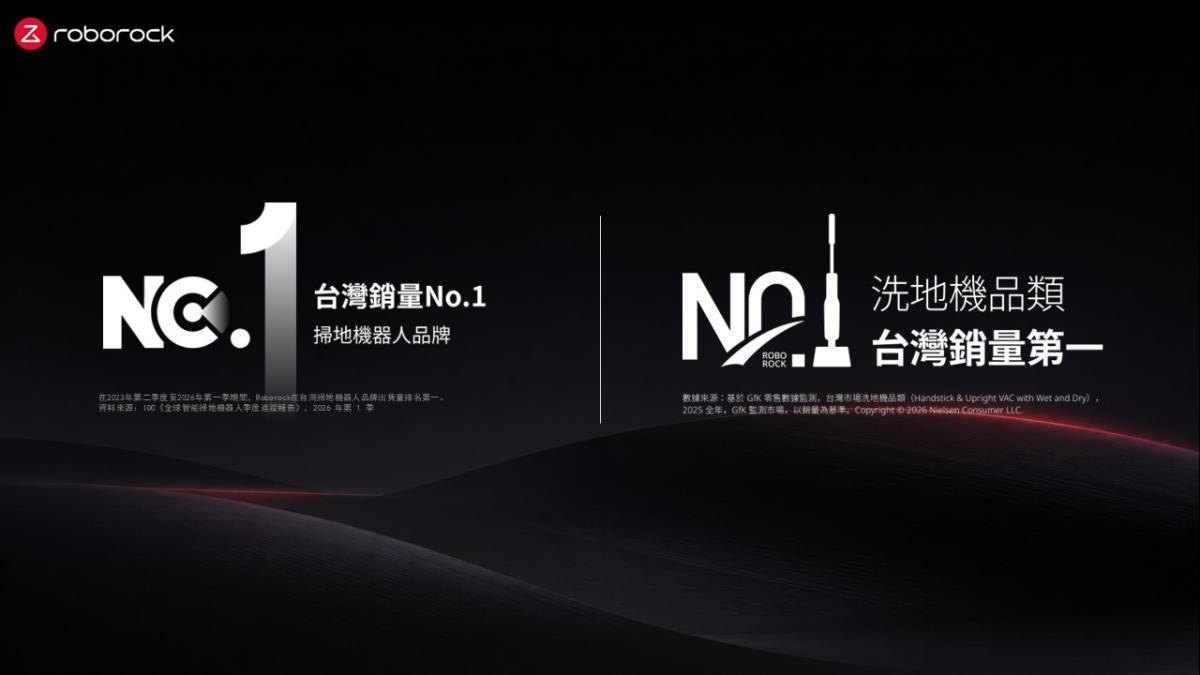
Roborock has filed over 800 patents in Taiwan and continues to integrate R&D outcomes into its products. These include the tangle-free cleaning system that reduces hair缠绕 and maintenance burden, and adaptive suspension technology that adjusts to thresholds, carpets, and varied floor surfaces. Roborock’s robot vacuums and floor mops have both achieved top sales in Taiwan (Note 1). Globally, Roborock leads in robot vacuum sales in over 10 core markets, with over 50% market share in South Korea, demonstrating that local insights are foundational to technological deployment and global expansion.
The Era of Rapid Iteration in Cleaning Appliances: One Factory for End-to-End R&D and Validation, Doubling Roborock’s Speed to Market
Faced with diverse and rapidly changing home cleaning needs, the cleaning appliance market has entered an era of high-speed product competition. Brands must not only innovate faster but also ensure stable mass production of new technologies. To achieve this, Roborock integrates product development, testing, and manufacturing at its Huizhou smart factory. This enables real-time quality data to feed back into R&D, while modular manufacturing capabilities have shortened the overall development cycle by nearly 50%. The company maintains product defect rates below 50 DPPM (defective parts per million), balancing development speed with production quality.
Roborock’s Huizhou smart factory integrates product development, testing, and production, using real-time quality feedback to R&D to accelerate innovation while ensuring stable mass production. (Image: Roborock)
However, faster iteration does not mean blindly chasing new concepts. Roborock does not aim to stack AI features but focuses on real, high-frequency use cases, ensuring every innovation addresses a specific cleaning challenge. In 2025, Roborock invested RMB 1.42 billion in R&D, a 46.13% year-on-year increase, deepening its capabilities in AI, algorithms, sensing, and electromechanical integration, transforming market insights into core technologies applicable across product lines.
Li Ping added, "Roborock has always put users at the center. Beyond continuous innovation, we promote ‘technology democratization’—bringing high-value, market-proven technologies to different product categories and price points. This comprehensive product strategy allows more households to enjoy truly practical smart cleaning experiences."
In 2025, Roborock’s R&D investment reached RMB 1.47 billion, a 46.13% year-on-year increase, further advancing AI, algorithms, sensing, and electromechanical integration to convert market insights into scalable core technologies. (Image: Roborock)
Smart Cleaning Expands from Floors to Spaces, and from Indoor to Outdoor
As household structures and lifestyles diversify, Roborock continues to expand the boundaries of smart cleaning. The company leverages its long-standing expertise in AI environmental understanding, sensing, navigation, obstacle avoidance, and electromechanical integration across various living spaces and cleaning tasks.
Indoors, the Saros Z70, equipped with a biomimetic robotic arm, enables robot vacuums to do more than clean floors—they can actively remove obstacles and organize items into designated locations, extending cleaning into space management. For multi-level homes, the Saros Rover, unveiled at CES 2025, features a dual-wheel-leg design with independently extendable and elevatable limbs, mimicking human movement to autonomously climb stairs and clean each step, overcoming the limitation of single-floor operation. Outdoors, Roborock is developing robotic lawn mowers to meet yard maintenance needs, further expanding the scope of smart cleaning.
Li Ping emphasized, "These initiatives are not just about adding product categories. They leverage our accumulated core technologies to address diverse spatial cleaning needs, driving Roborock’s evolution into a smart cleaning brand that spans both indoor and outdoor environments."
From floors to spaces, from indoor to outdoor—Roborock’s Saros Z70 breaks floor-cleaning limits with a robotic arm; Saros Rover conquers stairs, unlocking new possibilities for multi-level autonomous cleaning; and robotic lawn mowers further extend the reach of smart cleaning. (Image: Roborock)
[Notes] Note 1: Source: IDC Worldwide Quarterly Smart Home Device Tracker, Q1 2026; Floor Mops – Source: GfK retail data monitoring, Taiwan floor mop category (Handstick & Upright VAC with Wet and Dry), full-year 2025, GfK monitored market, based on unit sales. Copyright © 2026 Nielsen Consumer LLC.
FACT BOX
- Source: PR Times
- Category: New Product
- Products / services: Saros Z70 / Saros Rover