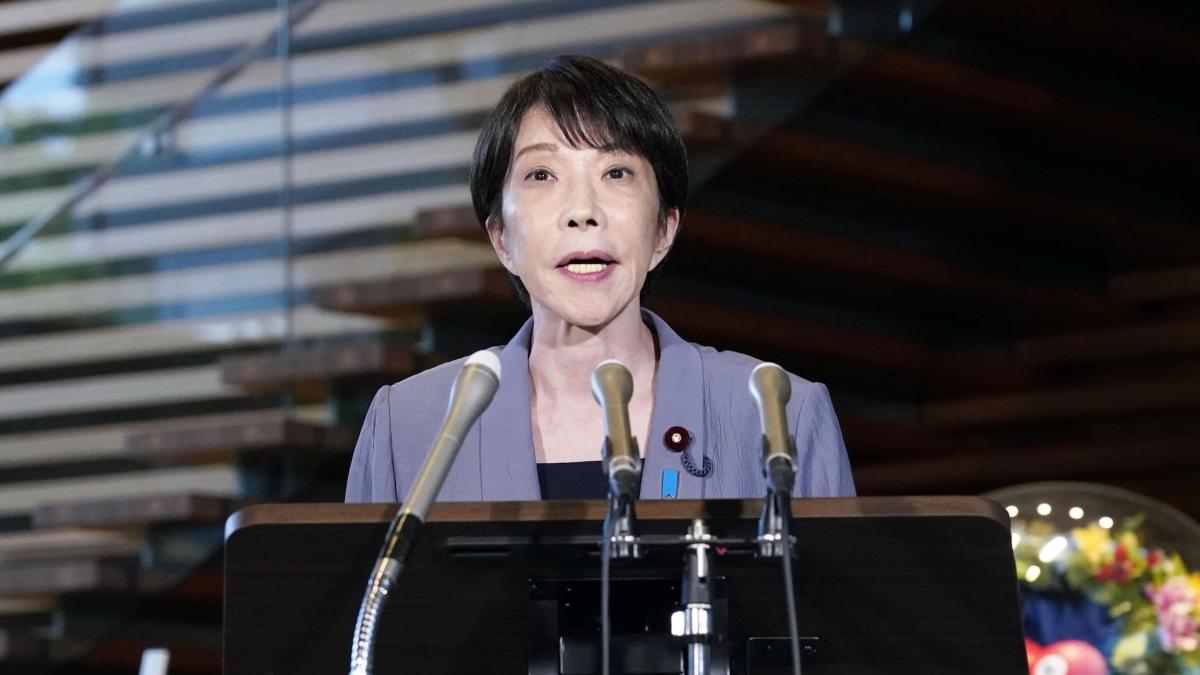
Following the Kumamoto earthquake in Japan, President Lai Ching-te made a personal donation of 200,000 NTD for disaster relief. Japanese Prime Minister Hayashi Sanae expressed gratitude on X (formerly Twitter) to various world leaders for their support but did not publicly acknowledge President Lai, sparking public discussion in Taiwan. Some scholars argue that Japan's public recognition of Kuomintang Chairperson Cheng Li-chun's donation, while omitting any mention of President Lai, raises questions about whether Taiwan's long-standing political goodwill toward Japan has truly been reciprocated with equal respect.
There is no doubt about Japan's goodwill and respect toward Taiwan. However, a clear distinction exists between official and private actions in international politics. Cheng Li-chun is a private individual, and acknowledging her donation poses no political complications for Japan. In contrast, Lai Ching-te is Taiwan's sitting president; even a personal donation carries political sensitivity. Given the reality that Taiwan and Japan lack formal diplomatic relations, it would be inappropriate for Lai to be mentioned alongside figures like Lee Jae-myung or Emmanuel Macron. The Japanese government's response demonstrates a precise understanding of diplomatic boundaries. Prime Minister Hayashi undoubtedly appreciates President Lai's gesture but, constrained by international norms, must remain diplomatically silent—'loving but unable to speak openly.'
Interactions between the Taiwanese and Japanese governments are similarly constrained by the absence of formal ties. Japan's recent fisheries boundary agreement with the Philippines, which disregarded Taiwan's claims, should not be interpreted as unfriendly toward Taiwan but rather as adherence to the One-China policy both Japan and the Philippines uphold. The DPP-led government has erected a statue honoring former Prime Minister Shinzo Abe, and President Lai has respectfully paid tribute to Yoichi Hatta. These gestures are noted and appreciated by the Japanese government, making it implausible that Japan harbors ill will toward Taiwan.
For the DPP administration, its primary external adversary is mainland China. The same holds true for Japan. Thus, 'allying with Japan to counter China' has naturally become the guiding principle of the DPP's foreign policy. Coupled with Japan's historical consciousness of its colonial rule over Taiwan, current Taiwan-Japan relations can be described as exceptionally solid. The scholarly concern over whether Taiwan's goodwill has been met with equal respect may therefore be somewhat overstated.
Scholars emphasize that Japan, like any mature nation, prioritizes its national interests. True diplomatic maturity lies not in binding oneself to an idealized strategic narrative nor in entrusting a nation's fate to the goodwill of a great power on moral grounds, but in maintaining autonomous judgment, flexible compromise, and strategic maneuvering space amid competition and cooperation. What truly requires reflection today is not merely the absence of a public thank-you, but whether the DPP government has become overly intoxicated with the narrative of 'the best diplomatic relations in history,' overlooking subtle but significant shifts in the international landscape.
In reality, the DPP government fully understands these diplomatic principles and the evolving global dynamics. However, constrained by geopolitical realities, it has no choice but to 'bind itself to an idealized strategic narrative and entrust its national destiny to the goodwill of a major power.' There is simply no alternative.
Scholars argue that in the face of rapidly changing international conditions, the government must prioritize national interests, enhance diplomatic sensitivity and strategic vigilance, and build a more balanced, pragmatic, and resilient diplomatic framework. Taiwan must avoid becoming a mere pawn in geopolitical games and, worse, the first to be sacrificed when circumstances shift. Yet Taiwan maintains no formal diplomatic relations with any neighboring country. Its diplomatic allies are distant and lack influence over global affairs. While the United States supports Taiwan, it engages with China based solely on its own national interests. Unless Taiwan can mitigate the influence of mainland China, it will be impossible to establish a truly balanced, pragmatic, and resilient foreign policy.
*The author is a retired ambassador.
FACT BOX
- Source: PR Times
- Category: News