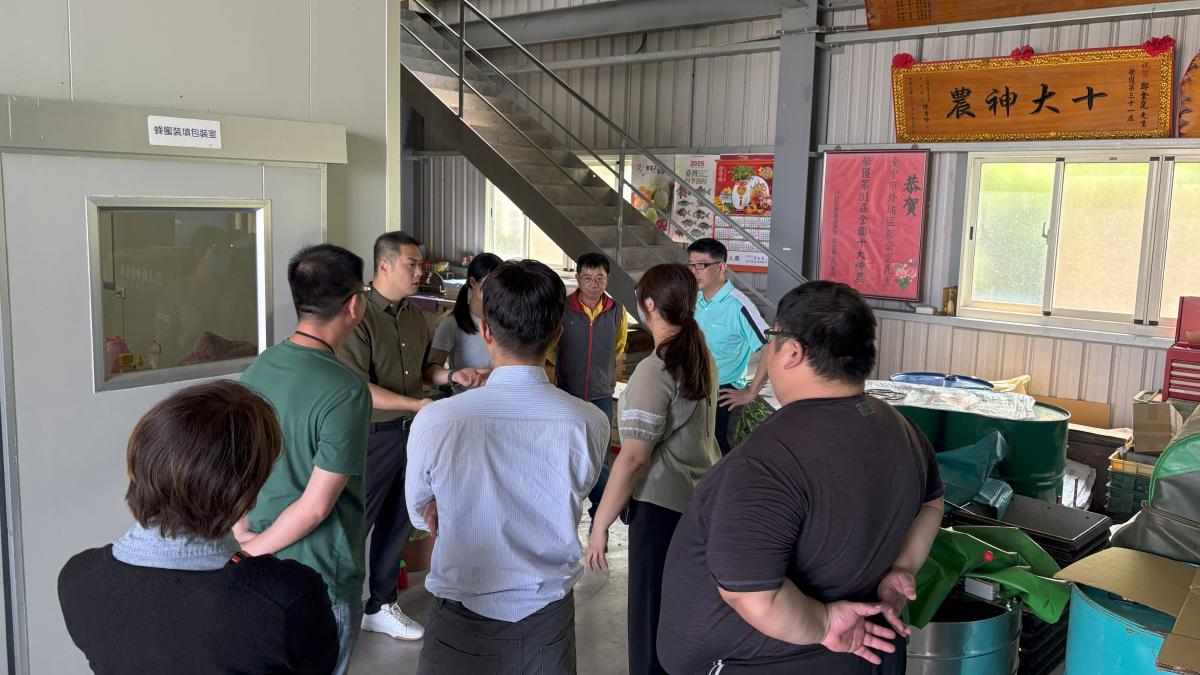
In response to global net-zero transitions and corporate demand for low-carbon supply chains, the Taichung City Government's Department of Agriculture is actively promoting a dual-track approach: implementing 'carbon footprint labels' and establishing 'localized carbon emission factors' for agricultural products. From 2025 to 2026, the city has supported eight agricultural products—including Dajia taro, Xinshe dried shiitake mushrooms, Wufeng fragrant and organic rice, Waipu longan honey, and Taichung soybeans—in completing product carbon footprint assessments. These have undergone third-party verification and are now submitted to the Environmental Protection Administration (EPA) for official carbon footprint labeling. Additionally, the city is developing localized emission factors for taro, mushrooms, fragrant rice, organic rice, honey, and soybeans, gradually building a representative set of Taichung-specific agricultural production carbon data.
The Department of Agriculture explains that the product carbon footprint label follows the 'cradle-to-grave' principle, assessing emissions across the entire lifecycle—from raw material sourcing, production, distribution, use, to disposal—enabling consumers to understand the carbon impact of specific products. In contrast, production emission factors primarily adopt the 'cradle-to-gate' scope, calculating emissions from raw materials through production up to the point of leaving the farm. This data supports downstream industries such as food processing, catering, and hospitality in conducting supply chain carbon assessments.
Regarding product carbon footprints, the city has guided agricultural cooperatives in assessing eight products: 'Yu Jian Xing Fu Series—Fresh Taro Cubes,' 'Yuan Xiang Wei—Peeled Fresh Taro,' 'Niu Kou Dried Shiitake Mushrooms,' 'CAS Wufeng Fragrant Rice,' 'Wufeng Organic Fragrant Rice,' '700g Mi Shi—Domestic Taiwanese Honey (Longan Honey),' '700g Taizhong Feng Hua—Domestically Rated Honey (Longan Honey),' and 'Kaohsiung No. 10 Soybeans.' These assessments have been submitted to the EPA for labeling, while simultaneously establishing localized emission factors for these crops. Currently, the EPA's database lacks production emission factors for taro, honey, and soybeans, and the factors for mushrooms and rice have not been updated for years. By building Taichung-specific data, the city fills critical gaps in existing carbon databases, providing reliable, referenceable data for downstream processing and supply chain carbon accounting—enhancing the accuracy of green product carbon calculations and boosting low-carbon market competitiveness.
The Department emphasizes that after completing carbon footprint assessments and establishing localized emission factors, the focus will shift from 'measuring emissions' to 'implementing emission reductions' at the agricultural production level. Farmers will be guided to identify carbon hotspots in their production processes, with ongoing promotion of domestic organic fertilizers, green manure crop rotation, rationalized fertilizer application, reduced chemical fertilizer use, and circular reuse of agricultural byproducts—reducing emissions from waste treatment and input use. Moving forward, through regenerative agriculture and improved farming practices, the city will support farmers in strengthening resource cycling and improving soil health, gradually transforming carbon data into concrete decarbonization actions. This integrated approach aims to balance food safety, agricultural sustainability, and industrial competitiveness, building a low-carbon, circular, and resilient agricultural system in Taichung.
FACT BOX
- Source: PR Times
- Category: News