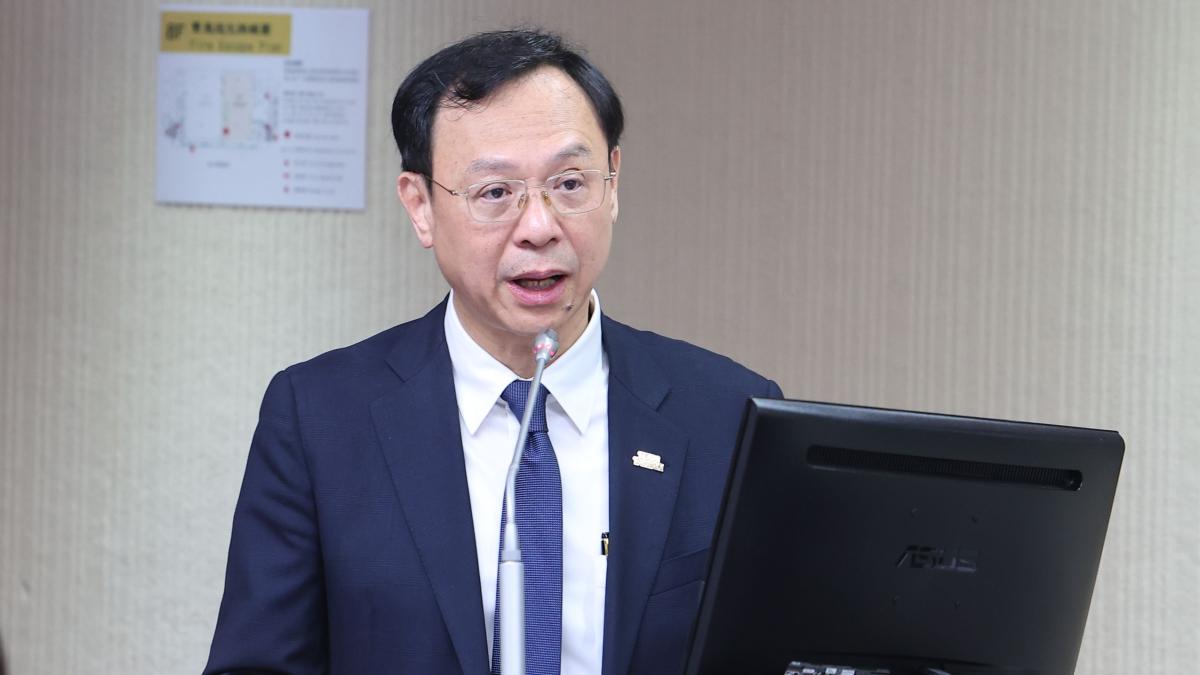
The carcinogenic oil scandal involving Zhonglian continues to escalate. The Taichung District Court has reopened a detention hearing, revealing that state-owned Taiwan Sugar detected benzopyrene (BaP) levels as high as 14.7 ppb (over seven times the edible standard) in crude oil from Zhonglian's Tank No. 311 as early as May this year.
However, when questioned about why Taiwan Sugar failed to report this to the competent authority, both the Ministry of Economic Affairs and Health and Welfare Minister Shi Chongliang defended the company in unison, claiming, "Degummed crude oil is a semi-finished raw material, not an edible oil product regulated by the Food Safety and Sanitation Management Act, and thus there is no legal obligation to report."
This statement immediately drew strong criticism from legal experts and food safety specialists. The Minister of Health and Welfare, responsible for national food safety, appears to misunderstand the basic definitions and applicable clauses of the Food Safety Act, and is suspected of downplaying the issue to shield a state-owned enterprise from accountability.
Controversy 1: Article 3 of the Food Safety Act clearly states "raw materials are food"—don't defend by misreading the law
The Ministry of Economic Affairs and the Ministry of Health claim that "crude oil is a manufacturing raw material and semi-finished product, not an edible oil product, and therefore not subject to the reporting requirements of the Food Safety Act." However, a review of Article 3 of the Food Safety Act reveals an extremely clear legal definition:
Article 3, Paragraph 1 of the Food Safety Act: "Food: products intended for human consumption or chewing, and their raw materials."
The law never excludes "raw materials" from food regulation! Food undergoes layered processing. If, as Minister Shi Chongliang argues, "raw materials are not subject to Food Safety Act regulations," then when major manufacturers like Nanhua and Taishan purchase crude oil or base oil from Zhonglian for processing, all of it is "raw material" before refining is complete.
By this absurd logic, does the entire upstream supply chain of food raw materials fall outside the jurisdiction of the Food Safety Act?
Taiwan Sugar sampled on May 11, tested positive on May 15 with a highly toxic level of 14.7 ppb, and processed a rejection and return on May 18. A situation where "a source raw material is contaminated with a severe carcinogen" cannot be dismissed as a mere "commercial return of semi-finished goods."
Controversy 2: The FDA fined Zhonglian under Article 15, the "sacred rule"—but now uses Article 17 to play dumb in defending Taiwan Sugar?
The reason the Ministry of Health gave to excuse Taiwan Sugar is that Article 17 of the Food Safety Act, which sets the "Hygiene Standards for Edible Oils" (BaP limit of 2.0 ppb), applies only to finished edible oils. However, Minister Shi Chongliang seems to have "forgotten" the strictest safeguard in the Food Safety Act—the "sacred rule" of Article 15!
Article 15, Paragraph 1, Item 3 of the Food Safety Act: It is prohibited to manufacture, process, blend, package, transport, store, sell, import, export, give as gifts, or publicly display food or food additives that "contain toxic or harmful substances or foreign matter."
The Food and Drug Administration (FDA) imposed a fine of over NT$165.2 million on Zhonglian, based precisely on Article 15 (containing toxic or harmful substances), determining that Zhonglian's production of oil containing the potent carcinogen benzopyrene was illegal.
Since the FDA has determined that the oil contains "substances harmful to human health" prohibited under Article 15, and Article 3 clearly defines "raw materials as food," the batch of crude oil with 14.7 ppb concentration constituted a major food safety violation from the moment of manufacture, storage, and sale.
As a state-owned enterprise, upon learning that a supplier's tank contained a severe carcinogen, Taiwan Sugar should have reported it to the competent authority under the spirit of Article 15 for administrative sealing, rather than quietly returning it. Minister Shi Chongliang's use of Article 17's semi-finished product standard to cover up for Taiwan Sugar is clearly a deliberate disregard of the sacred rule of Article 15.
Controversy 3: Taiwan Sugar concealed the critical "Batch No. 311," missing the golden window for administrative sealing and early warning
Beyond the confusion over legal interpretation, Taiwan Sugar's approach of "return only, no reporting" objectively delayed the competent authority's golden time to respond to the crisis:
1. Different tank batches are critical early warning information: In May, Taiwan Sugar detected abnormalities in Zhonglian's Tank No. 311; in June, Nanhua detected abnormalities in a different batch number.
2. Delayed authority assessment: When the scandal broke, if Taiwan Sugar had immediately provided the information that "Tank No. 311 tested at 14.7 ppb as early as May" to the health bureau or FDA, the competent authority could have immediately recognized that multiple tanks at Zhonglian's plant were contaminated with carcinogens over an extended period, and promptly imposed administrative sealing on the entire plant.
3. Returns allowed carcinogenic oil to remain on the market: Taiwan Sugar merely conducted a commercial return, leaving the crude oil from Tank No. 311 with 14.7 ppb of carcinogens inside Zhonglian's plant. Without regulatory oversight, this gave Zhonglian the opportunity to conceal data and continue selling the problematic oil to other unaware businesses.
Don't let "return = no reporting" become Taiwan's biggest food safety loophole
The arguments from Minister Shi Chongliang and the Ministry of Economic Affairs may seem like legal wordplay to excuse Taiwan Sugar, but in reality, they are setting an extremely dangerous precedent for Taiwan's food safety system. In the future, if any major food manufacturer detects toxins, carcinogens, or banned ingredients at the raw material stage, they could simply "process a return and not take delivery" to comfortably avoid reporting obligations, allowing toxic raw materials to remain on the market and be resold to other unsuspecting businesses.
"Raw materials are food" is a basic principle of the Food Safety Act, and Article 15 is an inviolable sacred rule. Minister Shi Chongliang, read the Food Safety Act clearly, stop pretending ignorance and shielding state-owned enterprises, and promptly close the loopholes in semi-finished product reporting and source supervision. That is the proper action expected of a competent authority.
FACT BOX
- Source: PR Times
- Category: News