Nikkei Asia published an exclusive interview on the 3rd with Joseph Wu, Secretary-General of Taiwan's National Security Council, discussing the Taiwanese government's welcome of closer cooperation between Japan and the Philippines. China has been aggressively deploying coast guard and other vessels to assert sovereignty, even framing maritime aggression as routine law enforcement, posing new challenges to Taiwan and the broader region.
Nikkei Asia emphasized that this is Wu's first in-depth interview with an international media outlet since assuming the NSC role two years ago. Speaking from the Presidential Office, Wu stated that China's threat extends beyond Taiwan, affecting the entire First Island Chain. 'Through imagery analysis from intelligence, surveillance, and reconnaissance (ISR), we see a significant increase in Chinese naval and coast guard deployments in the East China Sea, Taiwan Strait, Western Pacific, and South China Sea,' he said. He added that Taipei is taking coordinated cross-ministerial actions to better respond to the challenges posed by Chinese vessels in surrounding waters.
Beijing has repeatedly conducted 'law enforcement' operations this year in waters east of Taiwan, claiming jurisdiction. China is not only deploying coast guard ships supported by the navy but also mobilizing maritime law enforcement agencies, maritime militia, research vessels, and other ships to establish maritime control. Chinese coast guard vessels have even radioed commercial ships to inquire about their origins and destinations. Nikkei Asia reported that these actions have heightened cross-strait tensions and drawn global condemnation, including from the United States and European nations. Meanwhile, the Chinese government, which claims sovereignty over Taiwan and expresses strong dissatisfaction with Lai Qingde's defense of Taiwan's sovereignty, insists these actions are merely exercising legitimate rights.
On Japan-Philippines cooperation: Encouraging developments
Nikkei Asia noted that President Lai Qingde has prioritized strengthening democratic Taiwan's defense capabilities, with Wu bearing the responsibility of countering various forms of Chinese pressure—from maritime operations and spy networks to international efforts to marginalize Taiwan. Before becoming NSC Secretary-General, Wu served as Taiwan's longest-serving foreign minister. He told Nikkei, 'China accuses us of pursuing “Taiwan independence” and engaging in provocative acts, claiming we are the source of instability. But in reality, China has consistently threatened Taiwan and continuously escalated its threats.'
Wu emphasized, 'When China attempts to intimidate neighboring countries but blames the victims—Japan, Taiwan, and the Philippines—it accuses Taiwan of provocation, but we are merely trying to protect or maintain what we already have: our freedom and sovereignty.' Nikkei highlighted that Japanese Prime Minister Koike Takao's statement that 'a crisis in Taiwan is a crisis for Japan' previously strained relations with China, while the Philippines continues to face off with China in the South China Sea. These tensions have brought Tokyo and Manila closer and prompted Japan to accelerate defense reforms—all developments Wu welcomes.
Regarding the strengthening of Japan-Philippines cooperation, Wu described it as a 'natural response to Chinese expansionism.' He also stressed that it is 'encouraging' for Taiwan to see neighboring countries taking China's military threats more seriously than ever before. The London-based think tank 'China Strategic Risks Institute' recently warned that international shipping is now directly affected by Beijing's 'gray zone operations,' stating that 'China's potential assertion of jurisdiction over waters east of Taiwan could disrupt commercial shipping in the region.'
European diplomat: Joseph Wu is 'extremely important'
Wu also warned in the interview that, given Taiwan's immense influence in the semiconductor and artificial intelligence industries, a military conflict in the Taiwan Strait would severely impact the global economy, international trade, and high-tech supply chains. 'Among all democratic nations worldwide, Taiwan faces the most severe hybrid warfare, including disinformation campaigns, cyberattacks, cognitive warfare, and infiltration into our society,' Wu said. Nikkei noted that Taiwan's leadership believes China's hybrid warfare aims to weaken Taiwan's security and response capabilities and is closely linked to potential military invasion.
One of Taipei's core challenges, Nikkei pointed out, is explaining to the world that the threats it faces go beyond military invasion. However, an unnamed senior European diplomat told Nikkei that Wu's communication and outreach efforts with other countries are 'extremely helpful.' The diplomat said that the NSC under Wu is also committed to cultivating young talent—exemplified by his deputies—but 'the most outstanding and skillful official in the Taiwanese government is Joseph Wu.' He added that Wu 'uses a language we can understand' when conveying messages to the international community.
Wu told Nikkei that he agrees with Blaise Metreweli, the newly appointed head of the UK's MI6, who said last year that the UK is 'in a gray zone between peace and war' and that 'the front line is everywhere.' He emphasized that international cooperation is 'essential' in responding to such challenges, and Washington remains Taiwan's most important security partner. However, Nikkei also noted that after U.S. President Trump discussed arms sales to Taiwan with Xi Jinping in May, skepticism about Trump's commitment to Taiwan has grown. At the same time, Trump has led the strongest trade, investment, and arms sale agreements between the U.S. and Taiwan in decades.
On budget obstruction: Modern warfare cannot do without drones
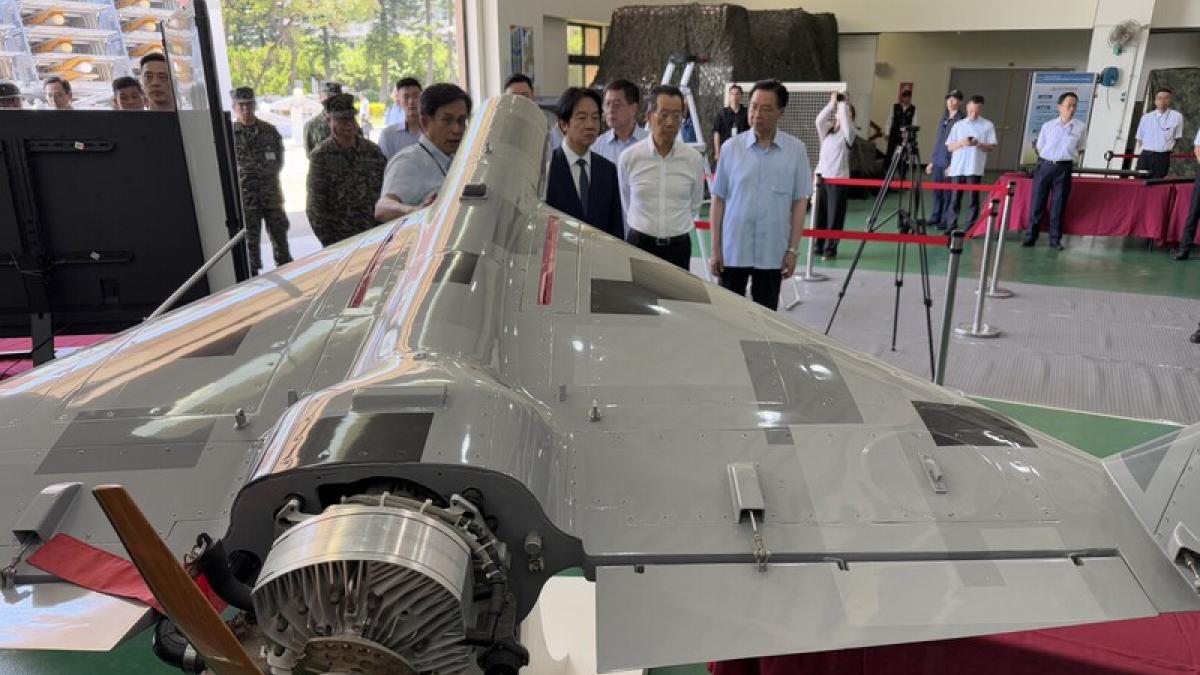
Regarding opposition parties blocking budgets in the legislature—even the 2026 government budget remains unpassed, and funding for indigenous drones in the defense special budget has been deleted—Wu said the delay in the 2026 budget has placed 'the entire government in an extremely difficult situation,' and he deeply regrets the cuts to the defense special budget. The budget was formulated after close consultation with the United States and was intended to cover weapons procurement and the development of domestically produced drones. Wu emphasized, 'Anyone paying attention to the wars in Ukraine or Iran can quickly conclude that modern warfare cannot do without drones.' Taiwan also needs to carry out related reforms, such as training personnel to operate these systems and integrating various types of drones—from reconnaissance to attack and service drones.
Although the opposition insists they support Taiwan's defense and are merely exercising democratic checks and balances, Nikkei Asia noted that government officials across Asia and the West have expressed serious concern, fearing that the legislative turmoil could undermine Taiwan's security and stability. Wu stated that Taiwan is racing against time to build critical drone capabilities, emphasizing that this is not to initiate war but to prevent it: 'War occurs when deterrence fails, and we do not want deterrence to fail against China. We do not want China to disrupt the status quo and then blame us for changing it.'
FACT BOX
- Source: PR Times
- Category: News