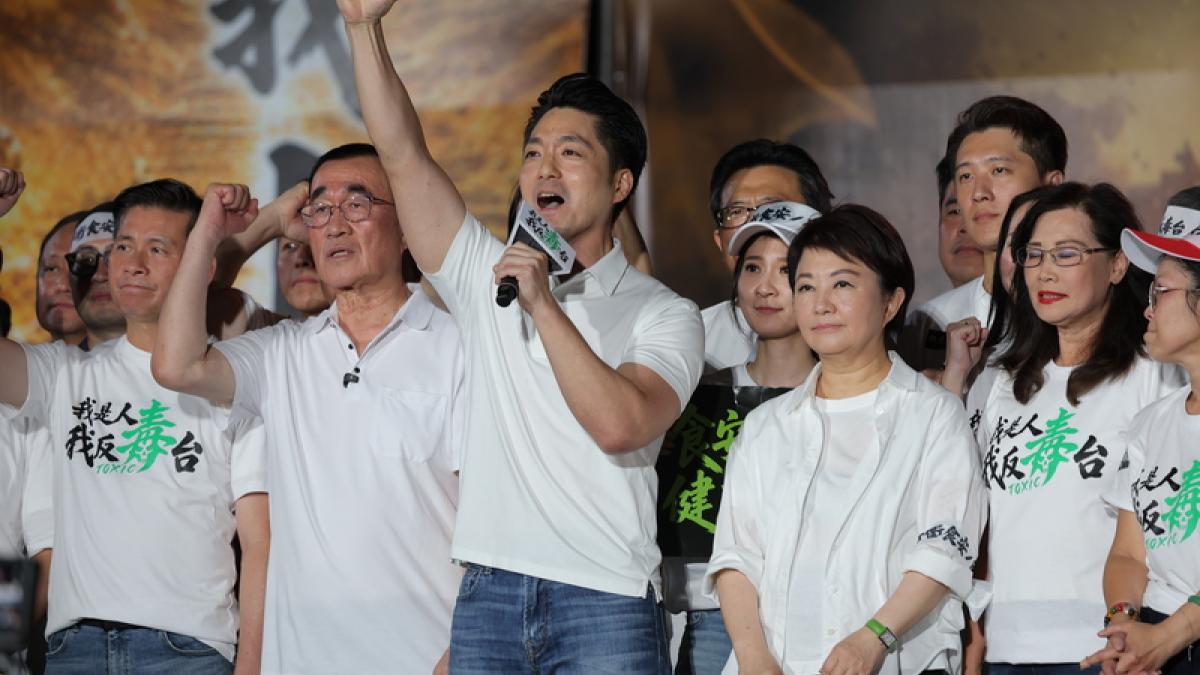
Taipei Mayor Chiang Wan-an has recently been active in political maneuvers, first calling on the Kuomintang (KMT) to protest on Ketagalan Boulevard on the 25th, then reigniting the debate over a vote of no confidence in the Executive Yuan. These actions appear closely coordinated with Taichung Mayor Lu Hsiao-yen, who is currently embroiled in the CPC carcinogenic cooking oil scandal, leading the public to believe Chiang is providing political cover for Lu. In response, media commentator Huang Yang-ming stated bluntly, 'The chemical effect between Lu and Chiang has already taken place.' He emphasized that Chiang Wan-an is now playing the role of a kingmaker, aiming to lift Lu Hsiao-yen out of political obscurity by 2028.
Huang Yang-ming noted on the program 'Lunchtime Talk' that Chiang had already stopped mentioning a no-confidence vote by last Wednesday. At the time, Chiang suggested that Kaohsiung Mayor Chen Chi-mai could take over as Premier but did not specifically state that this required a prior vote of no confidence—implying the government could simply appoint Chen directly. Of course, Chen did not accept this proposal and responded critically to Chiang.
Huang pointed out that after Chiang publicly called for a no-confidence motion, he quickly realized the political climate had shifted and the Taiwan People's Party showed little interest. 'On that day, Chiang signaled that the call for a no-confidence vote had served its purpose—his advocacy was complete, and it was time to withdraw.'
What is Chiang Wan-an's real strategy? Huang Yang-ming explained that from Chiang's July 25 protest on Ketagalan Boulevard to his subsequent push for a no-confidence motion, 'I believe the chemical effect between Lu and Chiang has already emerged.' Chiang is not only acting as an offensive force but also serving as a 'shield for Lu Hsiao-yen,' forcing the Green Camp to defend on two fronts: one against Chiang's potential 2028 presidential bid, and the other recognizing Lu as still a viable candidate, giving the Blue Camp two potential paths forward.
Huang stated that Chiang is, to some extent, acting as Lu's vanguard. He believes the two are not in opposition but rather in a strategic alliance. Every political narrative Chiang introduces allows Lu to advance by riding that momentum. 'Lu used to be extremely conservative, avoiding any risky political moves. But now, her staff are willing to speak openly about political ambitions—that's proof the chemical change has begun.'
Who will run against whom in 2028? Huang emphasized that Chiang Wan-an is currently acting as a kingmaker—the most politically energized leader in the Blue Camp. 'Whoever Chiang endorses in 2028 will rise to prominence. If he and Lu are in sync, Chiang will be the one to rescue Lu from the depths.' However, the key, Huang noted, is whether Lu 'can hold her ground.' If her polling numbers don't recover by next year, Chiang will likely prepare to run himself. Meanwhile, the Green Camp also faces uncertainty: 'Is Lai Qing-te definitely running in 2028?' After Lai challenged Tsai Ing-wen in 2019, he set a precedent that a sitting president can be challenged. Only after the 2026 local elections will it become clear whether Lai can maintain his position.
More exclusive insights from Wind Media: · Why did Chiang Wan-an initiate the Ketagalan toxic oil protest? A writer reveals his 'political favor' to help Lu Hsiao-yen · Chiang Wan-an loudly calls for a no-confidence vote! Guo Zheng-liang predicts it may 'push the DPP to play their ace early'—is that really beneficial? · Lu Hsiao-yen proposes a successful no-confidence motion with 'mayors and legislators voting together'! Yu Ying-long laughs: 'The probability is about the same as the sky collapsing.'
FACT BOX
- Source: PR Times
- Category: News