Huang Chih-Pin, professor at National Yang Ming Chiao Tung University’s Department of Environmental Engineering, said during the environmental assessment for the 'Changhua Fu-Han Wind Power Project' on July 30: 'This isn’t a technical issue. Low-frequency noise and shadow flicker are unacceptable globally—even the Netherlands has stopped approving onshore developments, shifting instead to offshore wind. Local residents are the frontline victims; opposition is entirely reasonable. What should be done? The Ministry of Economic Affairs’ Energy Administration must seriously consider how to gain public acceptance.'
However, the Ministry of Economic Affairs, as the responsible authority, consistently hides behind developers. It fails to review the rationality or necessity of projects, ignores public demands to establish safe distances between homes and turbines, and tacitly allows companies to repeatedly submit development proposals—even placing turbines as close as 21 meters from residences—then superficially urges them to 'communicate more with residents.'
How should the Ministry respond to Huang’s challenge? Only two paths remain: either establish scientifically acceptable safety distances, or halt all onshore wind development.
Misleading Communication Materials Accused of Deceiving Residents
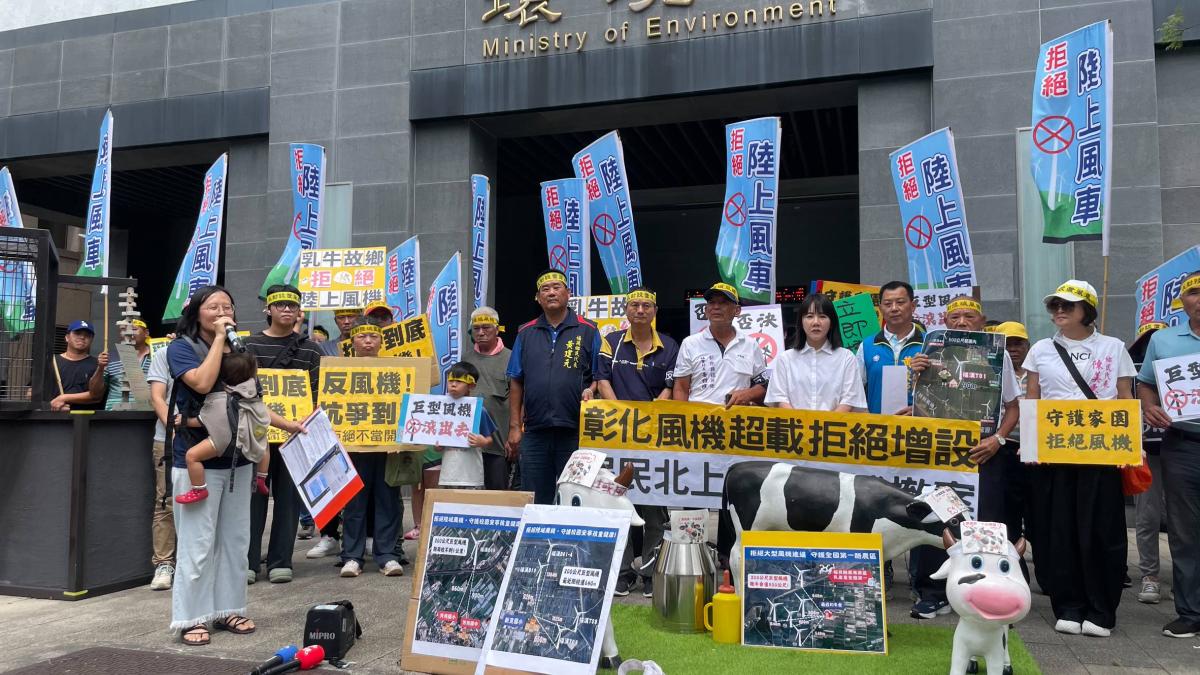
The 'Changhua Fu-Han Wind Power Project' plans to install 14 massive onshore wind turbines along coastal areas of Fuxing and Fangyuan Townships. The site has sparked major controversy—not only is it adjacent to Taiwan’s largest Fubao Dairy Farming Special Zone, but also near multiple elementary and secondary schools, homes, and aquaculture zones, some within 100 meters.
'I’m standing here to tell everyone: Would anyone agree if five wind turbines were suddenly built right outside your front door? This is bullying us,' said Dai Li-Fang, a dairy farmer, furious that developers misled and deceived residents by withholding turbine placement details. After she discovered the truth and alerted others, every dairy farmer signed a petition opposing the installation.
Fubao Township Representative Huang Jian-Yuan confirmed that during a local briefing two years ago, the developer promised not to proceed if residents objected. 'But what happened? They deceived us. They didn’t care about residents’ feelings. Despite knowing the significant impact on locals, they insisted on proceeding—and placed turbines so close. A company this untrustworthy must be resisted to the end.'
Other residents accused the developer of falsifying communication materials, claiming 'nine sites unused, seven opposed (four by one person).' One resident said: 'People live in our home, yet you label it as a construction shack.' Another questioned: 'Seven opposed, four by one person—that means only four people object? Among my relatives present today, four already oppose. How did you calculate this?'
Low-Frequency Noise and Shadow Flicker Make Life Unbearable for Humans and Animals
The claim that only two turbines (at 21m and 58m) cause minor low-frequency noise impacts, while other sensitive receptors beyond 80m experience none or negligible effects, has also been challenged. Wu Hui-Jun, director of Changhua Environmental Alliance, said: 'At such close proximity, how can simulations possibly show “no” or “minor” impact? Either the simulation is flawed, or the noise standards themselves are inadequate—this is utterly implausible.'
While simulations paint a rosy picture, real-life experiences are filled with suffering. Zhuang Chuan-Long’s clam farm already has four turbines within 500 meters. The noise disrupts his sleep, and mortality rates are higher in ponds closer to the turbines. The new project would place turbines just 90 meters away. 'Why don’t you ask developers to build elsewhere? Why take land from ordinary citizens?'
Huang De-Ren, chairman of Changhua County Herbivore Association, recently inspected operating turbines with a legislator and found audible noise even one kilometer away. 'To those of you here whose homes aren’t near turbines, passing by might be fine. But we live at our farms year-round, 365 days a year. Turbines hinder regional development and strangle the future of the dairy zone. We firmly oppose any intrusion of wind turbines into the Fubao Dairy Special Zone.'
Onshore Wind Development Must Be Halted Nationwide
Similar complaints arise in nearly every onshore wind project. For environmental assessment committee members, rejecting a proposal is extremely difficult—they’re tasked only with 'technical review,' and feel their duty fulfilled by merely advising against sensitive zones or adding monitoring measures. Despite these constraints, three Changhua onshore wind projects—including this one—have been rejected since last year, while others remain deadlocked.
Huang Chih-Pin emphasized it 'isn’t a technical issue' because 'no mitigation measure works.' Reviewing so-called 'impact reduction strategies' is now meaningless. The Ministry of Economic Affairs must take responsibility: either establish acceptable safety distances, or halt all new and repowering onshore wind projects. Green energy should improve the environment—not destroy ecosystems, landscapes, and peace for humans and animals—such projects cannot honestly be called 'green.'
*Author is an independent journalist.
FACT BOX
- Source: PR Times
- Category: News