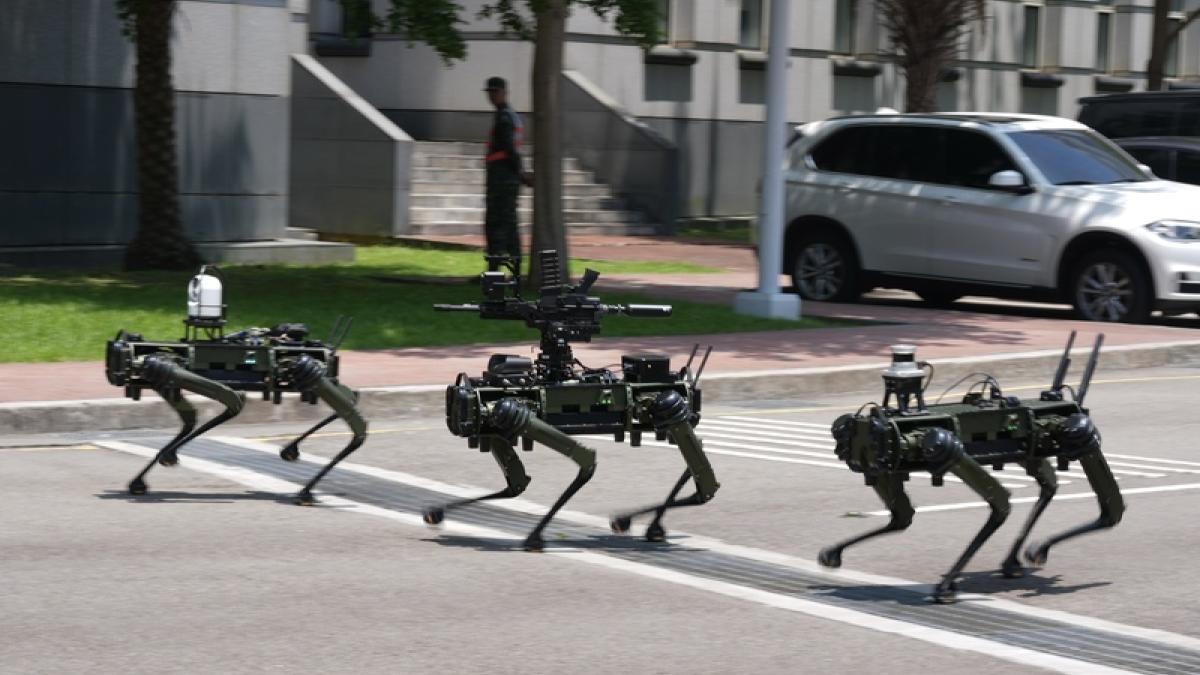
The US defense industry is accelerating the development of autonomous and semi-autonomous robot systems. US military leaders assess that such technologies will fundamentally transform the nature of future warfare. At the same time, China's People's Liberation Army (PLA) is widely believed to have made significant breakthroughs in military robotics and artificial intelligence (AI) integration, prompting a new arms race between the US and China in defense technology.
San Francisco-based robotics technology company Foundation Future Industries has revealed that it can equip its 'Phantom' humanoid robot with weapons and deploy it to the front lines upon request from the US Department of Defense. The company was co-founded in April 2024 by CEO Sankaet Pathak and retired US Marine Corps officer Mike Le Blanc, and has appointed Eric Trump, son of former US President Donald Trump, as Chief Advisor.
Foundation: Ready to Build 'Gun-Wielding Humanoid Robots' at Any Time
According to information disclosed by the company to the media, it has secured defense-related contracts totaling approximately $24 million (about NT$760 million), and will test the Phantom humanoid robot across multiple branches of the US military. It is also in talks with the US Department of Homeland Security to consider deploying the robot for patrol operations along the US-Mexico border. Pathak emphasized that the company can immediately build 'gun-wielding humanoid robots' upon directive from the Pentagon, arguing that armed robots can enable more precise tactical strikes while significantly reducing the risk of casualties among US military personnel. Betting on a future shift in Pentagon procurement policy, the company is currently seeking a new round of funding up to $500 million, with a valuation projected at $3 billion.
Beyond startups, major US defense industrial giants—including Anduril Industries, Shield AI, Raytheon Technologies (RTX), Lockheed Martin, General Dynamics, Northrop Grumman, and Ghost Robotics—are investing billions of dollars in developing unmanned ground vehicles, robotic sentries, AI-enabled drones, and various autonomous combat systems.
The US military's current operational strategy strongly emphasizes 'human-machine teaming.' Under this framework, robot platforms are responsible for tasks such as reconnaissance, logistics supply, mine clearance, and fire support, while final decisions involving the use of lethal force remain strictly under human command.
In technology demonstrations, Ghost Robotics has publicly showcased quadruped robots with high load-bearing capacity, capable of carrying sensors and various equipment. Anduril Industries focuses on AI-driven autonomous defense systems and advanced drone technology.
Pentagon Accelerates Procurement of Autonomous Technology
However, China's advancements in military robotics are also significant and cannot be overlooked. International military assessment agencies regard China as one of the global leaders in this field. The Chinese People's Liberation Army has repeatedly demonstrated infantry support robots, armed unmanned ground systems, logistics support robots, and coordinated drone 'swarm' combat drills. Chinese military strategic planners have repeatedly stated that AI and autonomous systems are the strategic core of future warfare, receiving massive financial and policy support from the Chinese government to achieve rapid technological iteration.
Defense analysts point out that Beijing has deeply integrated robotics technology, artificial intelligence, advanced communication networks, and vast manufacturing capacity, giving it a unique advantage in the 'mass production and rapid deployment' of military systems.
In response to China's military expansion, the Pentagon is accelerating the procurement of autonomous technologies, aiming to enhance battlefield awareness, expand the US military's strike range, and reduce personnel casualties through robotic systems. The Pentagon has expanded multiple rapid deployment programs, planning to produce and equip thousands of air, sea, and land unmanned systems with autonomous combat capabilities in the short term to maintain a critical technological edge over China.
The Next-Stage Global Arms Race
Despite rapid technological progress, military experts warn that fully autonomous 'robot soldiers' capable of independently selecting and attacking human targets remain highly controversial from ethical and legal perspectives. Under current US defense policy, even though AI is widely used in reconnaissance, navigation, logistics support, and target identification, any use of lethal force must ensure 'meaningful human judgment' is involved.
This competition surrounding AI and autonomous robots has been defined by numerous military strategy experts as the most critical global arms race of the next stage. Its impact will go far beyond the development of individual advanced weapons, fundamentally reshaping the operational forms and rules of future battlefields.
Editor: Hsu Yung-hsiang
More exclusive Focus News: ・US-China AI war escalates! China plans to restrict top-tier model exports; US Congress pushes RASA Act to block cloud access ・Iran air strikes Chinese company, at least one dead; Beijing: 'The deceased was not Chinese' ・Reports: Iran to purchase $60 million worth of shoulder-fired anti-aircraft missiles from China, to be shipped from Urumqi; China firmly denies
FACT BOX
- Source: PR Times
- Category: News
- Organizations: Foundation Future Industries / Anduril Industries / Shield AI