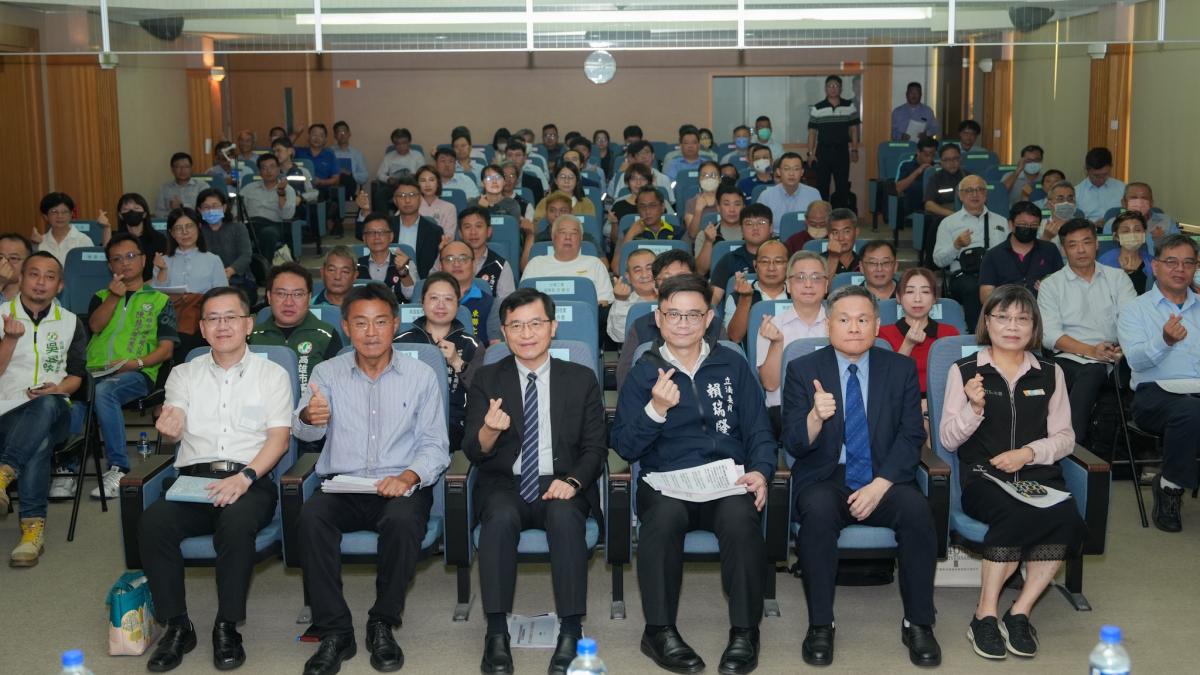
Legislator Lai Jui-long convened a roundtable today (3rd) with the Ministry of Economic Affairs, Ministry of Labor, and Kaohsiung City Government's Labor Bureau, alongside the Kaohsiung Petrochemical Industry General Union, industrial park enterprises, and representatives from traditional industries. The discussion focused on petrochemical industry development, labor protection, and industrial upgrading, during which Lai proposed four major strategies for 'high-value traditional industries.' He advocated integrating resources from government, businesses, and labor unions to form a 'Traditional Industries Upgrade Kaohsiung Team' to assist in transforming and upgrading Kaohsiung’s foundational industries.
Calling for collaboration among central and local governments and industrial unions, Lai emphasized strengthening labor protections while promoting cross-sector upgrades and local procurement. Industry and union representatives voiced concerns over challenges such as low-priced Chinese products flooding the market, rising energy and raw material costs, carbon fees, and pressures from net-zero transition. They also expressed worries about the ripple effects following Taiwan Benzene's announcement to halt operations at its Lin Yuan plant, urging the central government to provide more concrete support measures.
Lai stressed that Kaohsiung has long served as a backbone of Taiwan’s basic industrial sector, with the petrochemical industry being a key pillar driving manufacturing growth. He stated, 'If semiconductors are the sacred mountain protecting the nation, then all industries are the protective mountain ranges.' The technological expertise and capabilities accumulated by Kaohsiung’s traditional industries form a critical foundation for Taiwan’s industrial competitiveness. The government must assist in upgrading these industries rather than allowing them to decline.
Regarding the shutdown of Taiwan Benzene’s Lin Yuan plant, Lai emphasized that beyond legal compliance, companies should offer reassignment plans exceeding statutory requirements to properly protect the rights of middle-aged and retained workers. He urged the Ministry of Labor and Kaohsiung City Government to continue facilitating labor-management negotiations, understand employee needs, and coordinate with peer companies to prioritize job placement.
Lai also supported union proposals to reduce transition costs, establish early warning mechanisms for plant closures, strengthen labor safety nets, and promote high-value and green transformation of the petrochemical industry. He called on central ministries to develop concrete supporting measures to help industries respond to global competition and net-zero transitions.
Looking ahead, Lai noted that the central government is currently drafting the 'SME Transformation and Upgrading Development Act.' In the future, a project-based advisory model should be adopted, providing customized assistance based on the needs of different industries, promoting cross-sector collaboration, and driving the overall upgrade of industrial clusters.
Lai proposed four key strategies for 'high-value traditional industries': First, establishing an 'Industry Matching Platform' to connect demand from semiconductor, AI, defense, aerospace, and major infrastructure projects, helping traditional industries form teams to secure orders. Second, studying the establishment of a 'Kaohsiung Industrial Upgrade Fund' and professional advisory teams to assist enterprises in equipment renewal, automation, digital transformation, and new product development. Third, setting up an 'Advanced Materials and Smart Manufacturing Verification Center' to help enterprises integrate into international supply chains. Fourth, promoting a 'Local Procurement Mechanism for Major Investments' to foster collaboration between tech industries and local traditional industries in Kaohsiung, creating more orders and employment opportunities.
Deputy Minister Ho Chin-tsang of the Ministry of Economic Affairs stated that the ministry is planning an '8-year, NT$100 billion' industrial subsidy program. Through inter-ministerial cooperation, the program aims to expand its impact, establish direct communication channels between the Kaohsiung Industrial Advisory Team and various industry groups, assist enterprise transformation, and align with the Environmental Protection Administration’s incentives for net-zero transition.
Deputy Minister Lee Chien-hung of the Ministry of Labor said that in addition to launching a special assistance task force for the Taiwan Benzene case, a dedicated project team will be established for Kaohsiung’s petrochemical and steel industries. This team will proactively identify potential production cuts or plant closures, inventory job vacancies in related sectors, and strengthen employment security for workers.
The Kaohsiung City Government Labor Bureau stated it will conduct one-on-one outreach to the 147 employees of Taiwan Benzene’s Kaohsiung plant, offering voluntary severance counseling, vocational training, and job placement services to minimize the impact of the shutdown on workers’ families.
Lai concluded by emphasizing, 'We must boost industries while also protecting workers.' He pledged to continue integrating the efforts of central and local governments, enterprises, and labor unions to promote the high-value, intelligent, and sustainable development of Kaohsiung’s foundational industries—safeguarding both the city’s industrial foundation and the future of its workers and their families.
FACT BOX
- Source: PR Times
- Category: News