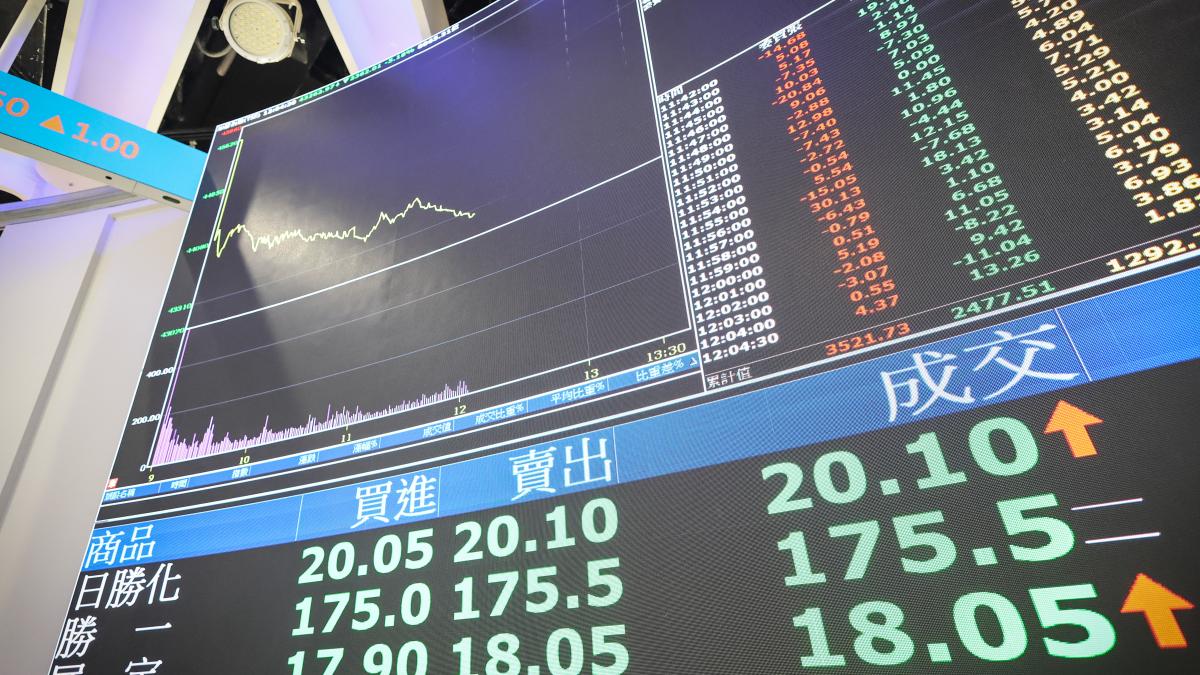
Taiwan's stock market has recently experienced extreme volatility. Last week’s sharp index plunge triggered widespread market panic, leaving many investors facing significant paper losses and even forced liquidations. However, the market rebounded strongly on Friday, and today (the 3rd), despite opening lower, it rose by 266 points.
In response, financial expert Ruan Mu-Hua asks: Why am I still focusing on monthly dividend payouts amid such turbulent trading? These past few days have been tough, and he knows many investors’ actively managed holdings are shrinking in value, causing them to question their original decisions.
Ruan states frankly: This kind of doubt isn’t necessarily bad—but you need to ask the right questions. "Are you doubting the fund manager’s stock-picking ability, or your own tolerance for volatility? From what I’ve seen, it’s usually the latter."
### Is a 15% Dividend Yield Downside Protection? Ruan: It Just Means the Price Fell
Ruan stresses a common misconception he feels compelled to correct: Some claim that a 15% or 17% dividend yield acts as downside protection—but this is incorrect. Dividend yield is calculated as dividend amount divided by share price. For 00929, the announced payout remains unchanged at NT$0.38. Yet the yield jumped from 15% to 17% solely because the share price dropped. "A high yield derived from a smaller denominator isn’t protection—it’s a result. Real downside protection comes from the fundamental strength and diversification of the underlying stocks, not from a mathematical formula."
### What Does 00929’s Diversification Look Like?
According to Ruan, after the June reshuffle—where TSMC and MediaTek were removed, along with United Microelectronics, previously its top holding—the current top ten holdings are: Novatek, Realtek, Catcher Technology, Synnex, ASUS, Rising Sun, Chunghwa Telecom,崇越, Quanta Computer, and Far EasTone. The highest allocation, Novatek, stands at just 3.38%. The top ten combined make up about 28%, with a total of 54 stocks spanning 18 industries, including all three major telecom operators.
What does this mean? Ruan analyzes: It means no single large-cap stock dominates the fund, limiting damage from any individual stock failure. However, it remains a tech-heavy portfolio, so sector-level risks persist. It performs well in bull markets but will also feel the pain during corrections. "So if you’re buying it because you’re afraid of volatility, let me be honest: it’s milder than ETFs concentrated on Taiwan’s ‘national fortress’ stocks, but it’s absolutely not a low-volatility product."
### Why Hold 00929 Despite Volatility? The Real Value of Monthly Payouts
Ruan clarifies: His reason for watching 00929 isn’t based on that alone. The true value of monthly dividends lies in reducing behavioral volatility. No matter how much the stock market falls, mortgage payments, utility bills, and internet fees still need to be paid. Having a steady monthly cash inflow doesn’t just make your account look better—it allows you to avoid being forced to sell stocks at a loss during market lows.
Ruan emphasizes: After years in this field, most long-term return erosion he’s observed didn’t stem from picking the wrong assets, but from the moment investors were “forced to sell.” What you’re really buying with a monthly dividend ETF is the ability to hold on.
Ruan notes that the dividend trend this year has indeed been upward: starting at NT$0.09, rising to 0.13, then 0.26, peaking at 0.38 in July—a new post-listing high—and maintained at that level this time. Performance has also been solid, delivering over 70% total return (including dividends) since last December’s major index overhaul, ranking first among high-dividend ETFs in the first half of the year.
But more important than the dividend itself, Ruan insists, is the “mechanism.” Since the revamp, semi-annual reviews now occur in June and December, while weight adjustments are fixed in February and August. The June review clearly shifted toward “income + defense,” adding telecom majors and a group of AI server supply chain stocks; the December review leaned more toward growth. This forces the portfolio to periodically refresh, preventing stagnation from holding losing positions. The trade-off is higher turnover costs from frequent trading. "You’re not buying specific stocks—you’re buying the rules."
### Three Key Reminders When Investing in High-Dividend Products
Finally, Ruan shares his three recurring reminders whenever discussing high-dividend investments:
First, dividend sources can include actual dividends, realized capital gains, or smoothing funds. A record-high payout doesn’t necessarily mean the underlying stocks’ earnings power has improved proportionally. Investors must examine the composition of the payout.
Second, dividend continuity is not guaranteed. Payouts naturally fluctuate and should not be treated as a fixed monthly entitlement.
Third, ex-dividend distributions merely convert part of the net asset value into cash returned to investors. Whether the price recovers (fills the gap) depends on future market performance. Large dividend recipients must also calculate dividend taxation and supplementary NHI premiums under the second-generation health insurance system.
Ruan stresses: Tools aren’t inherently good or bad—it’s about whether they match your needs. Clarify whether you’re seeking returns or cash flow, and the answer will become clear.
FACT BOX
- Source: PR Times
- Category: News