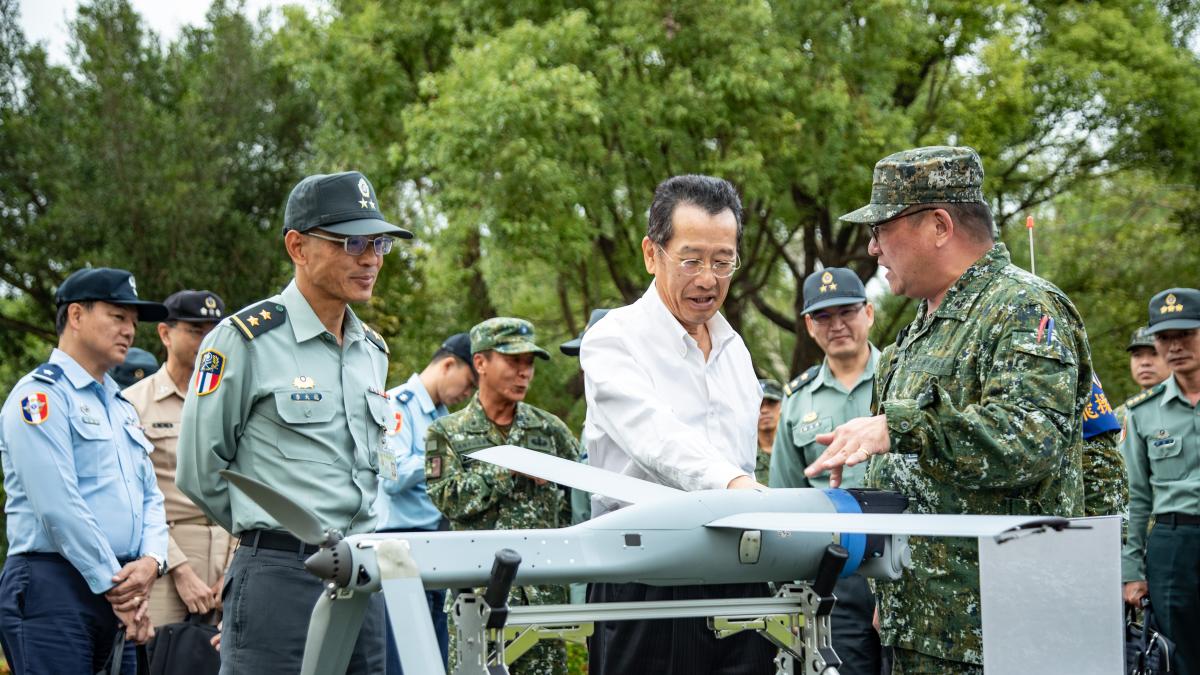
The Executive Yuan initially proposed a NT$1.25 trillion national defense special budget, but after cuts, the Legislative Yuan approved only NT$780 billion, with all funding for unmanned vehicles completely eliminated. The Executive Yuan quickly followed up by submitting a new special budget of NT$210 billion specifically for unmanned systems, while both the Kuomintang (KMT) and the Taiwan People's Party (TPP) have also submitted their own versions. All proposals are now under review in the Legislative Yuan, but amid ongoing political gridlock between ruling and opposition parties, no resolution has been reached—even the 2026 annual general budget remains unpassed.
Modern battlefields have evolved, making unmanned systems—such as drones, unmanned surface vessels, unmanned submarines, and robotic dogs—essential equipment. The Ministry of National Defense (MND) has kept pace with international trends, actively developing various unmanned platforms. However, given the current political climate, passing the NT$210 billion special budget poses significant challenges. What impact would failure to pass this budget have on Taiwan’s military strength? Defense Minister Ku Li-Hsiung is deeply concerned.
With battlefield dynamics shifting, unmanned systems have become indispensable. Pictured: an unmanned aerial vehicle squadron under the Guandu Command. (Photo credit: Chang Yao-Lin)
Rapid Wartime Consumption Requires Domestic Production Capacity
Recent conflicts—from the Russia-Ukraine war to U.S.-Iran tensions—have repeatedly demonstrated the critical role of unmanned systems. Taiwan’s National Chung-Shan Institute of Science and Technology (NCSIST) is currently co-developing the Chien Feng IV drone with Kratos, a major U.S. defense contractor, aiming to enter the global market. Despite strong industry momentum, budget approval remains extremely difficult due to political polarization.
Defense Minister Ku Li-Hsiung addressed media outlets, including Storm Media, clarifying misconceptions about the military’s unmanned development focus. He emphasized that public perception often centers on small-scale drones because of the high-profile NT$210 billion proposal, but in reality, this amount was originally part of the broader NT$1.25 trillion special budget dedicated to unmanned systems.
Ku explained that isolating NT$210 billion into a separate special budget underscores the government’s commitment to full domestic production. Specifically, coastal surveillance drones, coastal attack drones, and small suicide unmanned boats are expected to be heavily consumed during wartime operations. Drawing lessons from Ukraine, where such assets were rapidly depleted, Taiwan must establish sufficient domestic manufacturing capacity. By offering long-term military procurement contracts, the MND aims to incentivize local companies to invest in scalable supply chains while eliminating reliance on Chinese-linked suppliers (the so-called 'red supply chain').
Ukraine’s experience shows rapid consumption during war, necessitating robust domestic production. The military hopes long-term orders will encourage domestic manufacturers to scale up and exclude red supply chains. Shown: NCSIST's Chien Feng IV drone. (Photo credit: Liu Wei-Hung)
Counter-Drone Systems Already in Planning
On another front, Ku noted that the military has already initiated small-scale procurement programs. Beyond robotic dogs developed by NCSIST through domestic and international collaboration, many emerging technologies are being acquired incrementally. In addition to ground-based unmanned systems, small purchases include aerial, surface, stealthy resupply-capable unmanned boats, long-endurance surveillance vessels, and underwater unmanned vehicles. NCSIST is actively partnering globally, including acquiring next-generation counter-drone weapons via limited procurement. Ground-based unmanned systems have already been included in the fiscal year 2027 (116th year of ROC calendar) budget.
Beyond offensive drones, counter-drone systems have drawn increasing attention—and the military has corresponding plans. Ku stated that different threat levels require tiered responses. For example, portable soft-kill counter-drone systems are already in development and will be deployed across various unit levels, including battalion-level and below, primarily for self-defense purposes.
Counter-drone capabilities are now part of integrated air defense, but using Patriot missiles against drones is impractical. Currently mature methods include interceptors or gun turrets similar to 30mm chain guns. High-energy microwaves and lasers remain under research worldwide; even if lasers prove feasible, they demand substantial manpower.
NCSIST demonstrates a weaponized robotic dog. (Photo credit: Chang Yao-Lin)
If NT$210 Billion Becomes NT$40 Billion, Ku Fears Future Capabilities Will Be Capped
Although the military formulates budgets based on operational needs, final approval rests with the Legislative Yuan. What consequences would arise if the special budget fails? Ku clarified that the NT$210 billion proposal focuses on domestically produced coastal surveillance and attack drones, as well as suicide unmanned boats. However, other projects—including Qiang Gong missiles, Rui Yuan drones, ammunition production, and TAK kits—are still under Executive Yuan review. "We will definitely have supplementary budgets, and next year’s budget will grow," he said, emphasizing that overall defense spending will continue rising in line with operational demands.
Currently, the Executive Yuan, KMT, and TPP versions of the Unmanned Vehicle Procurement Special Act are all under legislative review. Notably, the KMT version designates the Ministry of Economic Affairs as the lead agency—a point of contention, as the military insists it should fall under the MND. Ku admitted he strongly hopes the NT$210 billion budget passes, but warned: "I truly hope we don’t end up with legislation capping all unmanned systems at NT$40 billion. Such a limit would severely restrict the military’s future possibilities."
Partisan clash over the Executive Yuan’s unmanned vehicle procurement bill. (Photo credit: Central News Agency)
Brave on Battlefield, Powerless in Legislature
Ku stressed that the proposed NT$40 billion cap covers all domains—air, sea, land, and underwater—as well as test sites and industrial support. At that level, funding would likely be insufficient. Such rigid constraints could even hinder acquisition of advanced systems like the MQ-9B. With unmanned technology advancing rapidly, locking it into a fixed annual budget risks stifling innovation. While continued dialogue with the legislature is needed, Ku stated clearly: "If the Executive Yuan version doesn't pass, we’ll have to absorb it into the annual budget—but we absolutely cannot accept legislation that caps all unmanned systems at NT$40 billion."
The Legislative Yuan holds a knife to the MND’s throat—life or death hinges on a single decision. Yet as nations worldwide accelerate unmanned system development and combat proves their effectiveness, Taiwan—facing imminent security threats—moves slowly on critical defense funding. Even foreigners find it baffling. The political karma of partisan conflict appears to burden the MND, but in truth, Taiwan’s entire combat capability is at stake. While the military can fight bravely on the battlefield, in the legislative chamber, it can only cry out in frustration.
FACT BOX
- Source: PR Times
- Category: News
- Organizations: Kratos