This August marks 81 years since the end of World War II. According to statistics from Japan's Ministry of Health (equivalent to Taiwan's Ministry of Health and Welfare), approximately 200,000 Taiwanese were mobilized as Japanese soldiers or military personnel during the war, out of a population of about 6 million—meaning one in every 30 Taiwanese was sent overseas. Of these, around 30,000 died or went missing, while the remaining 170,000 returned home.
However, due to political changes, social upheaval, and decades of martial law after the war, the experiences of these 200,000 individuals who witnessed the Pacific front firsthand remained largely unknown until the past 10–20 years. Especially in the last five years, related films and TV series such as the miniseries 'Listening to the Sea Roar' and the documentary 'From Island to Island' have significantly raised public awareness of this forgotten chapter of Taiwan's WWII history.
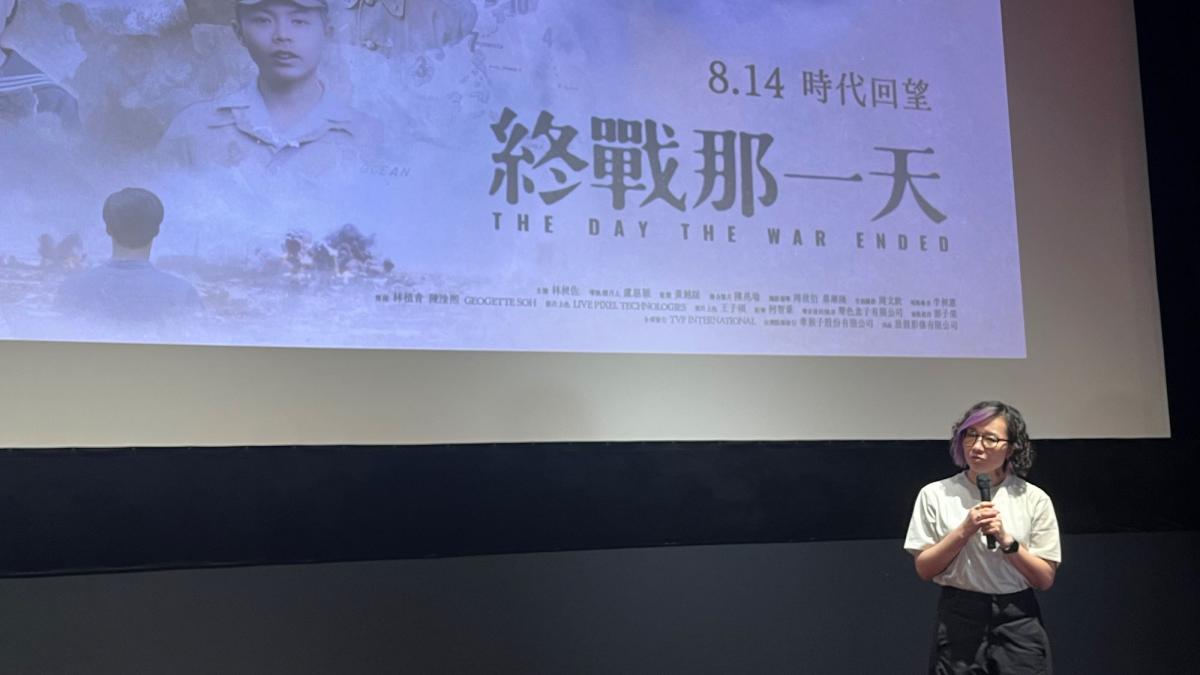
Directed by Lu Tzu-ying and seven years in the making, the documentary 'End of War That Day' is scheduled for release this month. It aims to preserve the stories of six elderly Taiwanese men and women who lived through the Pacific War, allowing younger generations to understand their grandparents’ wartime experiences.
In the 1940s, as Japan became increasingly entangled in the Pacific War, demand for manpower surged—not only on the front lines but also in rear military facilities. With Japan's domestic labor supply tightening, Taiwan became an ideal source of supplementary personnel.
Among the 200,000 Taiwanese soldiers and civilian staff, some were recruited as teenage technicians at naval aircraft factories in Yokohama; others witnessed the devastating aftermath of the atomic bombing of Nagasaki. Some served as nurses in Japanese hospitals in Hong Kong and Guangdong, while others, originally assigned to Singapore, were unexpectedly deployed to the front lines in Myanmar.
Today, few members of Taiwan’s WWII generation remain. The photo shows 96-year-old Tung Chun-hsien, who worked as a teenage technician at the Imperial Japanese Navy aircraft factory in Yokohama during the war. (Photo by Liu Huan-yen)
The origins of 'End of War That Day' trace back to 2015, when the National Taiwan Historical Museum in Tainan held a special exhibition titled 'Taiwanese People Under Wartime.' As part of the exhibition, a year-long reading group called 'That Day in History' was organized to collect personal memories of WWII.
After the exhibition, Su Shuo-pin, then director of the National Taiwan Literature Museum, suggested collaborating with the museum to transform the collected written materials into narrative form using nonfiction writing techniques by graduate students from National Taiwan University’s Department of Taiwanese Literature. The result was the 2017 publication of the book 'End of War That Day: Stories of Taiwan’s Wartime Generation' by Wei Cheng Publishing.
The book presents diverse perspectives—from frontline combatants to those in the rear and periphery—through the real-life experiences of nine individuals, illustrating the confusion and hardship faced by Taiwanese people at this historical turning point.
Of the six elderly interviewees featured in the film, the oldest living person is 104 years old. Director Lu recalled that when she read the book in 2019, she decided to adapt it into a film. 'By the time we decided to make it, very few people were still available for interviews. Mr. Tung Chun-hsien, the youngest among them, was born in 1930—already 90 years old when we interviewed him in 2020. The oldest is Yang Fu-cheng, who just turned 104. He’s in excellent health,' she said.
She added that all interviews were completed by 2021. While the team hoped the elders could share more, most were physically unable to speak at length. After careful consideration, they decided to use archival footage to supplement the narrative.
However, sourcing WWII-era archival footage proved another major challenge. While such material is readily available in the U.S. and Europe, most focus on Western events, with little coverage of Asia. Moreover, over 95% of the footage is black-and-white and silent—posing a significant barrier to engaging modern audiences.
'If we could recover footage related to Taiwan, it would help people visualize this era more concretely and reconnect the stories of those who fought in WWII, helping today’s viewers understand the difficult decisions they made and the hardships they endured. We believe this is the best way to foster empathy among modern audiences,' said Lu.
The production team spent three full years gathering archival footage from the U.S., Europe, and Japan—especially material related to Taiwan and the Pacific theater—followed by another year restoring and colorizing the black-and-white footage using AI.
This approach of using modern technology to restore wartime footage has precedent in the West. Peter Jackson, the New Zealand director famous for 'The Lord of the Rings,' led a team of over 400 people for 18 months to transform over 2,200 hours of original WWI footage and 600 hours of audio archives from the Imperial War Museum (IWM) into the 99-minute color documentary 'They Shall Not Grow Old' (2018), commemorating the millions who died in WWI.
The production team of 'End of War That Day' states in its promotional copy: 'The life stories of Taiwan’s grandfathers and grandmothers are not silent black-and-white images—they should not be buried under the dust of history.' The film 'breathes new life into historical footage through colorization and sound design, guiding viewers to experience Taiwan a century ago and return to that day once more.'
FACT BOX
- Source: PR Times
- Category: Event