When a Russian assault unit approached Ukrainian frontline positions in eastern Donetsk, they were met not by traditional soldiers, but by a combat robot equipped with a flamethrower. As Russian troops attempted to set up camp near a forest, the robot ignited the surrounding dry grass into a blazing inferno, followed by a machine gun-armed robotic squad moving in to eliminate the attackers.
The chief engineer of Ukraine’s 93rd Independent Mechanized Brigade, codenamed 'Magician,' told Bloomberg that the above scene was an actual combat event that occurred on the Dobropillia front line. Such scenarios are now becoming a common reality as Ukraine rapidly expands its fleet of unmanned ground vehicles (UGVs) in active combat zones.
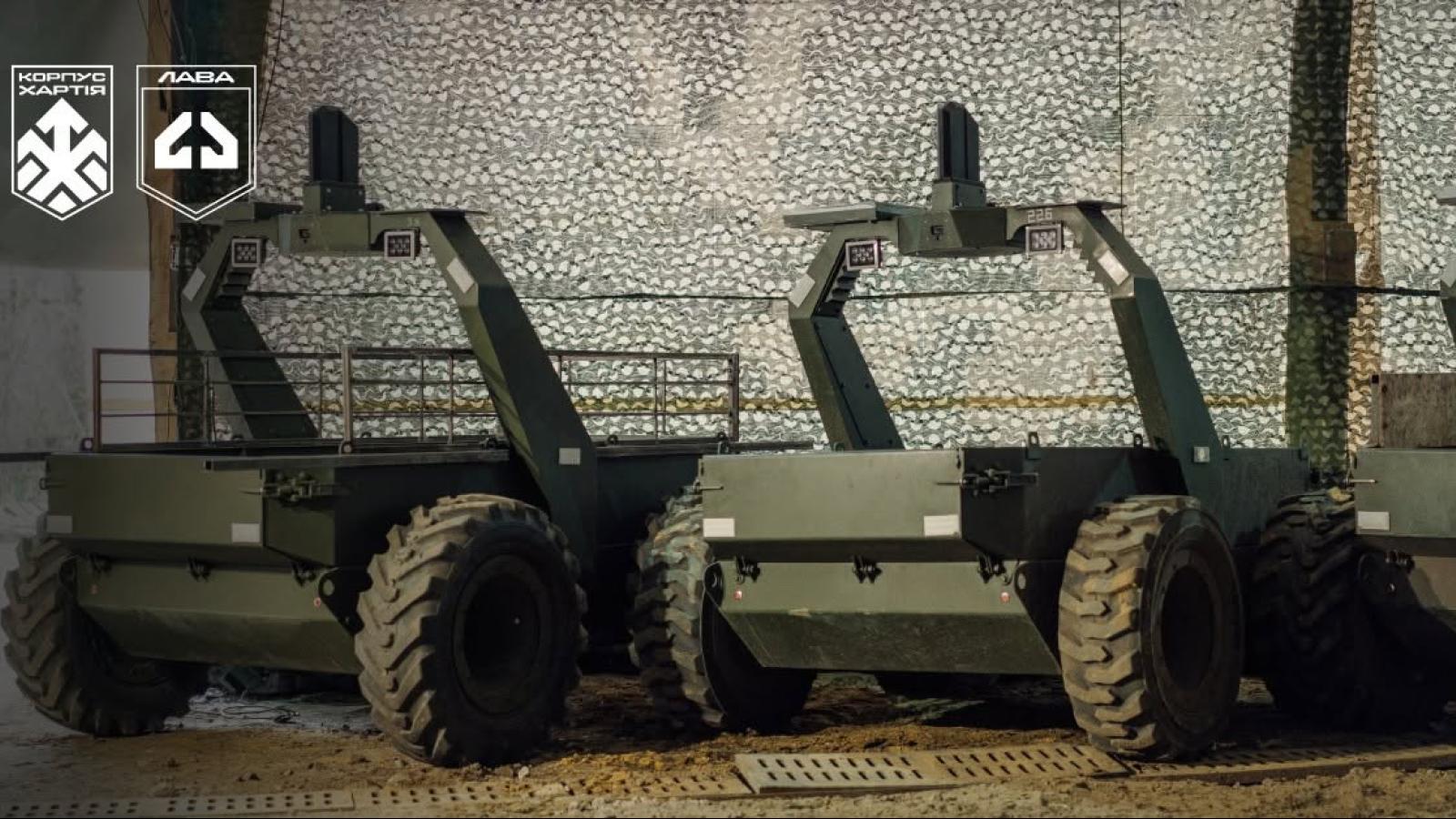
The Kyiv government has set a clear target: to domestically produce at least 50,000 UGVs by the end of 2026 and deploy them on the battlefield. These robots are equipped with various weapons, including rifles, flamethrowers, and grenade launchers (RPGs), and are designed to support frontline troops in countering invaders.
Ukrainian President Volodymyr Zelenskyy stated that it is now impossible to imagine defense without drones, and the same applies to unmanned ground vehicles. These robots are rapidly expanding their roles—from frontline logistics and casualty evacuation to direct combat missions.
Ukrainian soldiers remotely operating unmanned vehicles on missions. (AP)
In addition to land operations in the east, Ukrainian forces have achieved a world-first: 'cross-sea coordinated unmanned operations.' In July, Ukraine’s 123rd Independent Territorial Defense Brigade used an unmanned speedboat to transport a 'Wolly 7.62' remote-controlled combat robot—costing only $8,000 (approximately NT$260,000)—to an area 11 kilometers away, occupied by Russian forces. Upon arrival, the robot unleashed heavy machine gun fire on Russian positions, forcing enemy troops to retreat from parts of the coastline. After completing its mission, the robot self-destructed, denying the enemy the chance to capture and dissect it.
One Ukrainian soldier joked, 'We’re already using drones in many areas—it’s like the classic Hollywood movie Terminator.'
The 25-Kilometer 'Death Zone'
For Ukraine, which faces resistance to mobilization and must maintain an army of 900,000 troops, automation and unmanned vehicles are critical to filling manpower gaps and reducing soldier casualties. According to government statistics, around 2 million people are currently wanted by police for violating Ukraine’s conscription laws.
Robert Brovdi, commander of Ukraine’s Unmanned Systems Forces, said in an interview that the area within approximately 25 kilometers of the contact line has effectively become a 'death zone.' This region is saturated with high-density drones, and due to the extremely high risk to frontline personnel, large numbers of drones and UGVs are now replacing human soldiers to minimize Ukrainian military losses.
Mykhailo Drapatyi, Ukraine’s newly appointed Armed Forces Commander-in-Chief, has taken the same strong stance as his predecessor: leveraging Ukraine’s existing drone and robotics technology advantages to gradually regain strategic initiative in what is Europe’s largest military conflict since World War II.
US and Europe Invest Heavily and Learn from Ukraine’s Unmanned Systems
While Russia is also rapidly improving its own systems and has even acquired Iran’s Shahed drones, Ukraine’s pace of innovation in unmanned tactics has drawn far greater global attention. Western nations are not only providing financial aid but are also eager to learn from Ukraine’s real-world combat experience to enhance their own military capabilities.
As Ukraine signs drone production cooperation agreements with countries like Saudi Arabia and the Netherlands, and continues to strengthen its defense partnership with the United States, Kyiv is transforming its domestic unmanned vehicle manufacturing capacity into a core role within Europe’s overall security architecture. Local manufacturers such as Ratel Robotics and Tencore, which began as small workshops, have now scaled up to factories capable of producing thousands of units. These unmanned vehicles support frontline operations in logistics, mine-laying, and enemy clearance, continuously redefining the nature of modern warfare.
FACT BOX
- Source: PR Times
- Category: News
- Organizations: Ratel Robotics / Tencore
- Products / services: Wolly 7.62