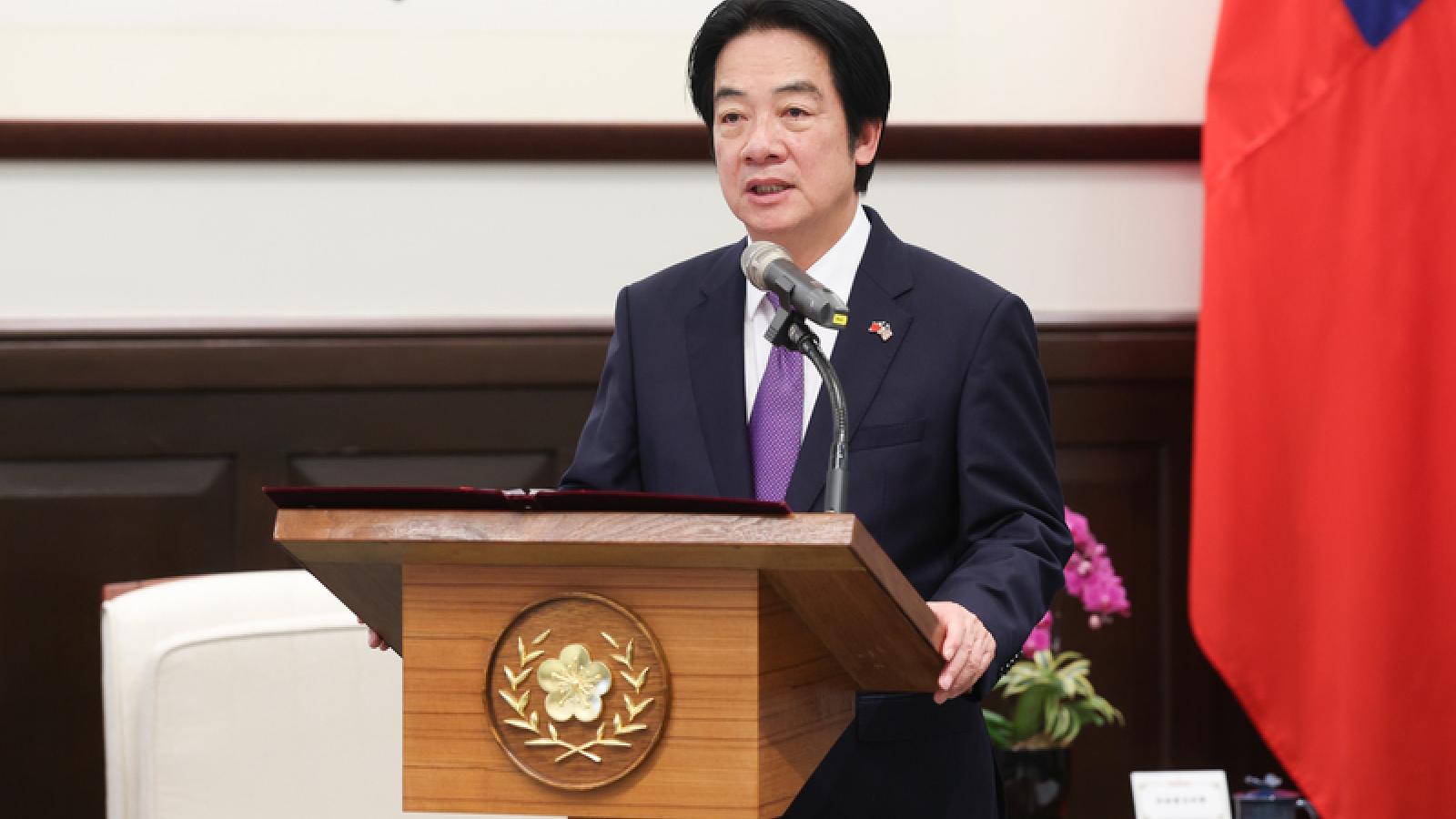
President Lai Qingde recently criticized the Legislative Yuan for failing to pass the central government’s budget and the 'Unmanned Vehicle Development Act,' stating during a meeting with SME representatives: 'Having served four terms as a legislator, I have never seen a Legislative Yuan like this.' Yet the public might well ask in return: Have we ever seen a president like this?
The Republic of China has operated under its constitution for nearly 80 years. We have seen ruling parties with minority seats and those with majorities; we have witnessed the Executive Yuan filing veto appeals, and the Legislative Yuan rejecting them; we have observed intense partisan conflicts and peaceful transitions of power. But never before has a president, within just two years in office, engaged in so many actions that destabilize constitutional order and subvert constitutional governance.
When the terms of Grand Justices expired, the president refused to make new nominations after biased candidates were rejected by the Legislative Yuan, violating constitutional loyalty and paralyzing the Constitutional Court. After the Prosecutor-General nominee was rejected, the president still appointed the rejected candidate as acting head, creating a constitutional controversy that undermines the legislature’s power of consent. While publicly advocating for abolishing the Control Yuan, the president simultaneously submitted a full list of Control Yuan nominees—revealing a glaring contradiction.
Moreover, the Executive Yuan, under presidential direction, has repeatedly refused to co-sign laws passed by the Legislative Yuan, delayed promulgation, filed constitutional interpretations to avoid enforcement, and obstructed implementation. The president himself was even impeached through constitutional procedures by the Legislative Yuan. These actions force the public to ask: Is the real problem the Legislative Yuan—or President Lai’s constitutional ignorance and reckless exercise of power?
The issue is not whether the president can criticize the legislature, but whether the president is willing to accept constitutional checks.
The Executive Yuan’s recent response to the 'Taiwan Children and Youth Growth and Future Account Act,' passed by the Legislative Yuan, further highlights this constitutional crisis. If the Executive Yuan believes a law is unworkable, the Additional Articles of the Constitution already provide a veto mechanism. If a veto fails to gain legislative support, the law must be promulgated and faithfully executed. Until a law is ruled unconstitutional, administrative agencies have a duty to enforce it. Otherwise, the executive could simply refuse to co-sign, execute, budget, or implement any law it dislikes—rendering the legislature’s lawmaking power meaningless and destroying the principles of rule of law and responsible government.
Historically, the core purpose of separation of powers is to check executive authority. Western tripartite systems were established precisely to constrain monarchical power. Locke and Montesquieu divided sovereign power into legislative, executive, and judicial branches, with the legislature and judiciary jointly checking the executive—especially the power over military, police, intelligence, bureaucracy, fiscal resources, and state authority.
Dr. Sun Yat-sen’s Five-Power Constitution further developed this idea. He believed that if examination and control powers remained under the executive, they would be subject to executive and party control. Thus, he established independent Examination and Control Yuan to check the Executive Yuan. Crucially, in the Five-Power system, the Executive Yuan itself also checks presidential power.
Article 37 establishes the co-signature system. Article 58 requires that bills, budgets, martial law, amnesty, declarations of war, peace treaties, international agreements, and other major matters must be decided by Executive Yuan meetings. Article 57 states that the Executive Yuan is accountable to the Legislative Yuan. The Executive Yuan is not a subordinate of the president but a constitutional mechanism designed to check presidential power. Subsequent constitutional amendments reinforce this principle.
The Additional Articles specify that only presidential appointments of the Premier, personnel requiring legislative consent, and dissolution of the Legislative Yuan are exempt from co-signature. All other presidential orders require the Premier’s co-signature—clearly indicating that co-signature exists to constrain the president. Even emergency orders must first be approved by an Executive Yuan meeting and then retroactively approved by the Legislative Yuan. If the legislature rejects it, the order immediately becomes void. Furthermore, appointments to key constitutional offices—Grand Justices, Control Yuan members, Examination Yuan members—require legislative consent.
Thus, nearly all of the president’s major constitutional powers require co-signature by the Premier, Executive Yuan meeting approval, or legislative consent and retroactive approval. The ROC Constitution never envisioned an unchecked president, but rather a layered, five-power system of mutual checks on presidential authority.
Therefore, before President Lai says, 'I’ve never seen such a Legislative Yuan,' he should first ask himself: Do I truly respect the legislature’s lawmaking, budgetary, and personnel powers? Do I uphold the rule of law? Do I respect the Executive Yuan’s responsibility to the legislature? Do I respect the independence of the judiciary, control, and examination powers? Do I accept that all five branches are meant to check me—not serve me—lest I become a constitutional monster uniting all five powers and endangering the people?
The people grant authority to government; the constitution divides power to limit it; responsible government holds it accountable. Western tripartite systems check monarchical executive power; the ROC’s Five-Power Constitution checks presidential executive power. Though the forms differ, the constitutional spirit is the same: to prevent concentration of power and protect people’s rights to life, liberty, equality, and dignity.
Thus, the real question for the nation is not 'Have we seen such a Legislative Yuan?' but 'Have we ever seen such a president?'
The true value of the Five-Power Constitution lies not in five co-equal branches, but in the collective check on presidential power—through legislation, judiciary, examination, control, co-signature, Executive Yuan meetings, and responsible government—ensuring that whoever holds supreme executive power remains loyal to the constitution, obeys the law, submits to legislative oversight, and answers to the people.
President Lai says he’s never seen such a Legislative Yuan in 40 years of public service. Perhaps the people can say: In nearly 80 years of constitutional governance, we’ve never seen such a president.
*Author: Retired university professor, advocate of 'Clinical Constitutionalism.'
FACT BOX
- Source: PR Times
- Category: News