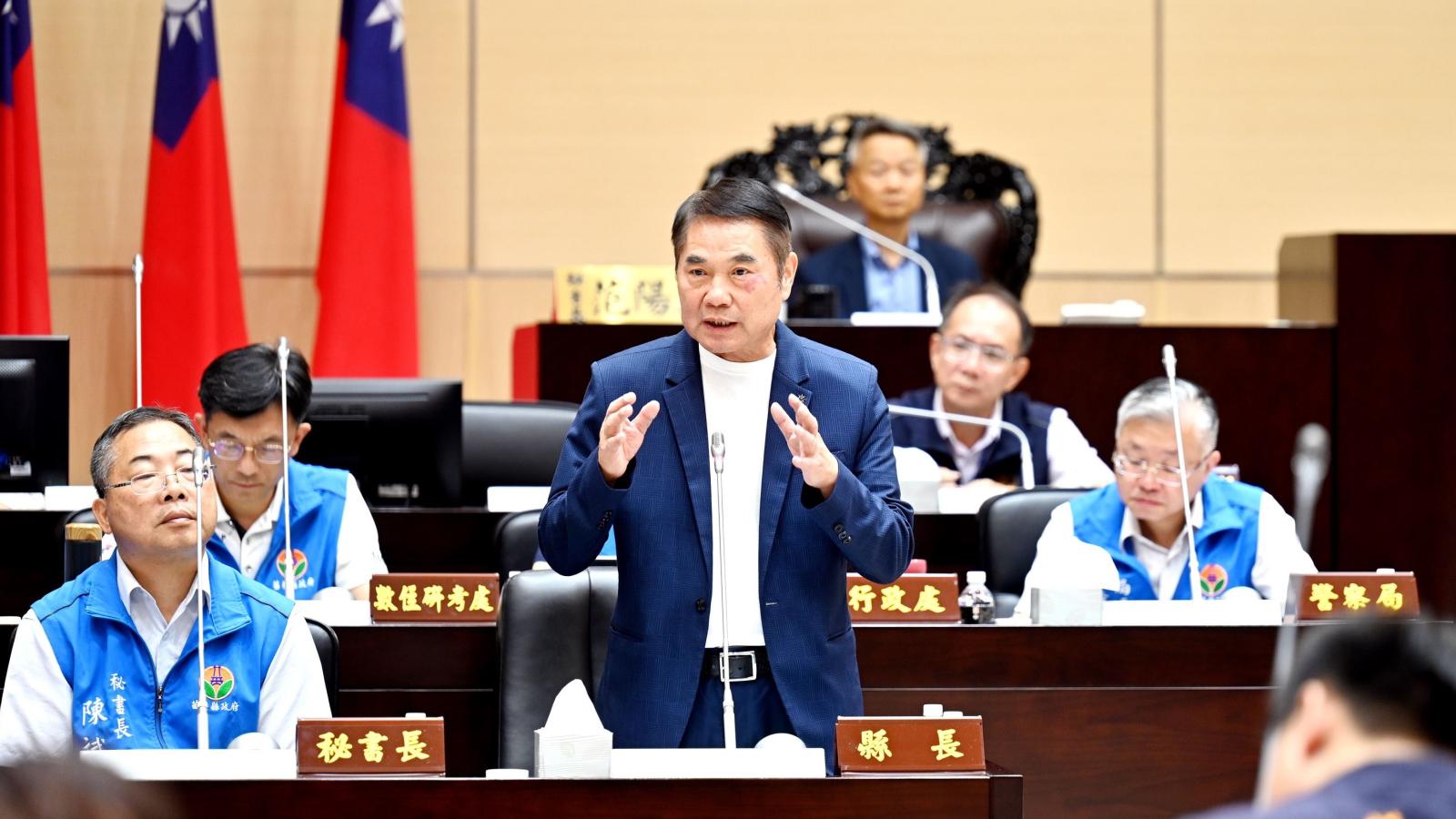
The Miaoli County Council convened its 21st and 22nd extraordinary sessions of the 20th term today (4th). Yang Li-fen, Audit Officer and Director of the Miaoli County Audit Office under the Directorate General of Budget, Accounting and Statistics, delivered the audit report on Miaoli County’s 2025 (FY114) consolidated final accounts, affiliated unit accounts, and summary statements. The report revealed that from 2018 (FY107) to 2025 (FY114), Miaoli County has cumulatively repaid over NT$5.9 billion in debt, with over NT$2.1 billion repaid in FY114 alone—the highest in its history. As of now, the county’s outstanding public debt stands at NT$32.623 billion.
According to the county’s Department of Budget, Accounting and Statistics, the audited revenue for FY114 totaled over NT$33.579 billion, while expenditures reached NT$32.578 billion, resulting in a budget surplus of NT$1.001 billion. Regarding public debt, FY114 saw NT$8.153 billion in new borrowings and over NT$9.184 billion in repayments, with principal repayments amounting to NT$1.031 billion.
The department explained that since FY105 (2016), Miaoli County has actively promoted fiscal discipline and expenditure reduction. For ten consecutive years—from FY105 to FY114—the county has maintained a budget surplus annually, consistently retaining surpluses in the tens of billions of NT dollars. In FY113 (2023), the surplus reached a high of over NT$2.078 billion, while FY114 recorded a surplus of NT$1.001 billion, demonstrating that despite active governance, the county’s overall fiscal condition remains healthy and stable.
On public debt, Miaoli County has also been diligently managing and repaying obligations in recent years. By the end of FY114, the debt balance had decreased by over NT$213.147 million compared to the previous year (FY113). The principal repayment for FY114 was finalized at over NT$1.031 billion, exceeding the originally budgeted NT$230 million by NT$801 million—an indication of the county’s firm commitment to reducing its debt burden.
Councilors Yu Yao-dong, Cheng Pi-yu, and Hsu Ying-ping expressed concerns about the low utilization efficiency of the senior citizen cards. They suggested that the monthly subsidy of 200 points for taxi rides and 100 points for shopping at farmers’ associations should be combinable, allowing seniors greater flexibility and improving card usage. In response, Magistrate Chung Dong-jin stated that the county is currently adjusting the system to allow seniors to freely allocate their points between taxi rides and farmers’ association purchases, while maintaining the current limit of 100 points per transaction. This change aims to encourage seniors to go out more and boost business at local farmers’ associations.
Magistrate Chung noted that the county government has practiced strict frugality in recent years. In addition to reducing debt by over NT$2.1 billion in FY114, the county is currently auctioning two plots of industrial land within the High-Speed Rail (HSR) Special Zone. If successfully sold for an estimated NT$5–6 billion, these funds will be used to further reduce debt and lower the total liability. Chung emphasized that the county team will remain cautious and continue saving public funds to accelerate debt repayment.
Chung acknowledged that while debt repayment is crucial—and the central government also urges faster repayment—he believes certain social welfare expenditures must still be implemented, especially as local tax revenues increase. He also expressed gratitude to several councilors for their suggestions regarding the senior card program.
Additionally, Road 301 in Luhu Village, Nanzhuang Township, frequently suffers from landslides. Although farmers grow sweet persimmons along the route, the road has been severely damaged for years and is no longer repairable. Chung said he will work closely with the persimmon farmers to relocate cultivation to the Luchang area, offering one-time compensation and harvest assistance for this season. This approach avoids costly road repairs and allows the forest ecosystem to recover, which he believes is the best method for soil and water conservation.
FACT BOX
- Source: PR Times
- Category: News