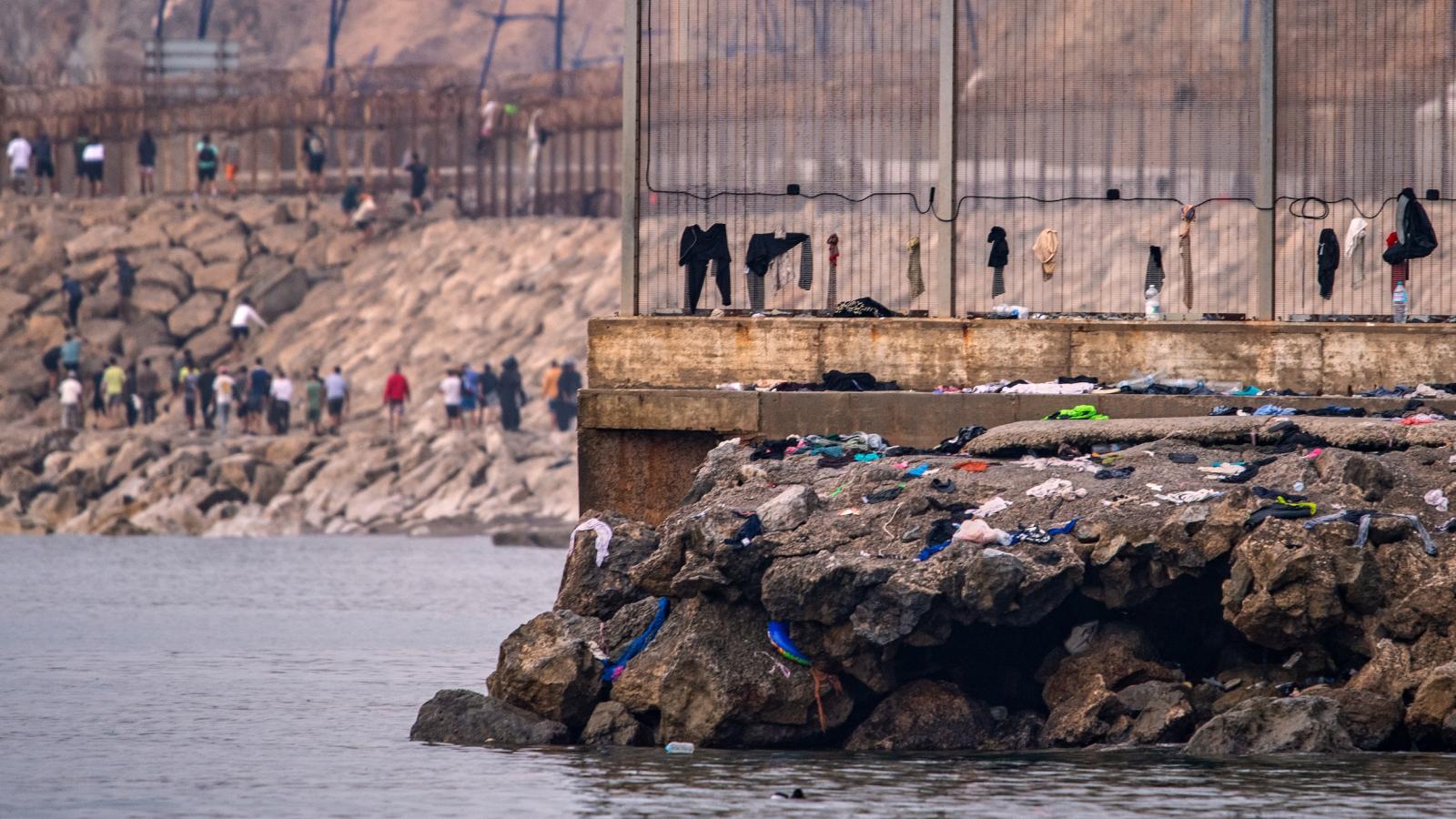
Waves crash against the breakwater of Ceuta, Spain’s North African enclave, as a 17-year-old girl from Tangier, Morocco, struggles to reach shore. Her 8-year-old brother drowned in the Mediterranean, and her mother vanished in the chaos of tens of thousands storming the border. The image of Spanish police retrieving her brother’s body from the sea has become the most brutal symbol of this European border crisis. “I saw people stepping over bodies to move forward,” the unnamed girl told the Associated Press (AP) through a translator. Her family attempted to swim across the border fence last Thursday (July 30) in search of survival. Now, she is one of hundreds of children stranded on Ceuta’s streets, begging for food. When she sought help at a government-run youth center, she was told, “There are no available spots.”
According to AP and The Guardian, over the past few days, approximately 70,000 people have attempted to cross from Morocco into Spain’s enclave of Ceuta. Although around 70,000 have since returned to Morocco through cooperation between Spain and Morocco, an estimated 3,000 to 5,000 remain stranded.
On August 1, 2026, a group of underage migrants returned from Ceuta to Morocco. (AP)
Juan Jesús Vivas, Ceuta’s autonomous city leader, confirmed in media interviews that the enclave’s two reception centers have completely “collapsed and paralyzed.” Ceuta official Alberto Gaitán stated that authorities are currently processing 862 unaccompanied migrant minors, who under Spanish law are granted special protection from immediate deportation.
Four days after the border crisis erupted, the death toll continues to rise. Citing Spanish Interior Ministry data, Reuters and AP report that Spanish authorities have confirmed 72 deaths—mostly by drowning—while Morocco has confirmed 11. The Guardian, referencing Ceuta’s local government statistics, states the number of deaths upon arrival has reached as high as 88.
On August 3, 2026, migrants who crossed from Morocco into Spain queued for food on a beach in Ceuta. (AP)
Deportation of 12-Year-Old Boy Sparks Outcry
On El Trampolín beach in Ceuta, hundreds of undocumented migrants—mostly from sub-Saharan Africa—huddle under towels to shield themselves from the wind, sleeping on the sand. Behind them, Spanish military and police patrol vehicles circle. In addition to Moroccans, the stranded include Sudanese fleeing war, Palestinians from Gaza, Afghans, and people from various African nations.
Spanish law mandates that adult undocumented migrants whose asylum applications are rejected face deportation. However, unaccompanied minors are legally entitled to protection and care.
On July 31, 2026, a large group of migrants entered Ceuta from Morocco. (AP)
AP journalists witnessed a Spanish soldier escorting a 12-year-old Moroccan boy who was crying and pleading not to be sent back to Morocco. Just meters from the border, local residents and reporters shouted that the child was a minor. A Spanish Army lieutenant colonel intervened, halting the deportation and transferring the boy to the National Guard.
Ramsés Mohamed Azumik, an activist with Ceuta’s migrant rights group Asociación Elín, told AP: “The authorities’ current strategy is to use hunger, thirst, and exhaustion to force these people to voluntarily return to Morocco.”
On August 3, 2026, a 12-year-old unaccompanied undocumented migrant from Ceuta was about to enter Morocco, begging not to be deported. After locals and journalists pointed out he was a minor, an official stopped the forced deportation. (AP)
Meloni Mobilizes 22 Nations, Sánchez Denounces 'Bias and Fake News'
The border chaos in Ceuta is not just Spain’s crisis—it has rapidly escalated into a political storm across Europe, triggering fierce disagreements among EU member states over border policy. The Guardian reports that Italian Prime Minister Giorgia Meloni and the Danish government spearheaded a joint letter signed by 22 EU leaders, directly criticizing Spanish Prime Minister Pedro Sánchez’s immigration policies.
The letter claims Spain’s plan to legalize up to 500,000 undocumented immigrants in 2026 creates a serious “pull factor.” The 22 nations demand stricter EU crackdowns on illegal migration, with Italy and Denmark even advocating for Spain’s temporary exclusion from the Schengen Zone. EU interior ministers are scheduled to hold an emergency video conference on Tuesday to seek consensus amid the enclave crisis.
Italian Prime Minister Giorgia Meloni. (Central News Agency)
Spanish Prime Minister Pedro Sánchez fired back, accusing these European allies of acting out of “bias, fake news, ignorance, or political interest,” violating EU law and humanitarian principles. Spanish Foreign Minister José Manuel Albares publicly criticized the Italian government for spreading misinformation, emphasizing that Spain had supported other EU nations during past migration crises and now expects reciprocal support.
Michele LeVoy of the undocumented migrant rights group PICUM analyzed that academic research has never shown legalization increases illegal migration. The strong backlash from EU nations stems from fears of “secondary movement,” where migrants enter via Spain and then move onward into other EU countries. “What’s happening in Ceuta is using migrants’ lives as political bargaining chips,” she said.
Despite deep political divisions, European Commission President Ursula von der Leyen sent a letter to Sánchez on August 3, praising Spain for quickly restoring order. However, she emphasized, “We must further strengthen the EU’s external borders at key locations, including vigilant monitoring and, where necessary, physical barriers.” Spain has already begun installing a 500-meter floating sea fence along its border with Morocco.
On August 3, 2026, migrants who crossed from Morocco into Spain queued for food on a beach in Ceuta. (AP)
Morocco’s ‘Opening the Floodgates’ Allegations and Spain’s Cabinet Infighting
Beyond the EU’s immigration policy debate, Morocco’s role in this crisis has raised serious suspicions.
Spain’s El País, citing informed officials, reported that Spain’s National Intelligence Center (CNI) concluded Morocco did not premeditate the border storming but adopted a permissive stance that worsened the crisis. The report states Morocco’s border controls gradually loosened throughout July and were almost entirely removed during Morocco’s “Throne Day” holiday at the Tarajal crossing.
Ceuta’s leader Vivas, in an interview with El País, harshly condemned the Moroccan government: “Morocco has proven itself unreliable. We have no choice but to take all necessary measures to ensure it cannot do this again.”
Morocco’s Interior Ministry issued a statement in response, blaming the migrant surge on social media misinformation, human trafficking networks, and misinterpretation of a Spanish court ruling that prohibits immediate maritime deportations. It emphasized Morocco’s commitment to combating illegal migration and human trafficking.
The crisis has also exposed internal tensions within Spain’s cabinet. El País revealed that Interior Minister Fernando Grande-Marlaska told media the Defense Ministry’s National Intelligence Center (CNI) issued no prior warning about the migrant wave, straining relations between the Interior and Defense ministries. Defense Minister Margarita Robles declined to comment on intelligence details, citing national security, while defending the performance of security forces.
On August 2, 2026, undocumented migrants who crossed from Morocco into Spain drank water provided by Spanish soldiers. (AP)
FACT BOX
- Source: PR Times
- Category: News