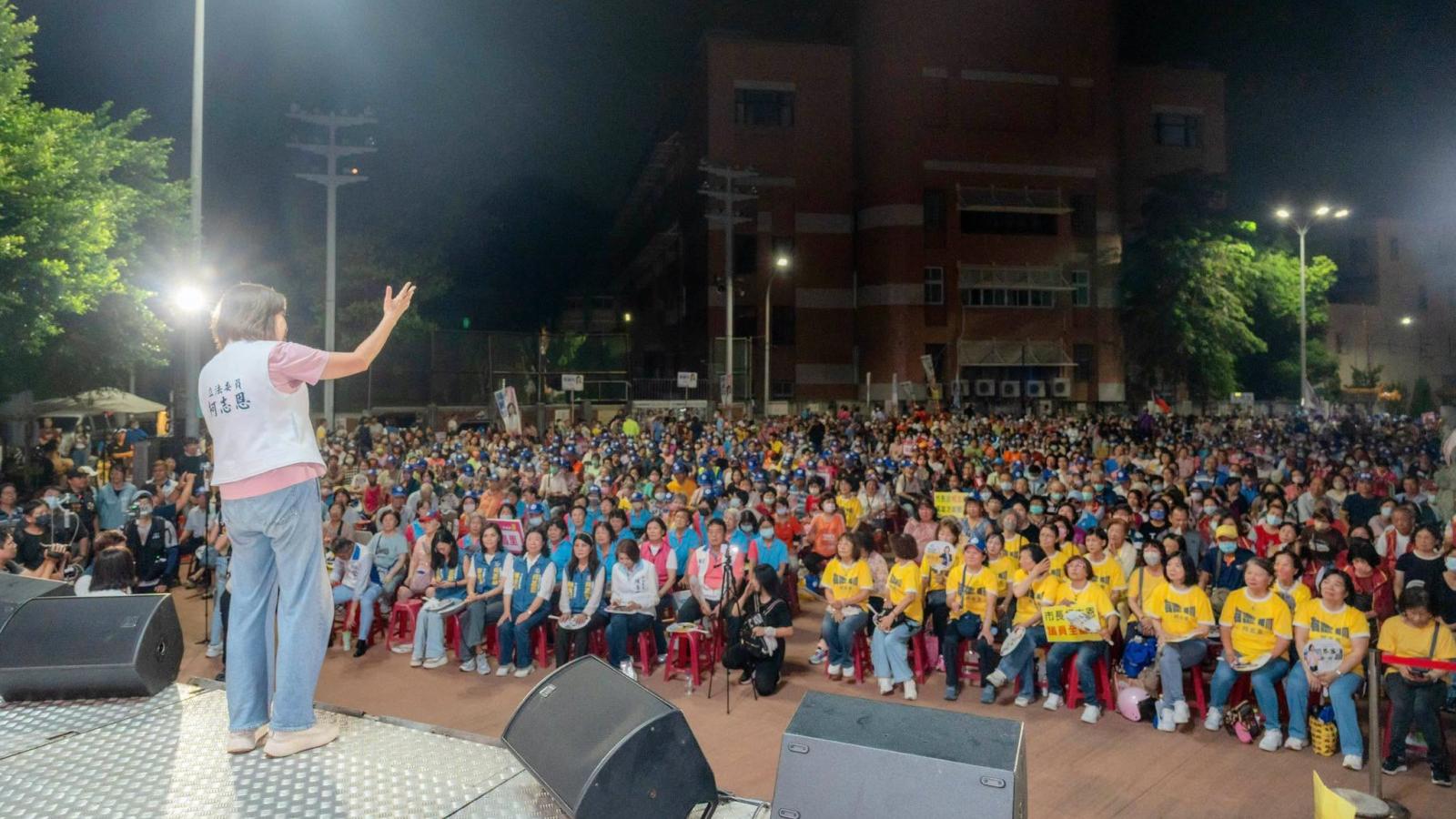
On the evening of August 1, Ke Tzu-en held a 'Temple Politics' lecture in Larnac, Kaohsiung. The venue was packed with supporters, and even those who had to stand wanted to listen to the end. KMT members immediately shouted 'The wind is blowing in Kaohsiung,' and some even compared the scene to the 'Korean Wave' of 2018. Blowing the whistle to boost morale is a necessary means of political mobilization. Supporters must believe they will win, volunteers must be willing to participate, local organizations must get moving, and cold public opinion polls can only be rewritten by hot public sentiment. However, the venue being hot is one thing, and whether votes are actually moving is another. If you mistake applause for public opinion and crowds for trends too early, you may end up losing your bearings in self-hypnosis. This event in Larnac is indeed worth noting, but what is truly worth observing is not whether 2,500 or 3,000 people came, but where these people came from. If most of them are KMT's existing supporters, local party branches, temple systems, and legislators' supporters, it only proves that the blue camp's base is warming up. If there are a large number of independents, young families, tech industry populations, and previously undecided voters who are willing to stop and listen, it may indicate that Ke Tzu-en is gradually breaking through the party's temperature layer. This is where 'Temple Politics' is more imaginative than traditional support groups. The founding general assembly of a support group is usually well-ordered, with everything arranged meticulously, such as who sits at the main table, who serves as the chairperson, and how many people came from which association. However, such activities are often just a roll call within existing organizations. The temple is different. It is an open and fluid public space where some come to pray, some buy dinner, and some just pass by. If political figures can use life-related language to discuss transportation, flood control, public safety, housing prices, and industry, they have a better chance of making middle-class voters, who are otherwise unwilling to enter the campaign headquarters, stop for a few minutes. However, being willing to stop and listen is still a long way from being willing to vote. Someone directly compares Ke Tzu-en's temple craze to the 'Korean Wave' of the past, which may still be premature. Han Kuo-yu's rise in 2018 was not just about the size of the venue and the number of people, but about the formation of a grassroots sentiment that transcended class, region, and party. That force included dissatisfaction with long-term rule, resentment of political elites, and collective projection of Kaohsiung's turnaround, which finally converged into a political storm that swept across the island. Ke Tzu-en's political characteristics are obviously different. Her advantage is stability, rationality, and clear arguments, with the image of a policy-type and knowledge-type candidate. However, she is not a figure who incites the masses like Han Kuo-yu, and she has not yet formed an emotional appeal that can penetrate the blue-green divide. She can make voters feel trustworthy and reliable, but she may not be able to create a frenzy in a short period of time. Therefore, the most accurate judgment at this stage is not that 'the Ke wave has formed,' but that the morale of the blue camp is rising, and the election situation in Kaohsiung is indeed no longer one that the DPP can face lightly. The DPP's true weakness in Kaohsiung is not that the satisfaction with governance has completely collapsed, but that the advantage of long-term rule has begun to show signs of fatigue. Chen Chien-jen still has a considerable political evaluation, but the halo of the five-star mayor may not be transferred intact to Lai Rei-lung. Voters can affirm the incumbent mayor, but it does not necessarily mean that they will accept the designated successor. Especially when Lai Rei-lung's campaign still focuses on support groups, organizational supporters, and party-government systems, it may form a contrast of 'the organization is very complete, but the social atmosphere is not hot enough.' More importantly, after the DPP has been in power in Kaohsiung for many years, it can no longer blame all the problems on the previous administration. Flood control, traffic, air pollution, housing prices, industrial transformation, and regional gaps will eventually fall on the shoulders of the ruling party. Past achievements can become assets, but long-term accumulated problems will also become burdens. When voters begin to feel 'comparison fatigue,' as long as the opposition party puts forward a seemingly stable and acceptable alternative option, the once solid party advantage may loosen. This is Ke Tzu-en's biggest opportunity right now. However, opportunity does not equal advantage. Ke Tzu-en must maintain the heat and not just turn the 35 temple lectures into a circus-style rally. She must also not repeat the same slogan every time she goes to a place. She must connect each activity with specific local issues: in Larnac, discuss the tech population, housing prices, and transportation; in Xiaogang, discuss air pollution, labor, and port safety; in Qijin, discuss flood control, agriculture, and medical care; in Gangshan, discuss the monorail, industry, and the development gap between the north and the south. The temple cannot just be a stage, but should become a cumulative municipal diagnosis report for each district. Next, she must turn the on-site heat into an organization. If there are no volunteer lists, social nodes, policy opinions, and neighborhood networks left after the event, then no matter how many applause there are, it is just the fireworks of that night. Heat is emotion, organization is votes; volume is waves, voter turnout is the real tide. The most critical thing is that Ke Tzu-en cannot just inherit the anti-green sentiment, but must also put forward a credible 'next step for Kaohsiung.' Middle-class voters may be tired of the DPP, but it does not mean they are willing to hand over the city to the KMT. She must answer which policies should be continued, which governance should be corrected, and which reforms can transcend the blue-green divide. Being able to affirm what the opponent has done right and then explaining how to do it better is the only way to truly open the hearts of middle-class voters. Therefore, the temple's popularity proves that Ke Tzu-en has already obtained the qualification to be seen; but from being seen to being trusted, policy, organization, and stability are still needed. The DPP's advantage in Kaohsiung has not disappeared, but it is no longer automatically redeemable; Ke Tzu-en's heat has indeed risen, but it is not yet the stage to declare that the wind is blowing. The venue being hot can boost morale; but if the heat is mistaken for advantage and applause is mistaken for votes, it may lose its bearings in self-encouragement. Whether Kaohsiung is really blowing or not is not about how many people came in one night, but about whether this wind can penetrate the party's temperature layer and blow into the hearts of those who have not yet decided!
FACT BOX
- Source: PR Times
- Category: News