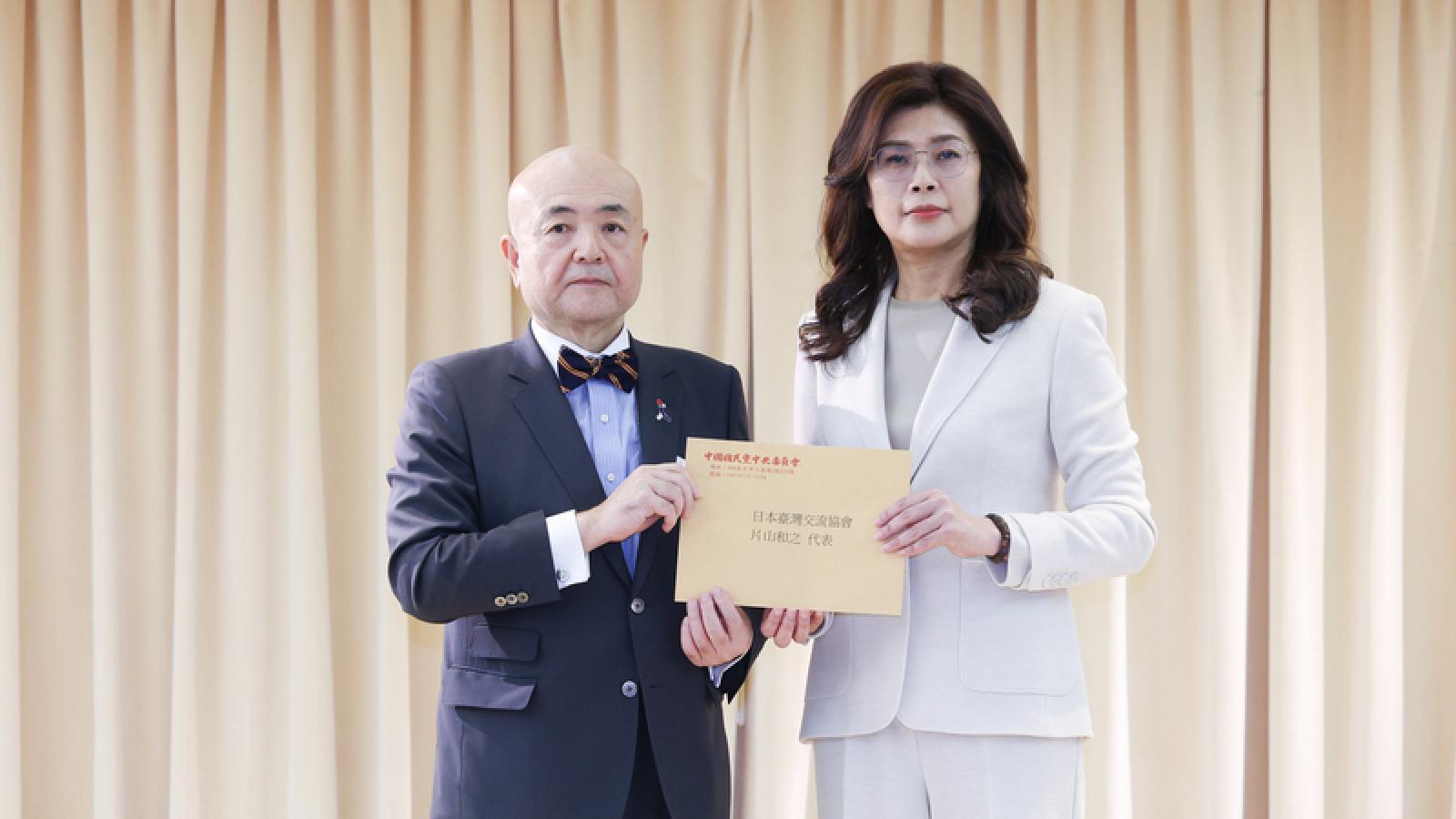
A magnitude 7.1 earthquake struck Kumamoto Prefecture in Kyushu, Japan—home to a semiconductor plant operated by Taiwan Semiconductor Manufacturing Company (TSMC)—on July 28, resulting in 38 deaths and prompting widespread concern across Taiwan. Kuomintang (KMT) chairperson Cheng Li-wen announced a personal donation of NT$1 million to support relief efforts, which was formally accepted by Kazuyuki Katayama, representative of the Japan-Taiwan Exchange Association in Taipei. The gesture has sparked online debate, with many netizens from mainland China criticizing Cheng and the KMT for their stance toward Japan. A scholar based in Japan argues that this incident highlights how attitudes toward Japan may become the most significant point of divergence between the two sides of the Taiwan Strait, aside from the issue of unification versus independence.
Controversy Over Cheng Li-wen's 'Excessive' Donation
On July 31, Cheng Li-wen posted on her personal Facebook page, stating that she was expressing condolences on behalf of the KMT for the strong earthquake in Kumamoto. 'Taiwan is located on a seismic belt, and we deeply understand the fear and pain caused by major earthquakes. We have also experienced the warmth and care from the international community during past disasters. Therefore, seeing Kumamoto suffer such a severe disaster, we must uphold the spirit of “feeling others’ hunger as our own, others’ drowning as our own,” and express our concern and support immediately,' she said.
In addition, Cheng visited the Japan-Taiwan Exchange Association to offer sincere condolences and donated NT$1 million in her personal capacity to Kumamoto Prefecture, hoping to contribute to rescue and reconstruction efforts and help victims recover and rebuild their lives. She also expressed hope that Taiwan and Japan could deepen cooperation in disaster prevention and relief, jointly enhancing resilience against natural disasters.
While many netizens expressed support, others in Taiwan and mainland China criticized Cheng for what they perceive as a double standard, especially when compared to her response to concurrent disasters such as floods in Guangxi. Some mainland users even compared the donation amount to contributions by DPP leaders, questioning why Cheng’s donation was five times that of President Lai Qingde. The scholar in Japan noted that this cognitive gap reveals a profound divergence in how the two sides view Japan.
Lin Chuan-chung, a specially appointed researcher at the Institute for Advanced Studies on Asia at the University of Tokyo, stated in an exclusive interview with Storm Media that the difference in perception regarding Japan-Taiwan relations is the most significant area of disconnect between the two sides—second only to the unification-independence debate. Interestingly, Lin noted that not only mainland netizens but also many of his Japanese friends were shocked by the size of Cheng’s donation.
Lin Chuan-chung appeared on Storm Media’s 'After Work International Line' program in September 2025. (Photo by Ko Cheng-hui)
Is Taiwan Truly a 'Pro-Japanese' Society?
Lin analyzed that the controversy surrounding Cheng’s donation is not merely a public relations crisis but a microcosm of the deep rift in moral frameworks and political narratives between the two sides. 'When humanitarian aid is easily labeled with political or nationalistic tags, the space for rational dialogue between the two societies is further compressed,' he said.
He also argued that labeling the KMT as either 'pro-Japanese' or 'anti-Japanese' oversimplifies the issue and ignores historical context. Since 1949, the KMT has consistently prioritized relations with Japan. Even during the Cold War under Chiang Kai-shek and Chiang Ching-kuo, key officials sent to Japan were close confidants. Since the Lee Teng-hui era, a 'pro-Japan' stance has become an established KMT policy.
Lin cited the 2011 Great East Japan Earthquake as an example. During Ma Ying-jeou’s presidency, Taiwan’s unprecedented foreign relief effort transcended the blue-green political divide and deeply moved Japanese society, ushering in a new era of 'special partnership' in Japan-Taiwan relations. 'The KMT has not been absent in building mechanisms for mutual support between Taiwan and Japan,' he emphasized.
Therefore, Lin stressed that for genuine 'rational dialogue' to emerge between the two sides, mainland Chinese public opinion must understand the historical roots and practical logic behind Taiwan’s pro-Japan sentiment—including within the KMT—rather than hastily labeling it as 'betrayal' or 'accommodation of Taiwan independence.' 'Only by discarding stereotypes can we accurately grasp the true trajectory of Taiwan’s political dynamics within the complex geopolitical landscape of East Asia,' he concluded.
FACT BOX
- Source: PR Times
- Category: News