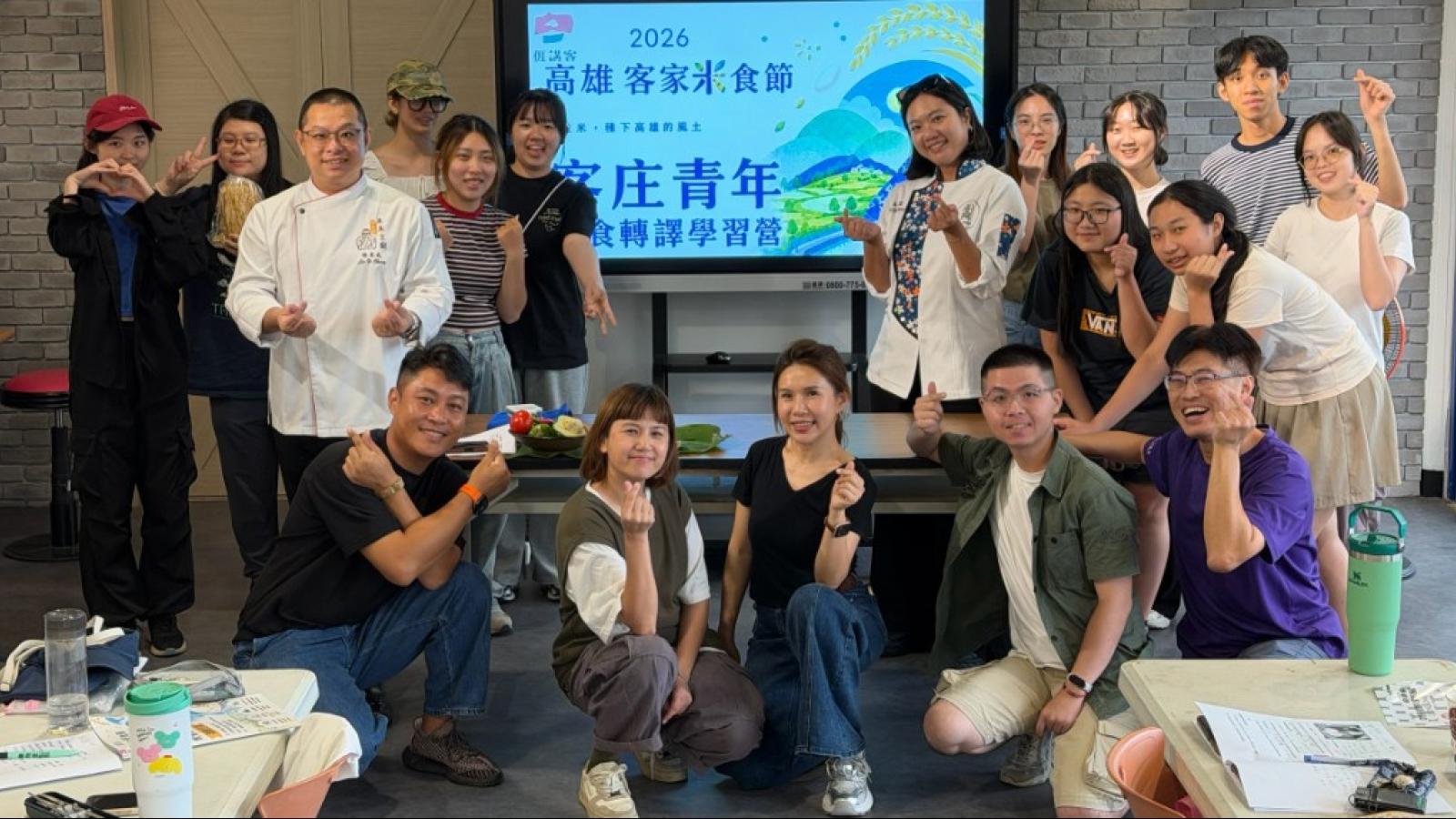
The Kaohsiung City Hakka Affairs Committee hosted the 'Rice Aroma Fills the Village: 2026 Kaohsiung Hakka Rice Food Festival – Youth Culinary Translation Camp' from July 30 to August 1, inviting 20 youth from across Taiwan to immerse themselves in Meinong’s Hakka culture. Over three days and two nights, participants engaged in immersive experiences including field research, culinary creation, and cultural exchange to deeply understand Hakka village life and creatively reinterpret Hakka rice cuisine—serving as a prelude to the upcoming 2026 Kaohsiung Hakka Rice Food Festival.
The 20 youth journeyed from field to table, culminating in six innovative Hakka rice dishes. Centered on the theme 'Youth Entering Hakka Villages,' the camp integrated local historical walks, irrigation community exploration, ecological surveys, video documentation, exhibition practice, and rice food creation. These activities guided youth to understand the cultural and lifestyle context of Hakka villages—from land and agriculture to dining—while fostering cross-disciplinary dialogue to inspire cultural translation and innovative applications.
The most anticipated course was led by Chef Lin Yi-cheng, a long-time advocate of food culture, and Chef Wu Sheng-jung, known for innovating Hakka cuisine. Using locally sourced Meinong ingredients, they reimagined traditional Hakka rice dishes. Breaking away from conventional ban tiao formats, they incorporated brunch, cold salad, and international culinary elements to create six new dishes: 'Vegetable Mien Pa Ban with Citrus Soy Vinaigrette,' 'Cold Five-Element Mien Pa Ban,' 'Salted Pork Carbonara,' 'Fragrant Stir-Fried Hakka Rice Noodles,' 'Green Wave Red Bean Mien Pa Ban,' and 'Meinong Mien Pa Ban with Cheese Egg and Spicy Fermented Tofu Vinaigrette.' These dishes will be publicly unveiled at the main 2026 Kaohsiung Hakka Rice Food Festival.
Many participants said the three-day deep dive not only renewed their understanding of Meinong and Hakka culture but also inspired them to promote local culture further. Some plan to share their learning through illustrations, videos, and social media, while others hope to revisit Meinong with family and friends or even introduce Taiwan’s Hakka culture overseas, showcasing the charm of Hakka villages.
Yang Jui-hsia, Chairperson of the Kaohsiung City Hakka Affairs Committee, emphasized the importance of youth truly entering Hakka villages to understand Hakka culture through land, agriculture, and food, and to appreciate the value of life from farm to table. She believes cultural innovation does not replace tradition but adds new perspectives to existing foundations. The exchange among youth from diverse backgrounds can also inject fresh creativity and vitality into local communities.
After the camp, participants will continue to engage in exhibition training and present their video, illustrated, and curatorial works at the '2026 Kaohsiung Hakka Rice Food Festival.' Paired with the six creative rice dishes, they will use taste, storytelling, and visuals to help the public experience Hakka culture from multiple angles—positioning youth as key ambassadors of Hakka cultural promotion.
Chairperson Yang Jui-hsia hopes youth will deeply engage with Hakka villages, understanding cultural values from farm to table. (Photo: Kaohsiung City Hakka Affairs Committee)
FACT BOX
- Source: PR Times
- Category: Event