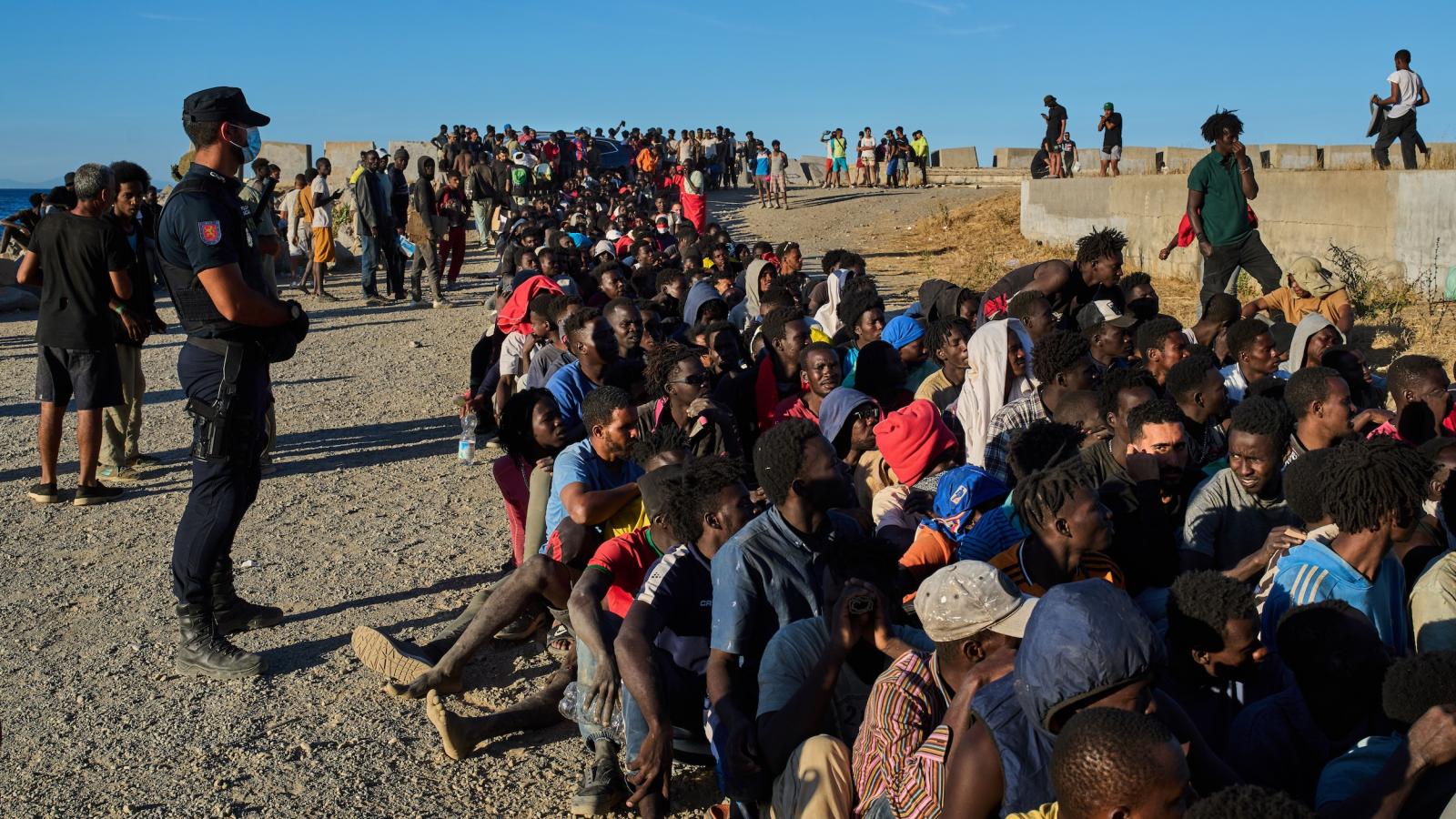
China's state-run Global Times reported on August 2 that last week's mass influx of Moroccan illegal immigrants into Ceuta, Spain's North African enclave, could provide new political ammunition for Europe's rising right-wing parties, further weaponizing the immigration issue. According to the Global Times, the incident has triggered a heated verbal exchange between Spanish Prime Minister Pedro Sánchez of the Socialist Party and other European leaders. Italian Prime Minister Giorgia Meloni and others argue that Spain has failed to effectively control its borders and should therefore be excluded from the EU's Schengen open-border agreement. Sánchez has hit back, accusing Meloni and other concerned European leaders of being 'driven by prejudice, fake news, ignorance, or political interests.' The Global Times stated that the incident threatens European unity and could strengthen 'far-right' parties in France, Germany, and Spain, as well as immigration-restrictionist forces within former U.S. President Trump's administration. On July 31, former U.S. President Donald Trump publicly said: 'I saw Spain yesterday, witnessed that disaster. It looks like hundreds of thousands of people are invading a country. If the Republicans aren't elected, the same thing will happen to us, but on a larger and more severe scale.' Cui Hongjian, a professor at Beijing Foreign Studies University, told the Global Times: 'This crisis shows that the long-standing dispute over responsibility-sharing between frontline border countries and inland member states quickly resurfaces when facing sudden illegal immigration surges. National interests once again override European collective solidarity.' The Atlantic magazine noted on July 31 that although Meloni has made such threats, there is currently no formal legal procedure to expel Spain from the Schengen Agreement. However, concerned member states could strengthen immigration checks or close borders, effectively rendering the Schengen Agreement inoperative. The Atlantic added: 'The Ceuta crisis will likely be brought under control quickly. But if Europe's response to migration waves is to isolate individual countries rather than use existing tools to protect freedom and manage human mobility in a globalized world, the Schengen Agreement truly faces risks.' China itself does not adopt open-border policies similar to Europe's and has no arrangement akin to the Schengen Agreement. The Schengen Agreement is built on trust among EU member states, assuming that peripheral countries can properly safeguard external borders. Editor: Xu Yongxiang Additional Focus News: • Court orders police not to enforce laws; thousands of illegal immigrants flood into Spain's overseas enclave; left-wing open-border policies are killing migrants and collapsing a city • 1.2 million illegal immigrants granted de facto legalization; Spanish police fear organized crime profits and ID issuance system collapse • Global crackdown on 'birth tourism' to the U.S.; U.S. State Department revokes hundreds of visas
FACT BOX
- Source: PR Times
- Category: News