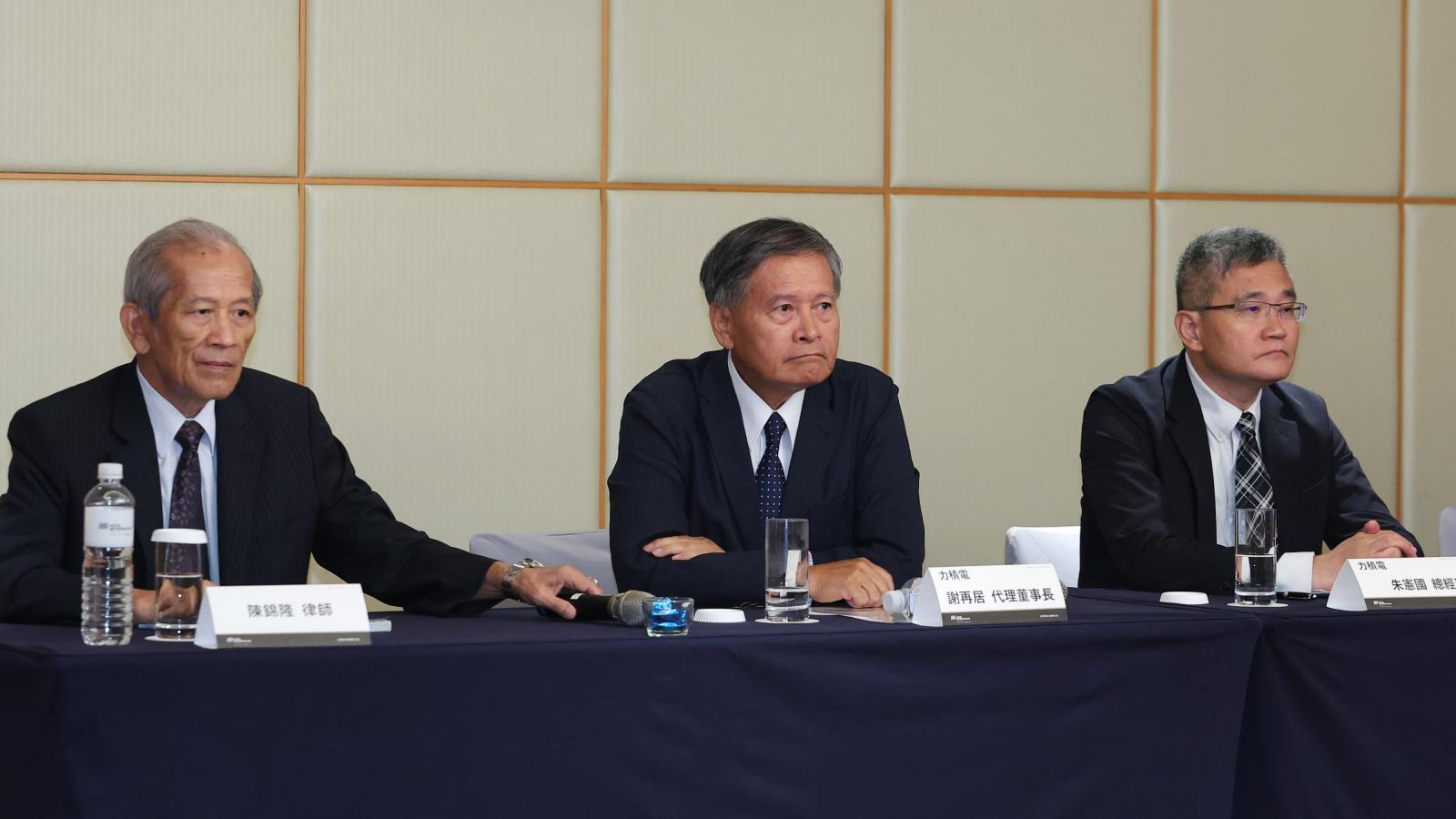
Powerchip (6770) Chairman Huang Chou-jen passed away last Friday due to heart and lung failure. In response, the management team held a media tea session this afternoon (4th) to outline future operational directions. Acting Chairman Hsieh Tsai-chu stated that the company will continue with the development blueprint laid out by Huang before his passing, including AI initiatives, collaboration with Micron, and the 3D AI Foundry strategy—none of which will change. However, he acknowledged that the company’s management style will become “more conservative” compared to Huang’s, with major overseas capital investments to be approached more cautiously. The goal is to steadily enhance profitability through stable operations and fulfill Huang’s pre-passing commitment to deliver dividends next year.
Huang Chou-jen passed away last Friday at the age of 76. Under corporate law, Vice Chairman Hsieh Tsai-chu will assume the role of acting chairman. The company’s largest institutional shareholder, “Powerchip Innovation Holding,” completed its board chair election on August 3, with former CEO Hsieh Ming-lin taking over as chairman. Powerchip is scheduled to hold a board meeting on August 11 to address subsequent chairman-related matters. Today’s media session was attended by Acting Chairman Hsieh Tsai-chu, CEO Chu Hsien-kuo, spokesperson Tan Chung-min, and lawyer Chen Chin-lung, who jointly presented the company’s succession plan, operational strategy, and future direction for the first time.
Hsieh Tsai-chu stated that Huang’s passing was sudden for the company. He was in Texas, USA, at the time and immediately returned to Taiwan upon hearing the news. Over the past few days, he has not only discussed with the management team but also communicated continuously with Huang’s family and close friends. He emphasized that the primary purpose of today’s press conference is to reassure shareholders and investors about the company’s future direction.
He noted that after several days of discussion, the company has confirmed several key directions, the most important being that Huang’s family will continue to support the existing management team. Powerchip’s current governance structure and operational team will remain stable and unchanged despite the chairman’s passing.
Hsieh also shared that he had stepped down as CEO two years ago, intending to gradually retire. Now, stepping back into leadership during this crisis, he feels deeply burdened but remains committed to guiding the company forward.
Regarding future development strategy, Hsieh stated that the company will continue advancing along the three core business pillars previously planned by Huang: Memory Wafer Foundry, Logic Wafer Foundry, and the recently emphasized 3D AI Foundry and AI advanced packaging semiconductor components.
He highlighted that AI-related businesses are already showing results and will remain a key growth driver for the company.
Additionally, the sale of the Miaoli plant to Micron this year not only brought in over NT$50 billion in cash inflow but also improved the company’s financial structure and reduced its debt ratio. More importantly, the collaboration has extended to post-wafer process manufacturing and DRAM technology cooperation, which is expected to further enhance Powerchip’s competitiveness in the memory foundry market. These collaborations will continue as originally planned by Huang.
Hsieh admitted that his management style differs from Huang’s. He noted that Huang was always proactive in pursuing new opportunities, investing boldly whenever potential was seen. In contrast, Hsieh prefers to assess risks first before evaluating opportunities. Therefore, the company’s future management style will be “more conservative, less aggressive.”
He emphasized that the company will still actively seek business and technology collaborations, but major capital expenditures, especially overseas investments, will be evaluated more carefully. He pointed out that Huang had repeatedly stressed that semiconductor manufacturing remains most efficient and cost-effective in Taiwan. Hence, any future overseas plant setup or major investment will place greater emphasis on investment returns and capital allocation.
Looking ahead, Hsieh stated that despite recent market noise, AI demand remains strong. Due to the two- to four-month lag between wafer tape-out and shipment in foundry operations, the rising AI demand and increasing average selling prices (ASP) will gradually reflect in revenue and profitability.
He expects the company’s operations to grow month-on-month and quarter-on-quarter in the second half of the year, with full-year revenue and profits likely to exceed last year’s levels, peaking by year-end. Under company policy, profits will be distributed, and the next board meeting may discuss first-half earnings distribution.
Hsieh further expressed hope that, beyond this year, the company can maintain stable profitability annually—“just as Chairman Huang promised at this year’s shareholder meeting, we hope Powerchip can deliver dividends every year.”
CEO Chu Hsien-kuo summarized the company’s future direction with “three unchanges.”
First, “core business growth remains unchanged.” He noted that despite recent market concerns over AI investment overheating and stock volatility, actual customer demand, pricing, and supply-demand dynamics remain strong. July’s revenue slightly exceeded June’s, and growth from August onward will be more evident. From Q2 to Q4 this year, each quarter is expected to achieve double-digit sequential revenue growth.
Second, “the management team remains unchanged.” He pointed out that most of the team has worked together for over 30 years, and Huang’s passing has not disrupted normal operations. Overall operations continue according to the original plan.
Third, “the future direction remains unchanged.” Chu stated that Powerchip has been actively investing in 3D AI Foundry, with related revenue share rising from 3% to 5%, and now reaching about 7%. The goal is to increase this to 20% within three years. Beyond Wafer-on-Wafer technology, the company continues to develop key AI advanced packaging components such as PWF and IPD, integrating memory and logic processes to enhance value and avoid competition in mature process markets.
Lawyer Chen Chin-lung, representing Huang’s will, stated that Huang fully trusted the existing professional management team and hoped the company could smoothly complete generational transition while continuing to maximize shareholder value.
Chen revealed that Huang had only one request for the management team: to fulfill his promise made at the July 14 earnings call—“dividends next year, guaranteed.” He believes that with the current team’s efforts, Huang’s commitment to shareholders will be honored, fulfilling his final wish.
When asked about potential expansion of cooperation with international semiconductor firms like Intel, Powerchip stated that it already collaborates with Intel in advanced packaging and is continuously discussing new opportunities.
Chu Hsien-kuo stated that the company has no preset stance on strategic partnerships. If customers wish to establish joint ventures (JVs) in the U.S., Singapore, or Malaysia, Powerchip is open to evaluating cooperation. However, Hsieh reiterated that major overseas capital investments will follow a cautious and conservative principle, prioritizing investment efficiency and shareholder interests.
Today’s press conference also announced memorial arrangements: from August 5 to 12, external visitors can make appointments to pay respects to Huang Chou-jen. The funeral committee is actively preparing the farewell ceremony, with TSMC founder Morris Chang agreeing to serve as Honorary Chairman of the Funeral Committee. The time and location of the farewell ceremony will be announced later.
FACT BOX
- Source: PR Times
- Category: 人事
- Organizations: Intel
- Products / services: 3D AI Foundry