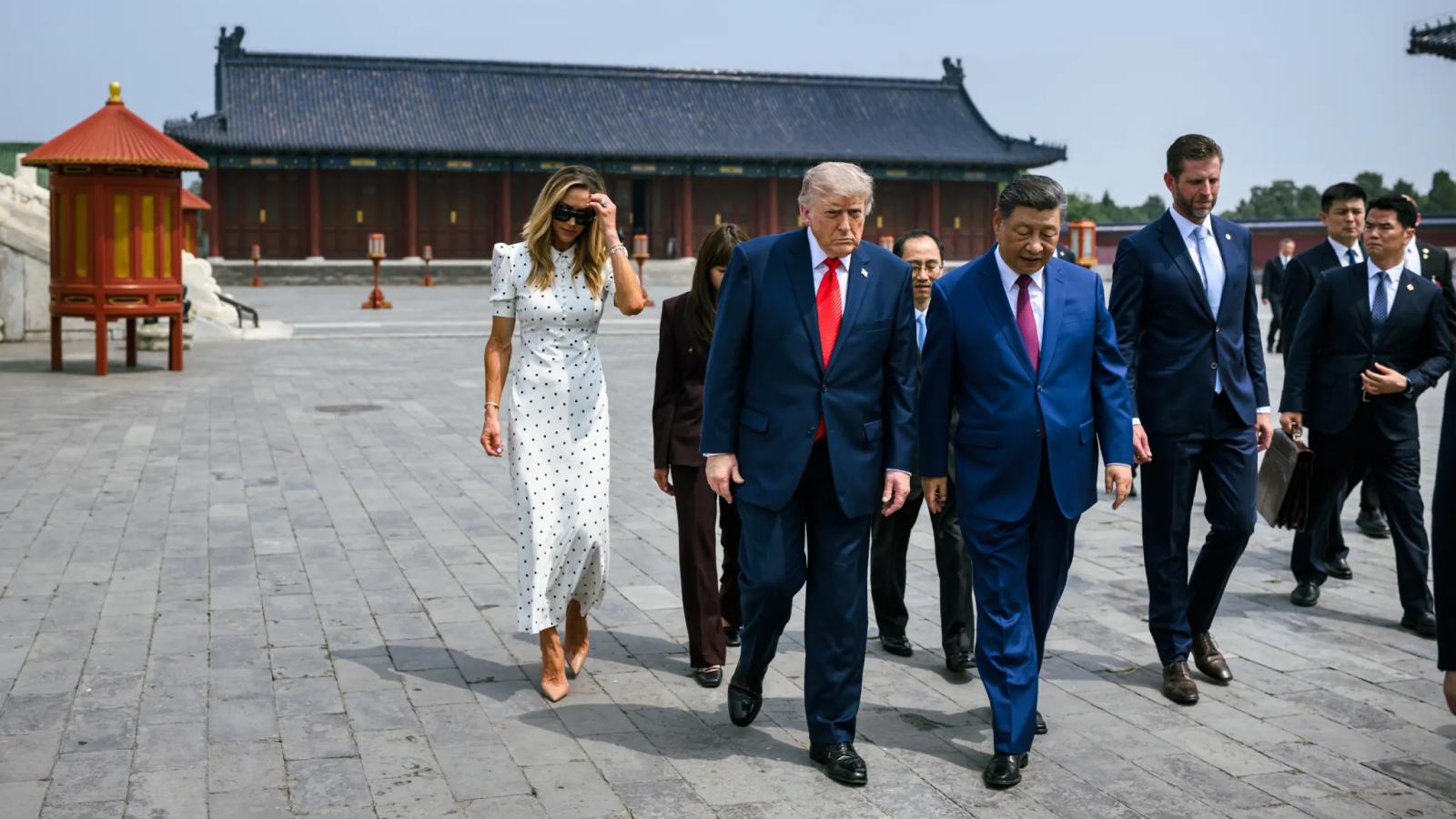
US President Donald Trump's visit to Beijing in May and his talks with Chinese President Xi Jinping led both nations to define their relationship as one of "constructive strategic stability," aiming to find controlled interactions amid competition and avoid further escalation. However, within months, Trump reignited accusations of "Chinese interference in the US election" during a national TV address. The US then imposed new Section 301 tariffs on several economies, including China (with a 12.5% rate), citing "forced labor," immediately triggering strong backlash and countermeasures from Beijing.
What strategic calculations lie behind these moves? Multiple scholars interviewed by BBC Chinese believe both sides are still probing each other within a "managed competition" framework, with the real test being the anticipated Trump-Xi summit in September.
Post-May Fluctuations: From 'Strategic Stability' to Mutual Probing
Since May, US-China interactions have followed a dual-track pattern—advancing cooperation while simultaneously applying pressure.
High-level communication has not ceased. Chinese Foreign Minister Wang Yi and US Secretary of State Marco Rubio held a 90-minute meeting in Manila, described by both sides as "pragmatic, positive, and constructive." Wang even referred to this year as a "big year" for US-China relations. Additionally, frequent contacts have occurred, including a visit by Chinese Vice Foreign Minister Ma Zhaoxu to the US and a trip by the FBI Director to China.
Yet friction persists.
Trump publicly accused Beijing of long-term interference in US elections, prompting immediate rebuttals from China's Foreign Ministry, which demanded Washington "stop unwarranted smearing."
In late July, after the US announced a new round of Section 301 tariffs, Beijing condemned the measures as unilateral but refrained from immediate retaliation, instead reiterating its stance and policy red lines.
The Taiwan issue continues to strain bilateral relations.
Following the Trump-Xi meeting, the US temporarily paused a major arms sale to Taiwan exceeding $100 billion. Meanwhile, Taiwan's Legislative Yuan opposition parties once again blocked the budget for purchasing drones from the US.
Last week, the American Institute in Taiwan (AIT) published a message, believed to be the first official US acknowledgment of a photo showing Taiwan's Coast Guard vessels alongside US Coast Guard ships, stating it "supports Taiwan’s substantive contributions on global issues such as maritime law enforcement." Taiwanese political commentator Tsou Ching-wen called it "definitely another major event in the First Island Chain region."
Overall, since the May talks, US-China relations have maintained high-level dialogue and made progress in economic, trade, and law enforcement cooperation, while continuing to spar over Taiwan, tariffs, and the South China Sea.
Experts: Both Sides Are Still Managing Competition
Elizabeth Larus, adjunct researcher at the US-based Pacific Forum, told BBC Chinese that Trump sent ambiguous signals to Xi.
She noted that while the US turns a blind eye to China’s military support in Ukraine and Iran, it is willing to discuss selling billions of dollars worth of US agricultural products to China.
She also pointed out that Trump has not clearly responded to China’s challenges in the Asia-Pacific region, particularly around Taiwan and the South China Sea. "If the US sees China as a security threat, it needs to adopt stronger military measures," she said.
However, Jonathan Czin of the Brookings Institution recently wrote in Foreign Affairs that the current US-China state is less a "stable relationship" and more "mutually assured disruption."
He argued that Trump has pulled the US back into the Middle East quagmire, allowing Beijing to calmly face a distracted Washington by leveraging its economic and military advantages.
Professor Jonathan Sullivan of the University of Nottingham’s China Policy Institute shares a similar view.
He believes Trump was already in a relatively weak position during the Beijing talks, and "the situation is worse now." He pointed out that Trump is losing a war, and worse, the US cannot disengage from the Middle East.
"Clearly, Beijing is happy to watch Trump accelerate America’s decline and weaken the US-led international order—when your enemy is making mistakes, don’t disturb them," he said.
However, Singapore-based independent international relations commentator Deng Mingjie cautioned against oversimplifying the situation as "US distracted, China benefits."
He noted that China’s economy is slowing, and Beijing is not simply benefiting but managing risks with restraint.
He added that Beijing’s response is not passive but precisely signaling its red lines to Washington, choosing not to escalate before those lines are crossed—demonstrating disciplined relationship management even under constraints.
What Will Be Discussed at the September Trump-Xi Summit?
Multiple scholars believe that if Trump and Xi meet again in September, the focus will be on "managing competition" rather than "solving problems."
Deng Mingjie believes Xi’s priority is "buying time," including extending the truce, exercising restraint on arms sales to Taiwan, and securing breathing room on chip issues.
"Both sides prefer to hold their strongest cards rather than play them, which is why truces and dialogue mechanisms exist instead of real solutions," he said.
Professor Larus expects Trump may propose increased Chinese purchases of billions of dollars in US agricultural products (beyond the 2025 soybean purchase commitment), easing restrictions on high-end Nvidia chips, AI-related issues, and opening commercial navigation in the Strait of Hormuz. The two leaders may also discuss their mutually imposed high tariffs.
Larus also said Trump might again raise the release of Jimmy Lai and China’s role in the Iran issue.
Experts agree that the Taiwan issue remains central to US-China relations. As long as Trump does not approve arms sales to Taiwan or directly touch the Taiwan issue, tariff or AI chip disputes won’t derail Xi’s planned September visit to the US.
"But Trump needs something, and China wants something too—like a public US stance opposing Taiwan independence," Sullivan said.
For Taiwan, Deng emphasized that every month the US arms sale remains unsigned, Taiwan falls further behind. He believes the bigger issue isn’t the sale itself but the precedent it sets, and Taipei needs its own strategic response.
Sullivan said US-Taiwan strategic interests still largely align, and there’s no need for panic yet.
"It’s also hard to speculate further, because six weeks in 'Trump time' might as well be 'eternity,'" he said.
FACT BOX
- Source: PR Times
- Category: News