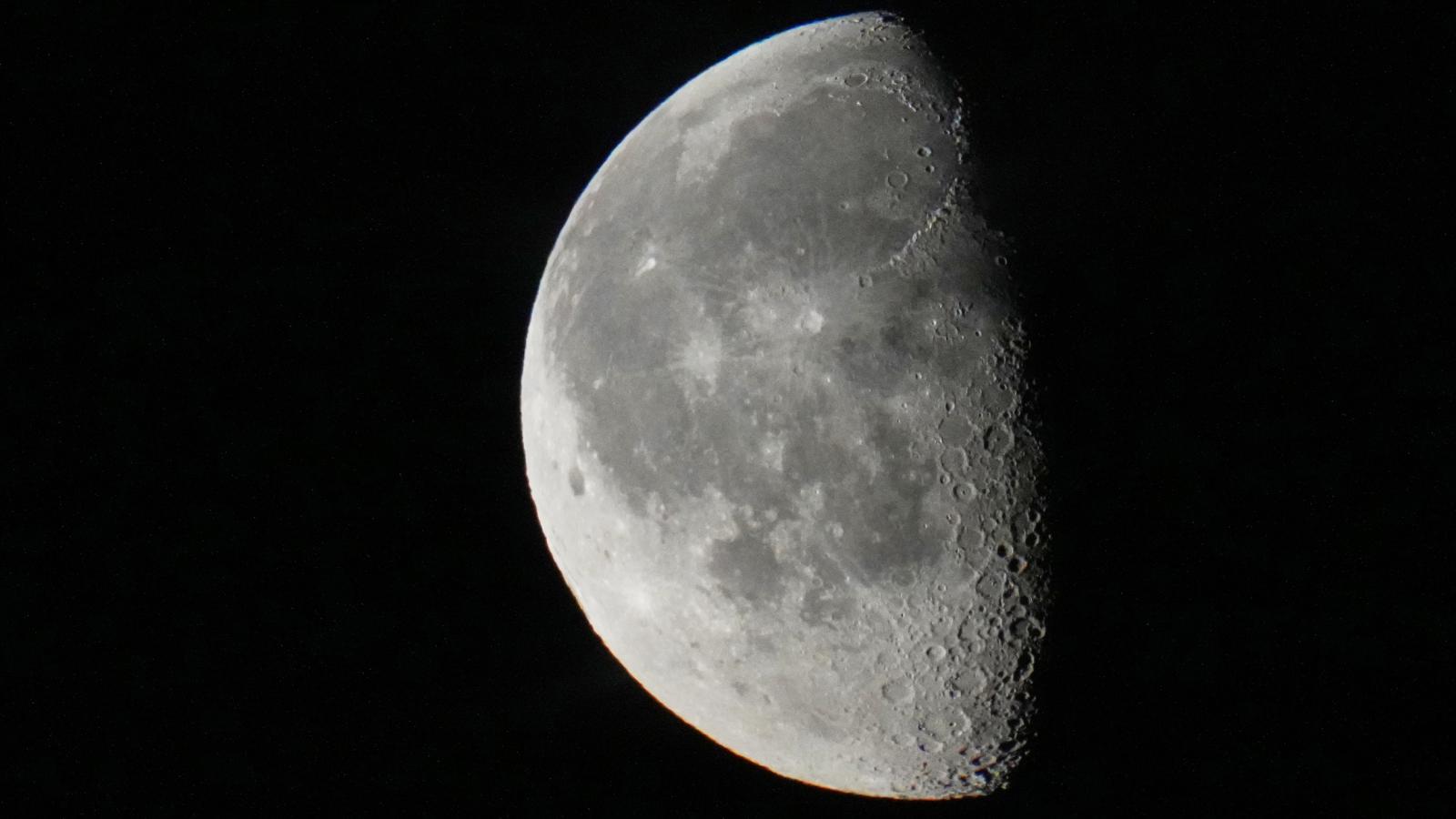
A discarded second-stage upper stage of a SpaceX 'Falcon 9' rocket from a mission last year is expected to impact the lunar surface at 14:35 Taipei time today, traveling at a speed of up to 8,700 kilometers per hour (approximately 2.4 kilometers per second). While this space collision has sparked criticism from astronomers over the 'negligence' in space debris disposal, it also presents scientists with a unique opportunity to precisely calibrate lunar geological data. NASA announced on the 4th that the 4,000-kilogram rocket upper stage was left behind after SpaceX successfully launched two lunar landers—'Firefly Aerospace' and 'Blue Ghost 1'—to the Moon on January 15, 2025, as part of NASA's Commercial Lunar Payload Services (CLPS) program. Due to its distance from Earth, it escaped Earth's gravitational pull and, influenced by solar radiation pressure and lunar gravity disturbances, eventually became uncontrollable and is now on a collision course with the Moon. The first to detect the rocket's orbital anomaly and warn of the lunar impact was Bill Gray, an astronomer from Maine, USA. Gray stated that this incident reflects a certain 'negligence' in space debris management. The SpaceX rocket debris even came close enough to South Korea's 'Korea Pathfinder Lunar Orbiter' (KPLO, also known as Danuri) to trigger a collision alert. However, both NASA and SpaceX emphasized that they are maintaining close communication. NASA's Jet Propulsion Laboratory (JPL) Center for Near-Earth Object Studies (CNEOS) has confirmed that the object will impact the Moon with 100% certainty, posing no danger to Earth. NASA also stated that disposing of rocket upper stages on the lunar surface is a technically accepted and highly safe practice, often the only feasible end-of-mission disposal method for low-lunar-orbit missions. The impact is expected to be equivalent to that of a micrometeorite, and scientists hope to use it to precisely calibrate lunar models. NASA estimates the impact site will be near the Einstein crater and Bell crater on the Moon, creating a new crater approximately 60 feet (about 18 meters) wide and 12 feet (about 3.6 meters) deep, ejecting large amounts of lunar dust and rock fragments (ejecta). The Taipei Astronomical Museum noted that the impact could produce a brief flash and a dust plume rising 75 to 100 kilometers high. Unfortunately, the timing coincides with daytime in Taiwan, making it unobservable for astronomy enthusiasts. The Economist pointed out that due to the Moon's lack of atmosphere, it is constantly bombarded by micrometeorites, experiencing an impact of similar energy roughly every six days. However, scientists cannot predict the timing of natural impacts or determine the size and composition of impacting bodies. In contrast, the precise dimensions and mass of this Falcon 9 upper stage are fully known, providing astronomers with a perfect 'calibration standard.' Since the impact will occur on the sunlit side of the Moon (the daytime hemisphere), Benjamin Fernando, an astronomer at Los Alamos National Laboratory, has called for global observatories to monitor the event. Fernando emphasized, 'We have never observed such an ejecta plume on the lunar surface before.' If the rocket impacts softer lunar regolith, the resulting flash could be detectable by Earth-based telescopes, and the high-altitude dust plume would be illuminated against the dark backdrop of space, offering an optimal opportunity to analyze the Moon's geological composition. NASA's Meteoroid Environment Office at the Marshall Space Flight Center will conduct real-time imaging using ground-based telescopes. NASA's Lunar Reconnaissance Orbiter (LRO) and the ShadowCam sensor aboard South Korea's KPLO will also attempt to capture before-and-after images of the lunar surface. This observation is crucial for future crewed lunar missions, as understanding the dynamics of impact ejecta is essential for ensuring the safety of future lunar inhabitants. NASA plans to execute the crewed 'Artemis IV' lunar landing mission in early 2028 and aims to establish a permanent base at the Moon's south pole by 2032. China and Russia also plan to jointly build an International Lunar Research Station by the mid-2030s. However, Fernando issued a warning, emphasizing that in the Moon's airless environment, high-speed debris from impacts can scatter at thousands of kilometers per hour over hundreds of kilometers. 'Any fragment hitting astronauts or a lunar base could result in catastrophic damage,' he stated.
FACT BOX
- Source: PR Times
- Category: News
- Organizations: NASA / Firefly Aerospace
- Products / services: Falcon 9