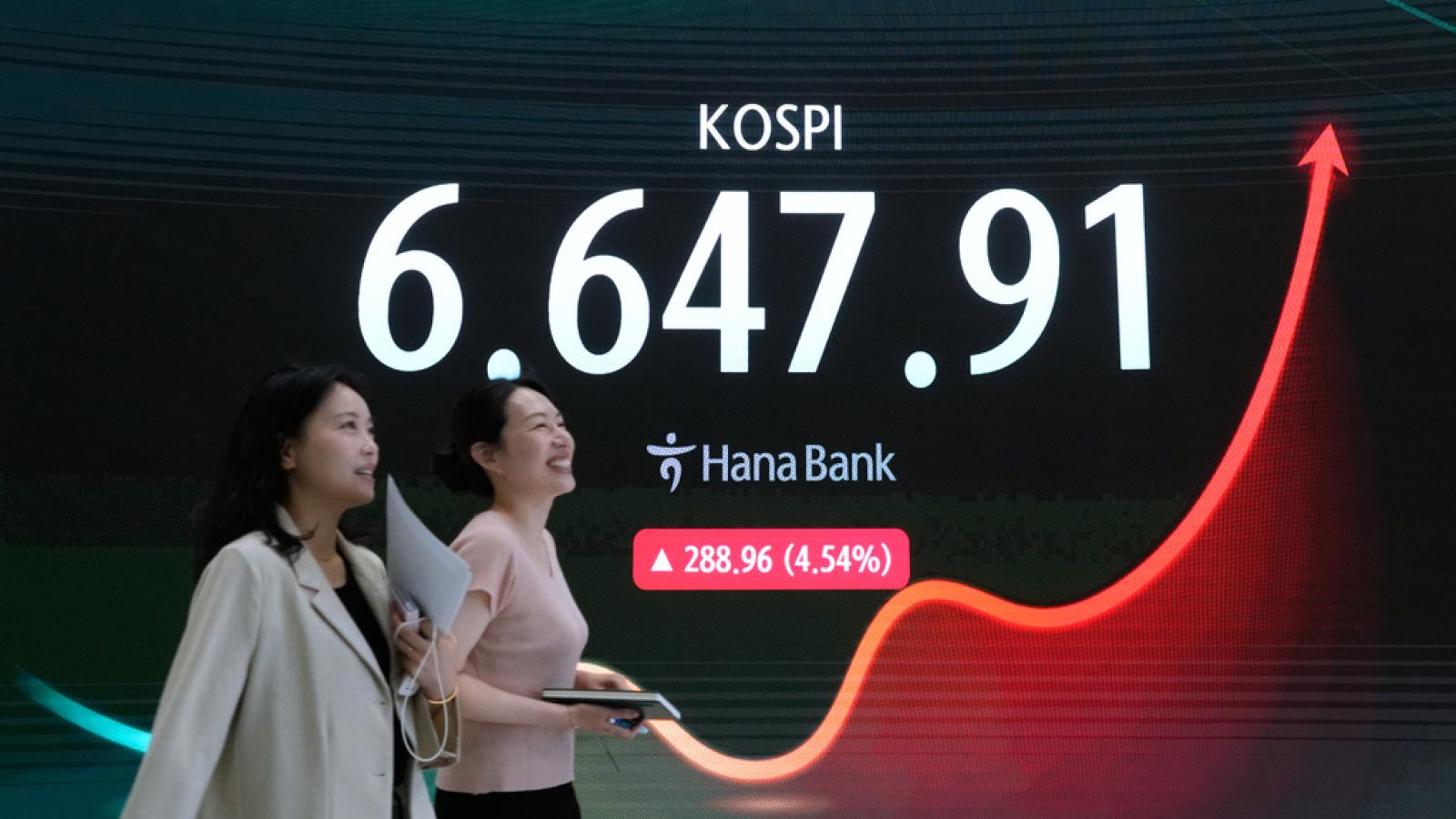
"This is no longer a market driven by corporate fundamentals—it's like flipping a coin!" After the most nerve-wracking week in South Korea's stock market history, an investor expressed their frustration on X (formerly Twitter). Looking back at the past week, the Korea Composite Stock Price Index (KOSPI) suffered three consecutive days of steep declines, sparking anxiety among retail investors and prompting Seoul authorities to intervene urgently by raising margin requirements and restricting leveraged ETFs to stem the bleeding.
Unexpectedly, just a few days later, the South Korean stock market witnessed an epic rally, soaring 17.91% (1,001.89 points) in a single day to close at 6,595.45 points—setting a new record for the largest single-day gain in the country's stock market history. This massive rebound was primarily fueled by strong earnings reports from U.S. tech giants, reigniting market optimism around artificial intelligence (AI) investments, which in turn drove Samsung Electronics and SK hynix shares higher. Foreign investors alone poured over 7 trillion won (approximately NT$158.7 billion) into the market in a single day.
Yet, this record-breaking surge failed to restore market confidence. Instead, it plunged countless retail investors into extreme panic. New terms like "Roller KOSPI"—a portmanteau of rollercoaster and KOSPI—have emerged on Korean forums and social media to describe the market's shocking volatility.
The Korea Composite Stock Price Index (KOSPI) declined again. (AP)
Many investors now question whether the domestic market has lost its normalcy. Since 2026, the circuit breaker mechanism—designed to temporarily halt trading to stabilize markets—has been triggered 44 times on the KOSPI, far exceeding the 26 times during the 2008 global financial crisis. One investor admitted in an interview that what terrifies them isn't the market rising, but "that it's not recovering steadily from a bottom, but instead making extreme V-shaped rebounds through wild swings."
The market's violent fluctuations have caused a sharp divide among retail investors in South Korea. Some young investors, driven by FOMO (fear of missing out), see every dip as a buying opportunity and insist on pursuing high returns in high-risk environments while they're young. Others, however, have been severely hurt by the volatility and have chosen to exit the market.
The data is even more telling: over the past month, deposits at South Korea's five major commercial banks increased by over 24 trillion won (approximately NT$544.1 billion), while customer margin deposits at securities firms dropped by more than 32 trillion won (approximately NT$725.5 billion) over the past two months—indicating that large amounts of capital are fleeing the volatile stock market and flowing back into relatively safe bank time deposits.
Extremely volatile gap openings have also dealt devastating blows to investors using leverage. According to statistics from the Korea Financial Investment Association (KOFIA), during the sell-off preceding the surge, the amount of forced liquidations due to insufficient margin collateral skyrocketed to 61.1 billion won (approximately NT$1.39 billion).
One group of retail investors, betting that semiconductor stocks would continue to fall, invested in a "2x Inverse Single-Stock ETF." However, the KOSPI saw a sharp rebound in chip stocks, mercilessly wiping out these leveraged investors. The ETF plunged over 59% in a single day, vaporizing much of these investors' capital.
When extreme market volatility creates massive social impact, it spills over into the political sphere. A civic group called the "Korea Shareholder Movement Headquarters" announced it has officially begun recruiting founding members to establish a new political group, the "People and Shareholders Party," open to any South Korean national holding at least one share of stock.
Regardless of whether this party becomes a significant political force, its emergence clearly shows that this year's volatile market conditions have rapidly expanded their impact on South Koreans' wealth and emotions. The question of when this rollercoaster-like psychological state will return to rationality has become the most pressing issue for Korea's entire economic and industrial community.
FACT BOX
- Source: PR Times
- Category: News
- Organizations: Samsung Electronics / SK hynix