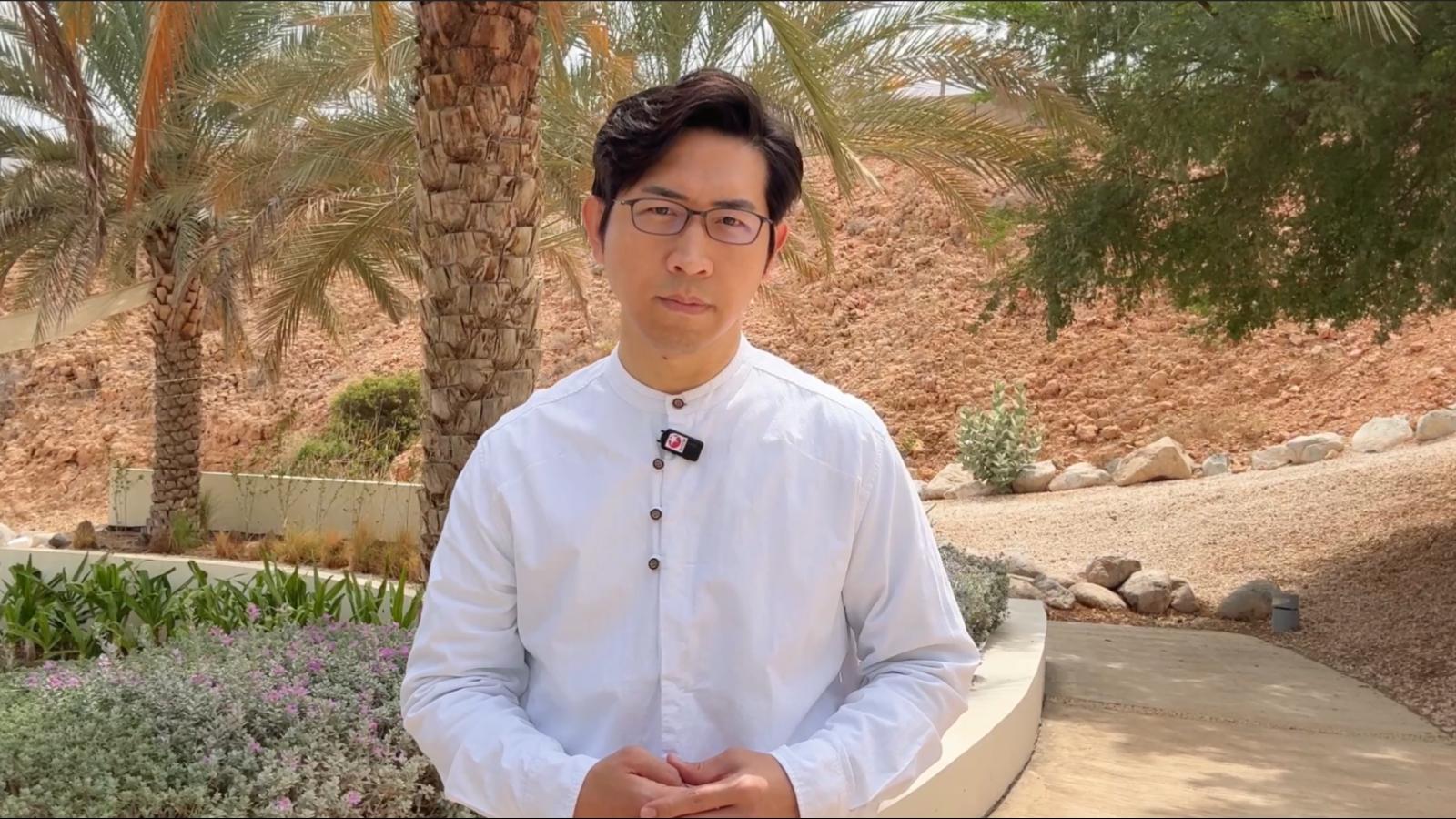
Regarding the war between the United States, Israel, and Iran, Chang Ching-Yi, a journalist from Taiwan formerly stationed at the White House, is now on the ground in the Middle East, observing the conflict firsthand. In an exclusive interview with Storm Media, Chang stated that the U.S., Israel, and Iran are all nations with strong religious identities, and their intertwined apocalyptic worldviews have imbued this war with a distinct 'religious' and 'end-times' character. However, the key lies in U.S. President Trump’s stance—though even Trump himself may not know what decision he will make next.
Chang analyzed that the only real constraint on the U.S. now may be its ammunition reserves. Trump can no longer alter the situation, and his frustration will likely dominate the remaining two and a half years of his term, leaving the unresolved crisis for the next U.S. president. As such, a clear end to this war appears unlikely.
Chang, originally from Yunlin’s Erh-Lun, holds dual bachelor’s degrees in Arabic and Journalism from National Chengchi University and a master’s in International Relations from New York University. He previously worked as a reporter for Far Eastern Weekly before becoming a White House correspondent for Phoenix TV and Oriental TV, making him the first Chinese-language media member in the over 100-year history of the White House Correspondents’ Association. In January 2025, Chang was reassigned to Abu Dhabi, United Arab Emirates.
Chang has published a new book titled War at the Window, reporting real-time developments from the frontlines of the Middle East while analyzing the political forces behind the conflict and the broader international upheaval. (Publisher’s photo)
The U.S.-Iran war erupted in February 2026, and Abu Dhabi, where Chang is based, came under Iranian attack. From his home, he heard terrifying explosions and felt the ground shake, while air-raid alerts blared on his phone. Amid this chaos, Chang wrote his 130,000-character book, War at the Window. For his family’s safety, he drove 500 kilometers to Oman to ensure his wife and children could board a flight out of the Middle East. He then returned to Abu Dhabi to continue reporting on the war unfolding right outside his window, offering viewers first-hand insights into the conflict’s political underpinnings and the global transformation underway.
With deep familiarity with both the U.S. and Israel, Chang provides a comprehensive view of the conflict from the Middle East.
Storm Media: What motivated you to write this book? What message did you hope to convey?
Chang Ching-Yi: There were two main reasons. First, my background: I worked at the White House for 15 years and was the first Chinese-language media member of the White House press corps. I observed the trajectory from President Obama through President Biden and Trump’s first term, giving me direct insight into how the U.S. inevitably entered this war.
Second, I speak Arabic and have been stationed in the Middle East since early last year, primarily covering the Persian Gulf, occasionally the Red Sea and the Gulf of Oman. Over the past year, I’ve interacted extensively with locals and also reported from Israel. I have a solid understanding of all three parties—U.S., Iran, and Israel—and wanted to synthesize their backgrounds so readers could better grasp the full context of this crisis.
Having covered the White House for years, I know that international news is often filtered through translations of U.S. media reports. But frankly, American journalists’ understanding of the Middle East is very limited—even their grasp of East Asia is shallow. I vividly recall asking Trump about tensions between Japan and South Korea during his first term. Later, several veteran White House reporters asked me, 'Why is the Japan-South Korea relationship so serious?'
That’s why I wanted to use my unique position to help audiences understand what’s really happening in the Middle East, what America truly thinks, and what I’m witnessing on the ground. When reporting from the field, all our senses are open—not just sight and sound, but even the smell of the air. With near-constant warfare, I’ve been reporting nonstop, yet I was determined to finish this book and convey my raw, immediate experiences to readers. Letting readers feel as if they’re there is a crucial role for journalists.
The U.S.-Iran military conflict has also affected other Gulf states. On March 14, 2026, debris from an intercepted Iranian drone struck an oil facility in the UAE, triggering a fire and thick smoke. (AP Photo)
From Obama and Biden to Trump: Iran Gradually Becomes a Powder Keg
Storm Media: The war broke out about a year after you were stationed in the Middle East in 2025. Did you expect the conflict to escalate so quickly?
Chang Ching-Yi: I always expected this conflict to happen—it was only a matter of timing. In my book, I mention that during the Obama era, we were optimistic about Iran, as we witnessed the U.S. and Iran negotiating and successfully signing the 'Iran Nuclear Deal.' The agreement was valid for 10 years, and we believed that by 2025, Iran’s nuclear issue would ease and the country would integrate more into the Western-led international community.
Then came Trump’s first term, which I covered extensively. It was a shock because our previous perception of America was more liberal—likely because I lived in New York and Washington and rarely visited rural towns. But once Trump took office, I realized how powerful the conservative base was, and how deeply they despised Iran—a blind spot during my eight years covering Obama.
Trump immediately withdrew from the Iran nuclear deal and in 2020 used a drone to assassinate Qassem Soleimani, commander of Iran’s Quds Force and Iran’s second-most powerful figure. Thus, the Iran policy script set by the Obama administration was completely overturned under Trump.
One could even argue that Trump’s stance on Iran reflects mainstream American sentiment. For over 50 years, Americans have been repeatedly told that Iran is a religiously fanatical nation that seeks to destroy the U.S., so many Americans share Trump’s view.
Between Trump’s two terms was Biden’s presidency. Logically, Biden should have reverted Iran policy back to Obama’s approach. But due to Americans’ overwhelmingly negative perception of Iran, reviving the nuclear deal offered no electoral benefit for Biden’s re-election. The same logic explains why Biden continued Trump’s anti-China policies—Americans have long absorbed negative narratives about China, making any shift toward engagement politically unviable.
Biden’s second challenge was his health. In private conversations, I’ve seen Biden lose focus, staring blankly with no response—indicating he can no longer make many key decisions. The fuse and the powder keg were already in place; only a spark was needed. We just didn’t expect Trump to ignite it before the midterm elections.
Yet despite the war’s escalation, Trump’s approval rating hasn’t plummeted. His current 37% support is relatively high. In normal democracies, leaders making grave errors see support drop to 10% or lower. But no matter what Trump does—even financial market turmoil—his support remains at 37%. This high baseline gives him the confidence to continue the war.
Obama’s (right) conciliatory Iran policy was reversed under Trump, and Biden (left) failed to restore it, allowing Iran’s situation to evolve into a powder keg. (AP Photo)
Trump Targets Iranian Oil, Aiming at China’s AI?
Storm Media: Is there a deeper logic behind Trump’s military action against Iran, including oil and religious factors?
Chang Ching-Yi: Looking back at Trump’s past statements makes it clear—he explicitly told reporters he wanted to control Iran’s oil.
The reason lies in U.S.-China tech competition. China has already caught up, and figures like Musk and Jensen Huang believe America’s decline is evident. Musk acknowledges a slight current advantage in high-tech, but based on current development curves, without major shifts, the U.S. will fall behind in AI and robotics within 10 years. This includes not
FACT BOX
- Source: PR Times
- Category: News