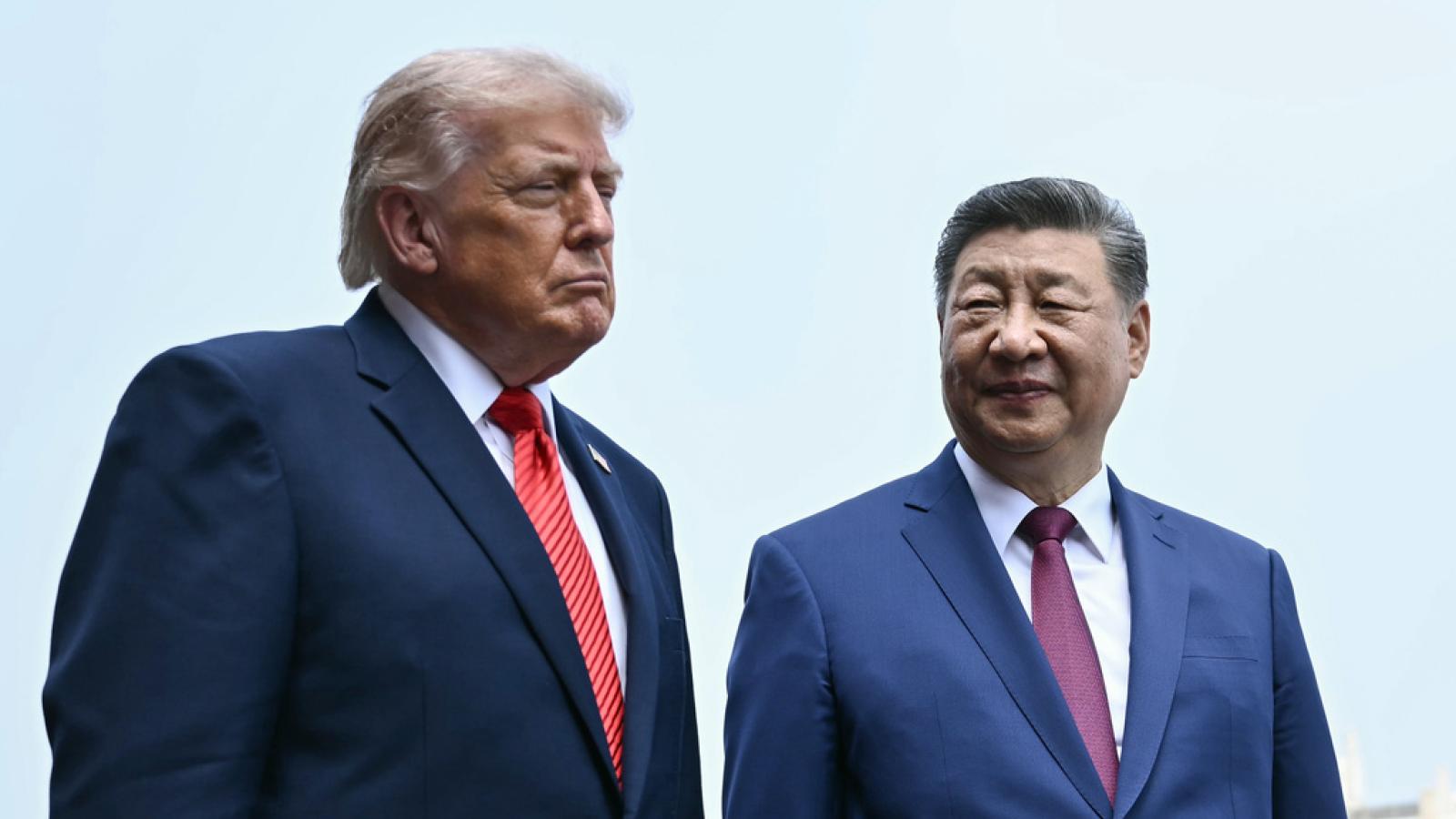
Chinese President Xi Jinping is expected to visit Washington in September to meet with U.S. President Trump, marking the second meeting between the two leaders this year. Zhang Jingyi, speaking in an exclusive interview with Storm Media, said that based on his experience covering 15 U.S.-China summits, the United States is gaining increasingly less from its engagement with China, as the balance of power between the two nations is no longer lopsided. In his view, Trump will gain little from this summit.
Zhang Jingyi, originally from Yunlin’s Er-lun Township, holds dual bachelor’s degrees in Arabic and Journalism from National Chengchi University and a master’s in International Relations from New York University. He previously worked as a reporter for Far Eastern Economic Review before becoming a White House correspondent for Phoenix TV and Oriental TV, making him the first Chinese-language media member in the over 100-year history of the White House Press Corps. In January 2025, Zhang was reassigned to Abu Dhabi, United Arab Emirates.
In February 2026, the U.S.-Iran war broke out. The Abu Dhabi base where Zhang was stationed came under Iranian attack. He could hear terrifying explosions and feel the ground shake at home, while air raid alerts blared on his phone. Amid this chaos, Zhang wrote his 130,000-character book, War at My Window, describing how he drove 500 kilometers to Oman to ensure his family could catch a flight out of the Middle East. He then returned to Abu Dhabi to report firsthand on the conflict, analyzing the political forces behind the war and the broader international upheaval.
Zhang Jingyi’s new book, War at My Window, brings frontline Middle East reporting to audiences, offering insights into the political dynamics behind the conflict and the global transformation underway. (Courtesy of publisher)
Storm Media asked: “Xi Jinping is set to visit Washington in September. When Trump visited Beijing last time, he appeared very accommodating toward China. Given that Trump has gained no leverage on Iran, will he now have to lower his stance before Xi?”
Zhang replied: “This is unavoidable. I’ve personally covered 15 U.S.-China summit meetings, starting with Hu Jintao and Obama, then Xi Jinping and Obama meeting at the Annenberg Estate in California—I was there. I was also present during Biden and Xi’s first virtual meeting. From these experiences, I’ve observed that the U.S. gains less and less from engaging with China, as the power balance is no longer so unequal.
If we calculate by per capita purchasing power parity (PPP), China first surpassed the U.S. between 2013 and 2014. The U.S. PPP is now only about 70% to 80% of China’s, meaning the U.S. is already lagging in economic strength.
Zhang, a Taiwanese national, served as Oriental TV’s White House correspondent—the first Chinese-language media member in the 100-year history of the White House press corps. He is now stationed in Abu Dhabi, UAE, observing the U.S.-Iran war firsthand. (Courtesy of publisher)
I clearly remember accompanying Trump on his first visit to Beijing. At that time, Trump brought back many deals—agricultural products, Boeing aircraft orders, and more. But in 2026, when Trump visited the mainland again, bringing along American business leaders like Musk and Jensen Huang, he returned empty-handed. The rumored Boeing orders never materialized, because China can now produce its own large aircraft.
Even in AI, China’s ‘Moonshot’ has launched Kimi, demonstrating that China now has large AI models on par with those in the U.S.
So what does China still need from the U.S.? Perhaps agricultural products, but as proven, sources like Brazil and Argentina can replace American farm goods.
Thus, at this stage in bilateral relations, the U.S. holds very few bargaining chips. Especially after the U.S. launched such reckless military actions against Iran, even traditional Gulf Arab allies have realized they need to hedge their bets. The U.S. military presence in Gulf Arab states, once seen as a security guarantee, has now become a liability. They realize the U.S. brings them risk, so they’re increasing contact with China.
This Iran war has made it clear: the U.S. not only lacks substance, but is now losing face as well. Of course, U.S.-China relations are extremely important. Stability between the two powers is crucial for global stability.
The latest Pew survey shows more countries now view China more favorably than the U.S. Global perceptions of the two powers are shifting, with China increasingly seen as a stabilizing force. Stable U.S.-China relations are vital for the world. If communication breaks down or miscalculations occur, it poses a global risk.
So overall, this summit is a positive development. But I don’t see Trump holding many cards. Even NVIDIA’s H200 chips are now ignored in China. The U.S. has little left to sell but soybeans and corn. What leverage does America really have?
In this summit, in my view, Trump will gain practically nothing. But the meeting itself can serve as a stabilizing force in today’s chaotic world.
FACT BOX
- Source: PR Times
- Category: News
- Organizations: Tesla / NVIDIA