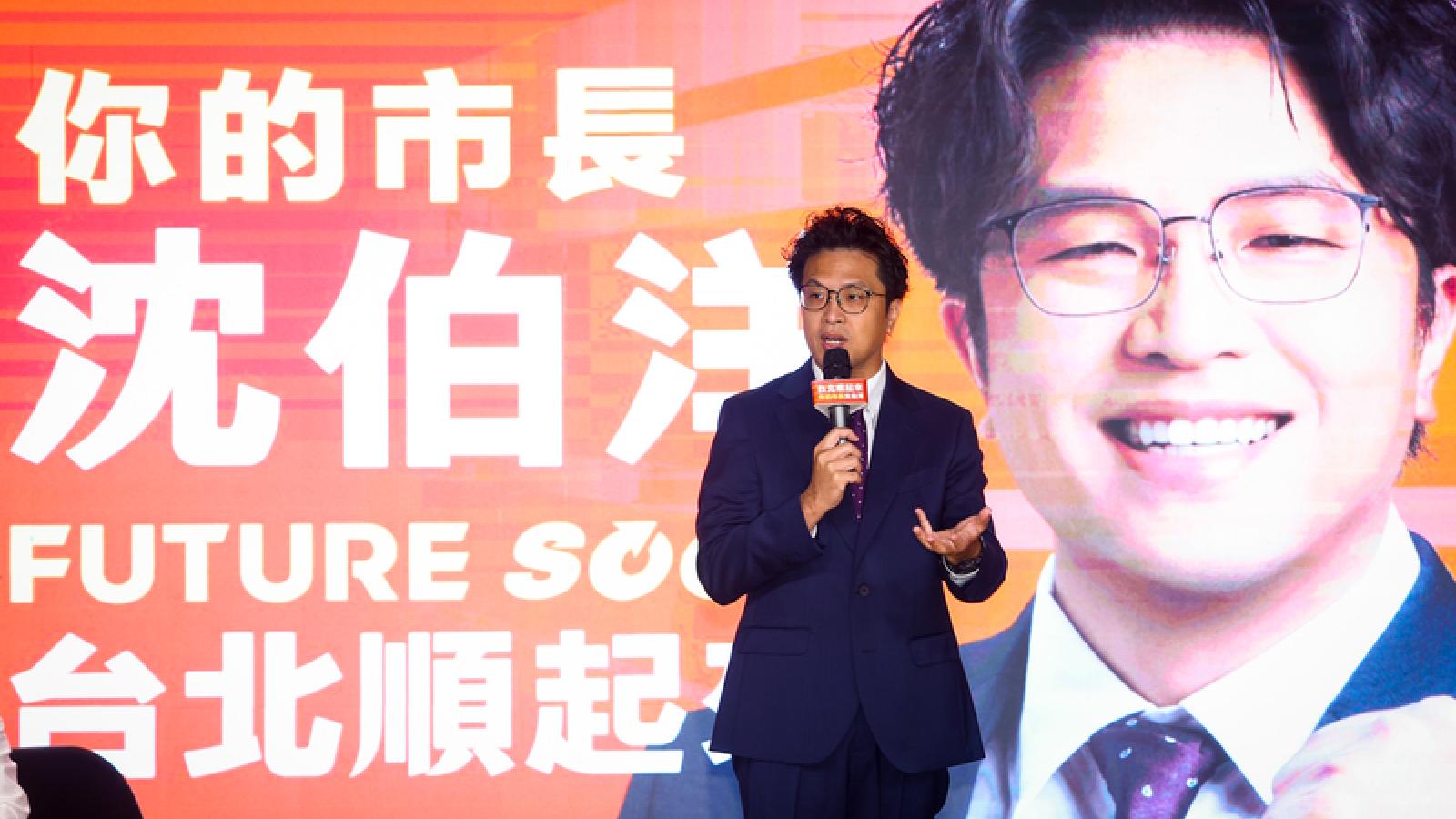
With less than four months to go before the 2026 county and city mayoral elections, Democratic Progressive Party (DPP) Taipei mayoral candidate and legislator Shen Po-yang unveiled his campaign's main visual on the 4th, adopting 'Your Mayor' as the first-phase campaign theme, emphasizing a governance approach centered on citizens' needs. Notably, Shen's campaign chose warm orange as its primary color, with ample white space and black or dark gray text, clearly distinguishing itself from traditional blue and green party colors, sparking discussion. In response, Professor Ni Tsu-hsun of the Department of Advertising at Chinese Culture University analyzed the move late on the 4th via Facebook, acknowledging Shen's intent to appeal to moderate voters but pointing out blind spots in the current campaign theme and strategic logic.
Regarding the Taipei mayoral race, incumbent Kuomintang (KMT) Mayor Chiang Wan-an, seeking re-election, has recently drawn political attention by taking strong stances on issues such as anti-drug campaigns and votes of no confidence. Meanwhile, challenger Shen Po-yang has taken the lead in announcing his campaign theme, downplaying the traditional blue-green political divide and focusing instead on listening, governance, and problem-solving, emphasizing 'When Taipei flows smoothly, the future will open up!' Professor Ni first expressed approval of Shen's campaign design, noting that Shen's claim to resolve Taipei's 'stuck' issues and positioning himself as 'Your Mayor' is well-structured. He pointed out that the large, bold character for 'smooth' is simple, clear, and easy to understand, and the main visual animation is bright and fluid, effectively echoing the campaign's theme. The use of orange tones helps build a 'warm' image and signals an attempt to appeal to moderate voters, demonstrating a coherent strategic narrative.
However, Professor Ni also highlighted its blind spots and limitations. He analyzed that, generally, a campaign theme must either connect with the candidate's personal traits or address issues voters want solved to be persuasive. First, 'Taipei flowing smoothly' fails to highlight Shen Po-yang's personal strengths. Moreover, various surveys show that Taipei residents' satisfaction with Mayor Chiang's administration exceeds dissatisfaction, undermining the persuasiveness of Shen's argument that Chiang's governance is 'stuck.' Furthermore, 'Your Mayor' and 'flowing smoothly' resemble mere slogans—lacking the necessary momentum and not uniquely tied to Shen Po-yang or Taipei City, making them easily applicable to any municipality. He cited former presidential candidate Ma Ying-jeou, who used slogan-based concepts like 'Taiwan moving forward' and 'Taiwan will surely win,' explaining that if the 'product strength' is strong enough, supporters will buy in and even expand votes among moderates. However, Shen Po-yang still has room for improvement.
Shen Po-yang held a press conference in Taipei on the 4th to unveil his campaign's main visual. (Photo credit: Central News Agency)
Lastly, Professor Ni evaluated that the creativity behind 'Taipei flowing smoothly' also appears lacking. Looking back at the 2002 Taipei mayoral election, DPP candidate Lee Ying-yuan's campaign theme was 'Taipei IN,' a pun on the word 'in' that also targeted criticisms of opponent Ma Ying-jeou's perceived lack of leadership vigor, demonstrating strategic logic. Given that a party predecessor has already used a similar concept, Shen Po-yang's approach lacks novelty or originality, which is somewhat regrettable. Professor Ni concluded that for Shen Po-yang to strengthen his electoral momentum, he must first enhance his 'product strength,' establish a completely distinct image and positioning from Chiang Wan-an, and thereby boost political energy and form a coherent strategy. With a clear strategy, he can then infuse it into his campaign theme, making it more vibrant and capable of mobilizing votes, allowing the campaign to gradually gain momentum.
FACT BOX
- Source: PR Times
- Category: News