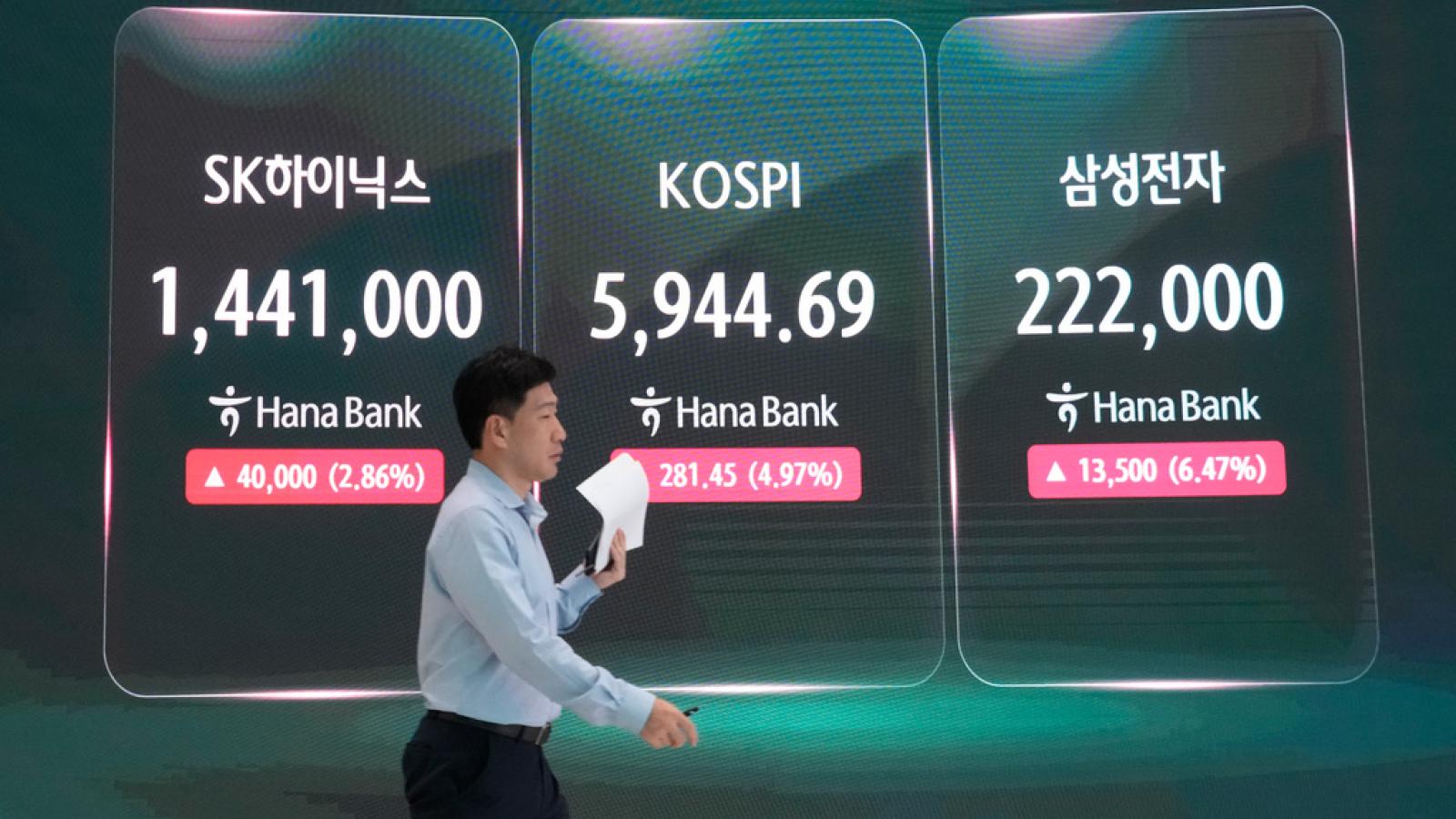
South Korea's stock market has become the world's most talked-about market this year. However, recent movements in Korean equities have resembled a rollercoaster. The Korea Composite Stock Price Index (KOSPI) plummeted nearly 40% in just 27 trading days, causing some investors to grow fearful. Although KOSPI has recently stabilized above the 6,000-point mark, Bloomberg columnist Shuli Ren stated on the 4th that the sell-off has tarnished the market, and South Korea is increasingly being seen as an 'uninvestable market' following China.
Ren believes that the South Korean government's approval of single-stock leveraged ETFs has amplified market volatility. Yet, even as authorities move to restrict retail investors' access to these ETFs during the market crash, such measures may still be insufficient to rescue KOSPI. Investors may continue to believe in AI-driven industrial prosperity but choose to stay away from the Korean market.
Ren compared last month's sharp decline in Korean stocks to China's 2015 stock market crash. As the downturn in AI-related stocks eases, people naturally ask: Can KOSPI return to its first-half glory? Bulls may argue that today's Korea is different from China a decade ago, with solid corporate fundamentals. The two major memory chipmakers, Samsung Electronics and SK Hynix, account for over half of KOSPI's market capitalization and directly benefit from the booming AI infrastructure. KOSPI's current valuation remains attractive, with a price-to-earnings ratio of just 5.5x—the lowest in a decade.
However, Ren disagrees with this view. Before predicting a rebound, she argues we must first ask whether the recent sell-off and the government's clumsy market-support measures have inflicted psychological trauma on a new generation of investors and cast a shadow over the market. Indeed, Korean stocks have been extremely volatile this year. There were 33 days when KOSPI's daily fluctuation exceeded 5%, compared to just 4 days for Japan's Nikkei 225 and zero for Hong Kong's Hang Seng Index. Foreign investors, aiming to avoid excessive concentration, have been selling all year. For traditional fund managers, risk-adjusted returns and portfolio diversification are equally important—meaning they are unlikely to increase holdings if KOSPI continues to swing wildly.
Ren identifies the massive influence of ETFs as the main driver of market volatility, especially after the South Korean government approved single-stock leveraged ETFs in late May, significantly expanding their impact. ETF issuers must perform mechanical rebalancing daily, and their 'buy high, sell low' behavior amplifies price swings. According to Goldman Sachs, during KOSPI's peak in June, a 5% fluctuation in SK Hynix's share price could trigger rebalancing flows equivalent to 40% of its average daily trading volume.
Given these products' negative impact on KOSPI, the South Korean government plans to restrict retail investors from buying them, though a full ban has not yet been implemented. As a result, although these ETFs pulled back during July's sell-off, they still wield significant influence. Goldman Sachs estimates that leveraged products could still account for 17% of SK Hynix's trading volume on days of extreme price swings, meaning KOSPI will likely continue to experience severe volatility.
More concerning is that retail investors have long been skeptical of Korean stocks' persistent discount phenomenon. It was President Lee Jae-myung's stock market reform policies that eased their concerns, prompting them to enthusiastically enter the market this year and fill the gap left by foreign sellers. But last month's market crash devastated these retail investors. The most popular SK Hynix leveraged ETF, for example, lost up to 84% of its value compared to its June peak. An estimated 360,000 brokerage accounts were forcibly liquidated (investors didn't want to sell, but brokers closed their positions due to insufficient margin), with 62% of the account holders being under 35 years old. It's no wonder Korean investors are furious—just as global AI trading reached its peak, Seoul encouraged inexperienced traders to take excessive risks, only to see their hopes shattered.
Unlike China, South Korea does not impose strict capital controls or restrict citizens from investing overseas, allowing Koreans to freely enter and exit any market they're interested in. In the past, Korean investors favored Nasdaq. After the Korean stock plunge, Ren worries that some may now permanently abandon KOSPI.
In addition to allowing single-stock leveraged ETFs, Ren views the $1 trillion National Pension Service (NPS) breaking its own rules by raising its domestic stock target price to avoid selling its KOSPI holdings as another major policy failure by the government. This move undermined the pension fund's inherent risk-hedging mechanism and fueled KOSPI's irrational surge.
Ren concludes by noting that global asset managers have long complained that China is unsuitable for investment, primarily due to policy missteps and disregard for investors. Unfortunately, similar concerns are now emerging in South Korea. She questions whether Seoul has clarified its policy direction and whether young, first-time investors are adequately protected. She ends by writing: 'The South Korean government should seriously reflect on this.'
FACT BOX
- Source: PR Times
- Category: News