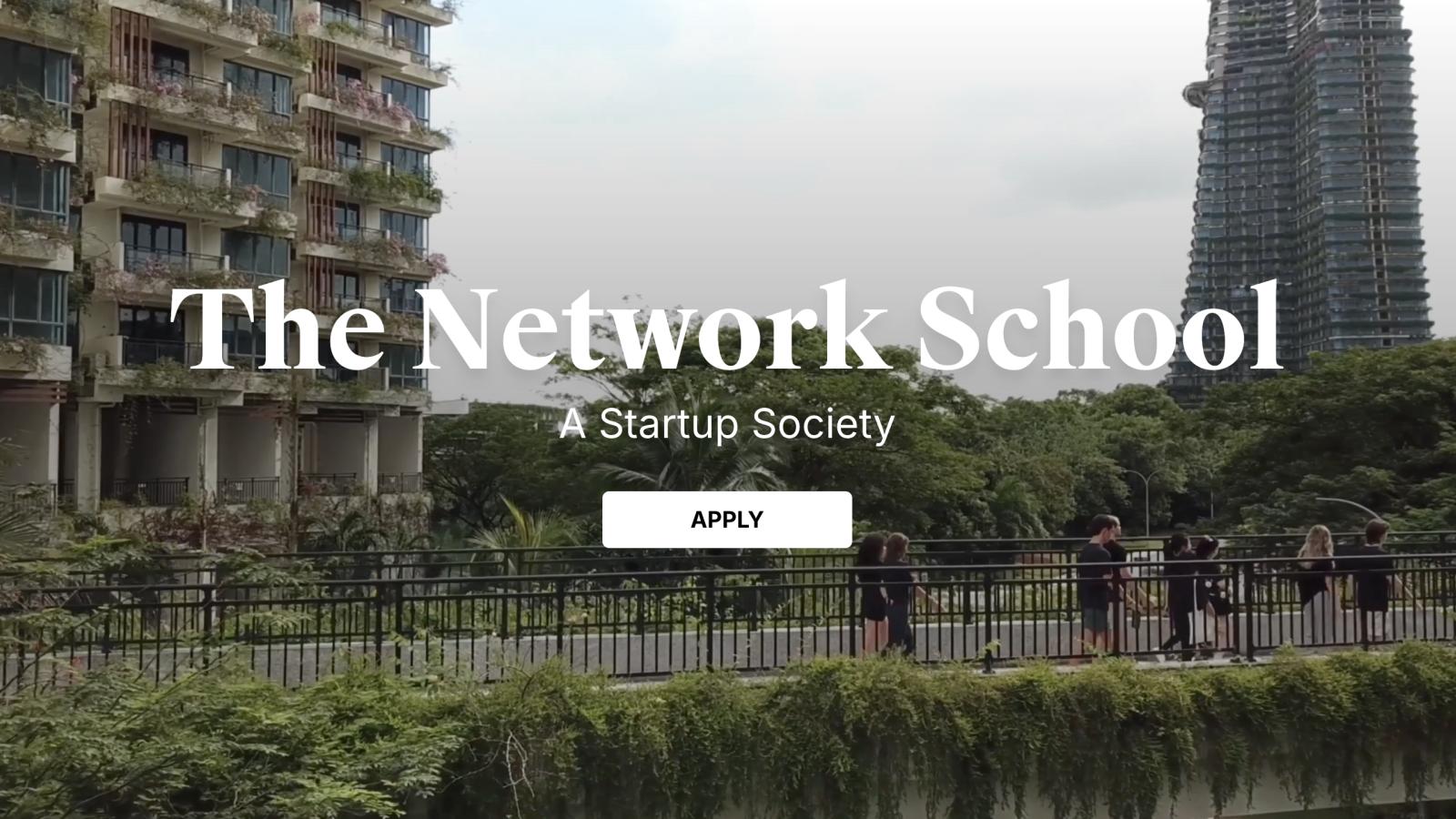
Tech entrepreneur Balaji Srinivasan believes the United States is gradually descending into anarchy. His proposed solution is strikingly simple: build a new nation from scratch. "Bryan Johnson (the entrepreneur known for his 'extreme anti-aging experiment') wants to live forever, Sam Altman (CEO of OpenAI) wants to create superintelligent machines, Elon Musk (founder of Tesla and SpaceX) wants to land on Mars," Srinivasan said recently on a podcast. "And me? I just want to build a new country."
He left Silicon Valley and took the first step toward creating a tech community in Asia that could rival Silicon Valley. He established a campus equipped with shared office spaces, top-tier gyms, and even meals designed by Bryan Johnson, a well-known entrepreneur promoting longevity. He even surveyed potential residents' political views and his strongly advocated 'pronatalism' ideology.
View this post on Instagram
According to The Wall Street Journal, the experimental stage he calls the 'Network School' is both grand and surreal: located in a $100 billion luxury development in Malaysia built by a Chinese construction company, now nearly vacant and resembling a 'ghost town.' Yet Srinivasan says that in the distant future, the Network School might gain its own special economic zone, "or we might build artificial islands through land reclamation off the coast of a cooperative country. We might even accompany Musk to Mars."
To test this concept, Srinivasan targeted a nearly abandoned artificial island in Malaysia. In this southernmost region of Malaysia, seaside high-rises built for tens of thousands remain mostly empty. This development, originally named 'Forest City,' is actually a remnant of China's real estate bubble burst, situated just one bridge away from Singapore. Srinivasan says he has now obtained Singaporean citizenship, and federal records show he and his wife renounced their U.S. citizenship in 2023.
In 2024, Srinivasan rented space in a hotel within this failed Chinese investment project and launched the 'Network School.' This campus, functioning as both a tech incubator and a self-improvement retreat, starts at $1,500 per month and includes accommodation, meals, courses, and beach access. People can choose long-term residency or stay for just one month. Families can even hire nannies.
Srinivasan revealed that the first cohort attracted 128 participants, the second cohort in 2025 offers 256 spots, and recent estimates suggest several hundred participants are present at any given time. The program's original goal is for people to come, learn, focus on their personal ventures, work out, eat healthily, and build strength to create their own utopias elsewhere. Its official website states: "If you want to build a startup society that spawns other new societies while improving yourself, you should apply."
What exactly is his 'nation'?
In his 2022 book 'The Network State,' Srinivasan claimed there have been six ways to establish a new nation: elections, revolutions, wars, micronations, seasteads, and space colonies. But he believes the ideal method is the 'network state': starting from a digital community, organizing into a networked alliance. He declared his intention to build it as an open-source project, creating an internal economy around remote work, cultivating offline civility, simulating architecture in virtual reality, and producing art and literature that reflect its values. Srinivasan wrote: "We want to peacefully build a new nation, for the same reason we want an empty lot, a blank page, an empty text buffer, a fresh startup project, or a blank canvas. Because we want to create new things without being bound by history." "Through the internet, we can digitally stitch together these dispersed enclaves into a new type of political entity capable of gaining diplomatic recognition: the network state."
Two years after its launch, the 'Network School,' which Srinivasan calls a 'startup society,' has hit a cold wall of reality. Participants began complaining about moldy rooms, dull nightlife, and a lack of female participants—a familiar flaw in Silicon Valley. Then, a larger obstacle emerged: the 'real nation' they were living in.
An Instagram post claimed Srinivasan's program accepted Israeli citizens, prompting the Malaysian government to investigate the school's 'residents.' Because Malaysia, with its predominantly Muslim population, does not recognize Israel, Israeli nationals require special permission to enter Malaysia. Although the investigation concluded 'no illegality found,' in late July the Malaysian government ordered the program to cease all operations, citing 'administrative licensing violations.' Hours later, Srinivasan posted online confirming they were 'preparing to relocate the campus to Kazakhstan.'
In response to The Wall Street Journal's inquiries, Srinivasan stated the Instagram post was a complete hoax and emphasized: "We respect Malaysia's sovereignty and strictly comply with all Malaysian laws." Mold issues are common in Southeast Asia's climate, and his team will carry out repairs as needed; people come to the Network School for self-improvement, not partying, and there is no shortage of women, "We are absolutely not just for 'tech bros,' but for tech dads, tech moms, tech families, and tech kids."
The Tech Elite's 'Enclave' Dream
The Wall Street Journal notes that Srinivasan is not alone—other tech leaders are also attempting to carve out independent enclaves. Patri Friedman, a software engineer and grandson of Nobel economist Milton Friedman, once attempted to build a floating city at sea and later founded a fund to support 'startup cities.' This fund's investors and advisors include Srinivasan, Peter Thiel, and Marc Andreessen.
One of the fund's investment projects is 'Próspera,' launched in 2017 on an island in Honduras, offering residents low taxes and light regulation. However, the Honduran Congress later turned cold toward such economic zones and even pushed for their abolition. Próspera has since filed a lawsuit against the Honduran government. A spokesperson for the investment project emphasized that Próspera operates under Honduran sovereignty, creates jobs for the country, and brings in foreign investment.
Now 46, Srinivasan grew up in Long Island, New York, to Indian immigrant physician parents. He says he was bullied in elementary school as "the only brown kid among hundreds of students," and when he fought back in self-defense, he was unfairly punished by school authorities: "I realized long ago that you have to stand up for yourself; the system is already rigged... the state is against you."
After earning an engineering degree from Stanford University, he co-founded a genetic testing company, worked at venture capital giant Andreessen Horowitz, and briefly served as CTO of cryptocurrency exchange Coinbase. Coinbase CEO Brian Armstrong once praised, "Balaji is an incredibly smart person who brought tremendous value."
But Armstrong also admitted Srinivasan was "a bit difficult to manage." "Roughly once a week, someone would walk into my CEO office saying, 'I can't work with Balaji anymore; he's causing too much damage.'" Srinivasan responded on X, emphasizing he never instigates conflict unnecessarily: "Overall, I play good cop most of the time and only become bad cop when absolutely necessary."
What Are the Residents Doing Here?
The Wall Street Journal points out that Srinivasan is an advocate for increasing Earth's birth rate, partly to open new frontiers in space. He said at a 2023 pronatalism movement conference: "You need a lot of people because space exploration will kill many, and there are still many planets out there." Srinivasan also believes that nations existing before the internet era rarely survive, especially as the U.S. declines due to political polarization.
On a 2022 podcast, he said: "In about one generation, it will at least evolve into a conflict like that between Protestants and Catholics, or Sunnis and Shiites." "Unfortunately, moving toward anarchy is
FACT BOX
- Source: PR Times
- Category: News
- Organizations: Coinbase / Andreessen Horowitz / OpenAI