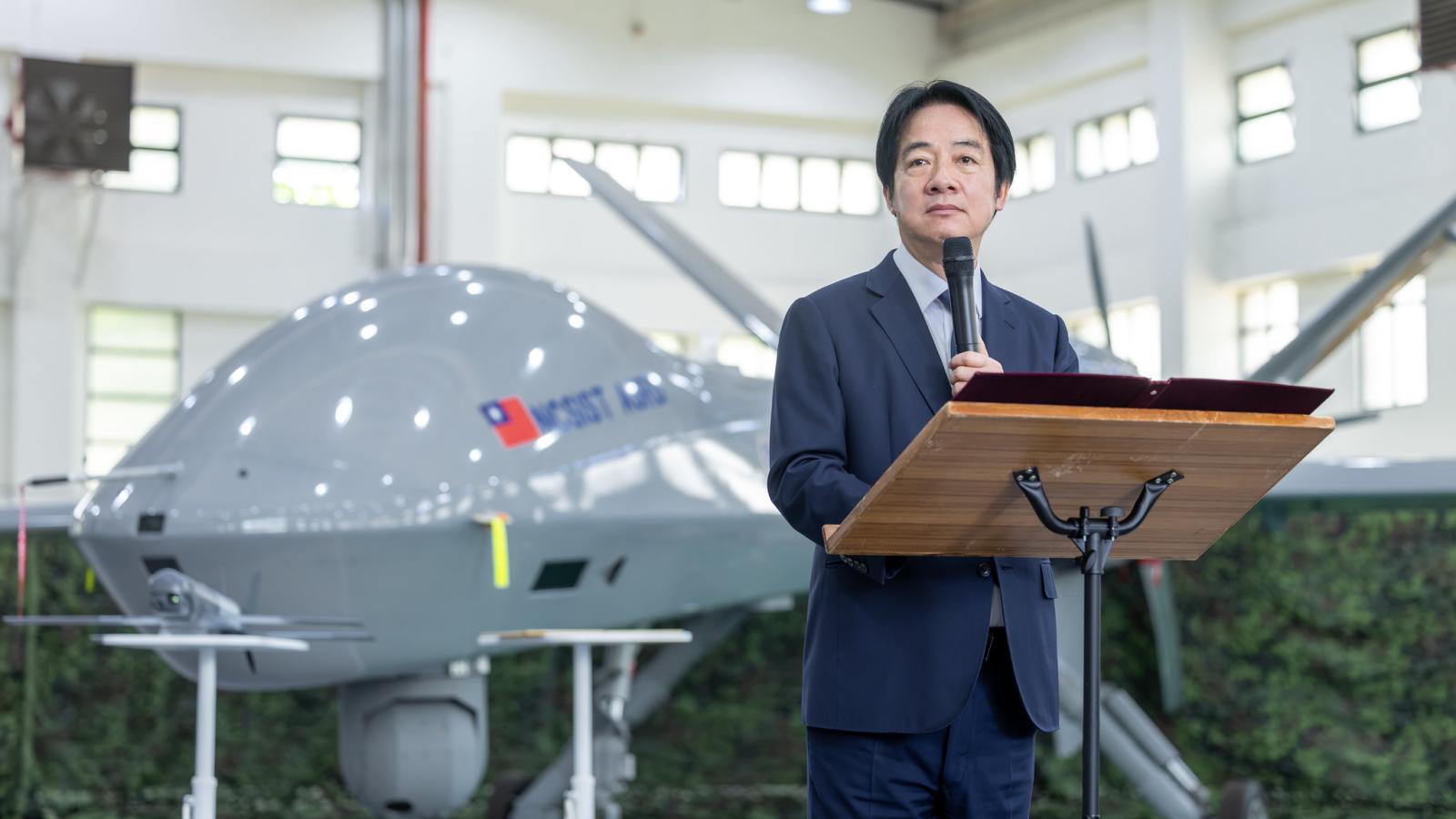
Drones have become a strategic focus for an increasing number of countries, propelled by conflicts such as the Russia-Ukraine war and U.S.-Iran tensions. Wu Ming-wei, Chairman of the Taiwan Defense Industry Development Association, asserts that Taiwan’s three core strengths—two decades of cybersecurity defense experience, the global trend toward sovereign AI, and a complete drone industrial supply chain—form three indispensable 'moats' in building a non-red supply chain.
Speaking at the 'AI Unmanned Vehicles, Communication Resilience, and Cybersecurity' cross-domain application symposium co-hosted by the AIoT Alliance and the Taiwan Global Wireless Platform Promotion Association on August 4, Wu emphasized that democratic nations seeking to develop non-red drone supply chains cannot do so without Taiwan.
First, Taiwan has spent 20 years strengthening its cybersecurity defenses. Wu compared this to Ukraine’s rapid drone innovation over the past four to five years, noting that Taiwan has undergone two decades of continuous iteration under constant cyberattacks. "Our industries have continued to operate despite being under a barrage of cyberattacks. You may not feel it, but without these national and industrial efforts over 20 years, the resilience and prosperity of all sectors could vanish overnight. This cybersecurity moat is uniquely Taiwan’s."
Second, in the era of sovereign AI, hardware production is inseparable from Taiwan. Wu stated, "If you’re not sourcing hardware from Taiwan, you might as well not even try." As nations seek to deploy AI models within their own sovereign boundaries, Taiwan’s semiconductor and hardware manufacturing capabilities are essential. "This makes AI Taiwan’s second moat."
Third, Taiwan’s full supply chain is concentrated on a single island, enabling rapid mass production. While innovation is showcased globally at defense expos, Wu stressed that without mass production, innovations remain mere demos. "Our integrated supply chain allows scalable manufacturing. Even if future needs require production closer to frontlines, we can replicate this ecosystem efficiently."
Stan Shih, founder of Acer and Honorary Chairman of the GloRa Promotion Association, also attended the event. GloRa, a low-power wireless transmission technology transferred from Taiwan’s National Chung-Shan Institute of Science and Technology, was launched in 2019 to foster an open innovation platform. Shih highlighted Taiwan’s R&D strength, urging a shift from the left (manufacturing) to the right (applications) of the smile curve. "Unmanned vehicles represent a major future application, especially integrating communications and AI, including edge computing chips—areas where Taiwan can lead."
Chen Yi-ting, Chairman of the Taiwan Disaster Prevention Industry Association, proposed three recommendations: First, government investment in the 'triple-integrated chip' (navigation, imaging, communication), currently dominated by China. Second, establishing a UTM (Unmanned Traffic Management) platform for airspace regulation. Third, shifting government procurement from hardware purchases to service-based models, allowing drone vendors to provide ongoing operational support and prevent underutilization due to staff turnover.
Chen emphasized that Taiwan’s long-term success in drones depends on regulatory readiness, supply chain credibility, and talent accumulation.
FACT BOX
- Source: PR Times
- Category: Event