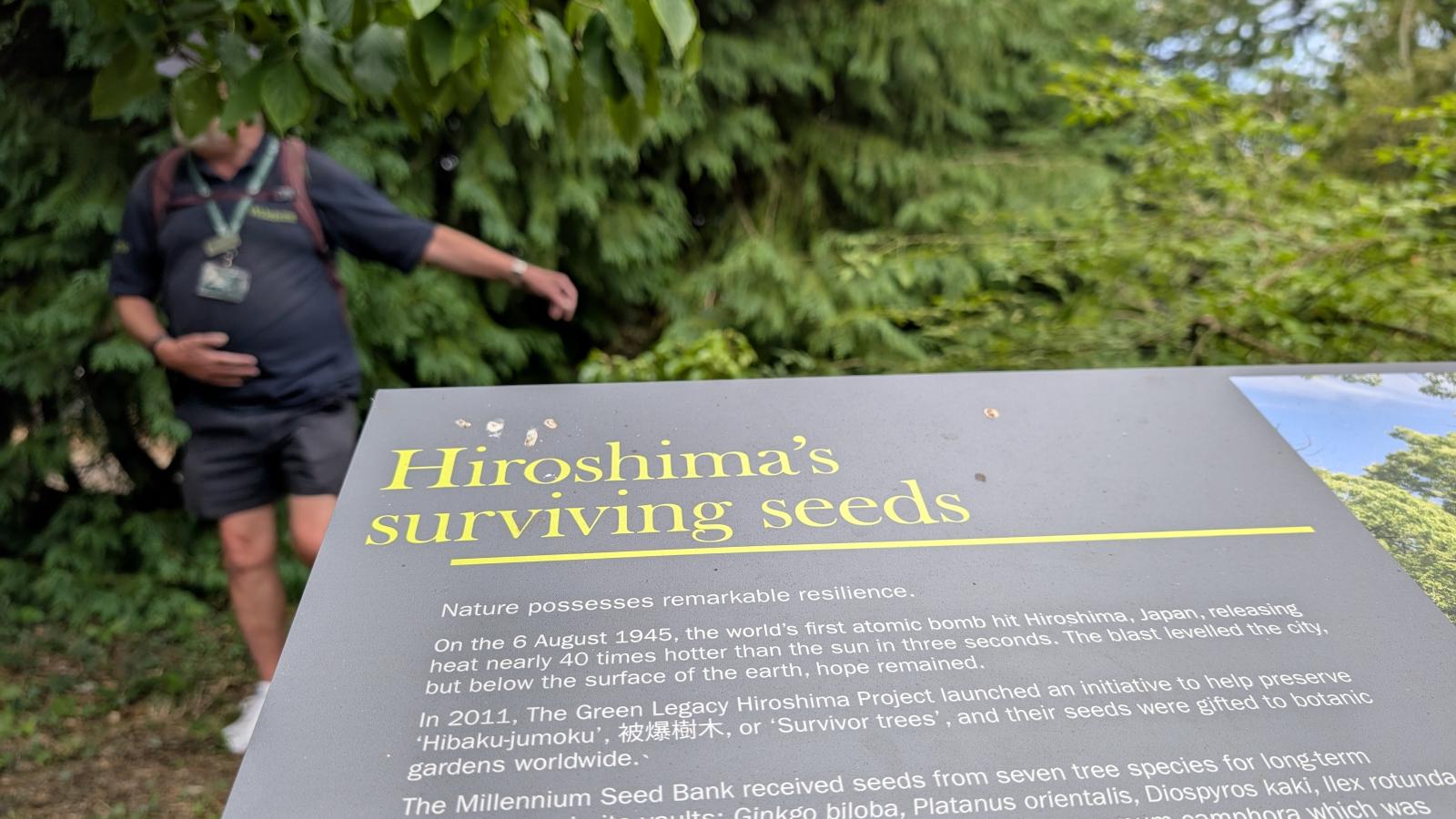
It has been several weeks since I began my internship in the UK through a youth agency program. My first trip out of London by British National Rail was to Wakehurst, located in West Sussex. After over an hour by train from London, I joined several other Taiwanese students in a shared taxi for another ten-minute ride to arrive at the site. Wakehurst is the country estate of Kew Gardens and home to the Millennium Seed Bank—one of the world’s largest seed banks and a key institution for conserving and researching biological genetic resources. Most visitors come to enjoy the lush flowers and greenery of the botanical garden, and we did too—though we were guided by a docent, listening to the stories behind each plant. Seed bank scientists at work in the laboratory (photo by Huang Yi-Fan) 'Hibaku Jumoku?' While listening to the English tour guide, I suddenly spotted four Chinese characters amid the sea of English text on a signboard—like spotting patches of land from an airplane flying over a blue ocean. I unconsciously read them aloud, smugly wondering why this English-to-Chinese translation looked so odd. 'Isn’t that Japanese?' A fellow traveler’s comment snapped me out of my ignorance. In Japanese, 'hibaku' means suffering from the atomic bomb or exposure to nuclear radiation. A web search for the term first brings up the Wikipedia page for 'hibakusha' (atomic bomb survivors), where black-and-white photos show heartbreaking images of severe burns and scars. Survivors with visible injuries often did not survive the acute phase, while the number and scope of those suffering long-term effects are far greater. Today (August 6) marks the 81st anniversary of the Hiroshima atomic bombing, and the day after tomorrow is the anniversary of the Nagasaki bombing. Babies who were in their mothers’ wombs at the time—known as 'in-utero hibakusha'—are now likely elderly with white hair. According to a report from Nagasaki Shimbun last year, by the end of 2025, 91,105 people will hold official hibakusha certificates, with an average age of 86.66. Over 9,000 kilometers from Japan, in a quiet corner of a British countryside botanical garden, a camphor tree (Cinnamomum camphora) about the height of an adult’s thigh is protected by a fence. Anyone with basic botanical knowledge can tell: this is not what an 80-year-old camphor tree should look like. Indeed, the tree growing in this historic estate is a descendant of an atomic-bombed tree—trees that personally endured the war, possibly once standing in parks, along streets, or in private gardens in Hiroshima. More than 200 atomic-bombed trees have been officially registered in Hiroshima and Nagasaki. At Sannō Shrine in Nagasaki, two famous camphor trees are designated as city monuments. From what appeared to be charred, lifeless trunks in 1945, they now boast green canopies stretching over 40 meters long and 20 meters wide. Their thick trunks have even become the shrine’s torii gates. The resilience of these plants served as a spiritual pillar during local reconstruction. While the shrine is worth visiting, locals do not wish for the old camphor trees to become overly commercialized tourist attractions. Trees after the atomic bombing. (Wikipedia) The 'Green Legacy Hiroshima' initiative, founded in 2011, distributes seeds from atomic-bombed trees worldwide to spread historical memory and a commitment to peace. At least seven species—including ginkgo (Ginkgo biloba), persimmon (Diospyros kaki), and Japanese camellia (Camellia japonica)—have been sent to Kew Gardens’ Wakehurst seed bank and botanical garden. These seeds, collected from bombed trees and shipped across oceans, undergo rigorous processes. Some are germinated, and the saplings are carefully nurtured to take root in foreign soil. Without signs or labels, no one would notice their special origin—just like people. Memory must be passed on; history must be told. Sometimes, seeds carry more than genetic or reproductive codes. In the Green Legacy Hiroshima project, they become messengers of hope, love, and peace. *The author is a wildlife enthusiast with a humanities background, currently interning at Kew Gardens in the UK through a youth agency program.
FACT BOX
- Source: PR Times
- Category: News