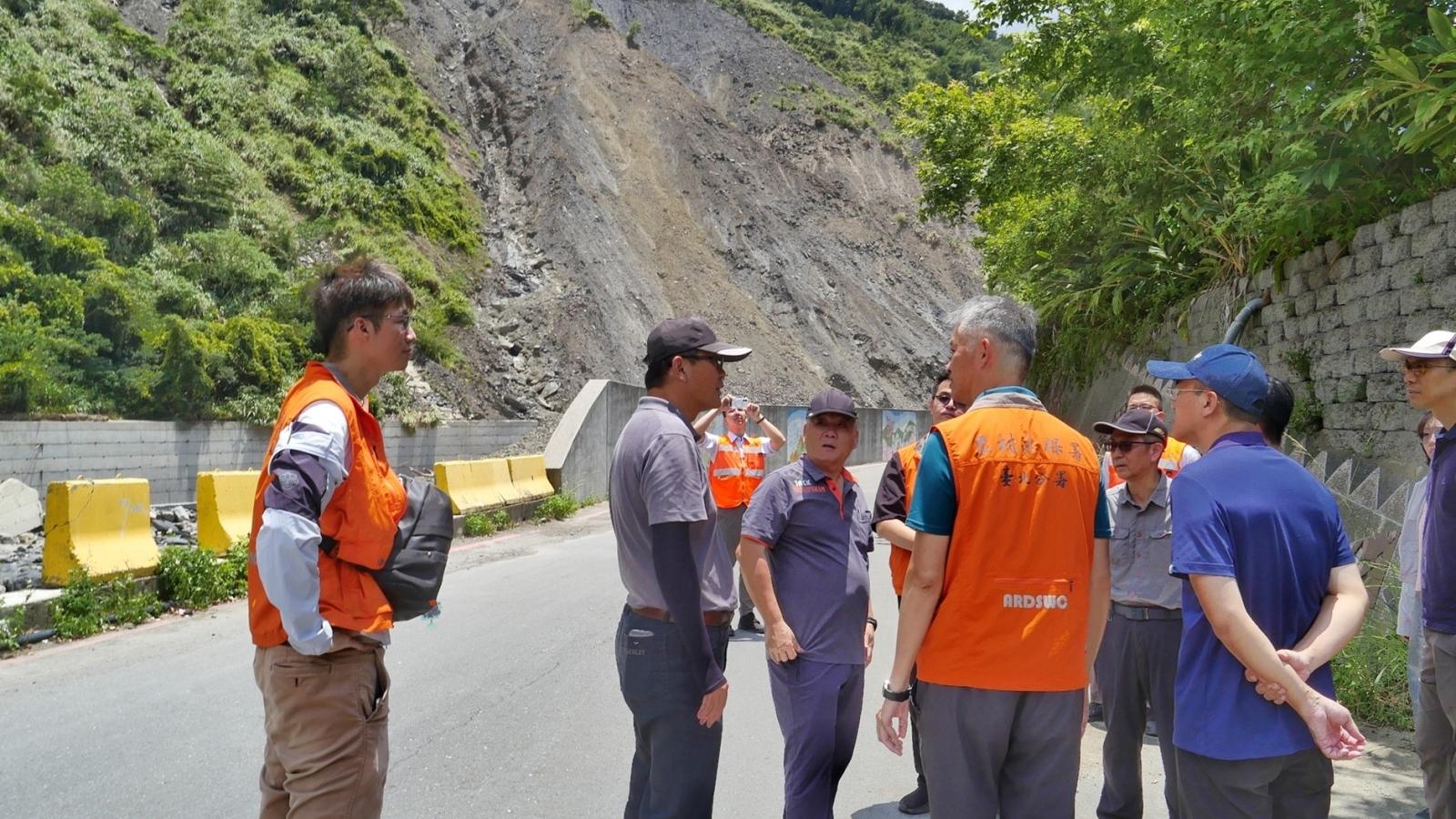
During Typhoon Bavi's impact on Taiwan, heavy rainfall in the mountainous areas of Jianshi Township, Hsinchu County triggered partial soil and rock slides in the large-scale landslide-prone zone of Xiuluan. In response, Chen Chun-Yen, Commissioner of the Council of Agriculture's Rural Development and Soil and Water Conservation Bureau (SWCB), led a team to conduct an on-site inspection on the morning of the 5th. The team assessed the extent of damage and slope stability, while receiving briefings from the SWCB Taipei Branch, construction teams, and relevant agencies on rainfall during the typhoon, slope changes in the landslide area, the scope of soil and rock movement, slope conditions, monitoring results, and future mitigation plans.
The Xiuluan large-scale landslide-prone area has been under continuous monitoring and mitigation efforts for years. Using instruments such as inclinometers, water level monitoring wells, ground tiltmeters, CCD cameras, and GNSS, the bureau tracks slope movements in real time. Since 2005, phased slope protection, surface and subsurface drainage, and groundwater management projects have been implemented. Going forward, slope protection and drainage infrastructure improvements will continue based on monitoring data and field observations to enhance slope stability and overall disaster resilience.
The SWCB emphasized that despite rainfall easing after a typhoon, prolonged precipitation can leave slopes in unstable conditions due to extreme weather patterns. It is therefore critical to promptly assess landslide extent, terrain changes, and slope conditions. Based on field surveys and monitoring data, continuous reinforcement of monitoring and mitigation measures, along with rolling reviews of future strategies, is essential.
The SWCB is also advancing disaster preparedness for debris flows and large-scale landslides. This includes strengthening alert dissemination via cell broadcast systems, promoting community-based debris flow disaster prevention programs, and periodically reviewing and updating debris flow warning thresholds. Additionally, to address risks affecting settlements, roads, and downstream areas, coordination with local governments is being enhanced to ensure timely emergency repairs, warnings, and evacuation preparedness—minimizing the risk of secondary disasters from subsequent rainfall and fully protecting the lives and property of mountain residents.
The SWCB reiterates its warning: when rainfall reaches alert levels in debris-flow-prone streams, large-scale landslide-prone zones, or high-risk secondary disaster areas, notifications will be sent via phone, fax, SMS, and disaster alert cell broadcasts to local governments and residents. These alerts will also be published simultaneously on the 'Debris Flow and Large-Scale Landslide Disaster Prevention Information Website' (https://246.ardswc.gov.tw) and the SWCB's official Facebook page for public access. Residents or members of the public who observe disaster signs are urged to report immediately via the Debris Flow and Large-Scale Landslide Hotline: 0800-246-246 (Toll-free).
FACT BOX
- Source: PR Times
- Category: News