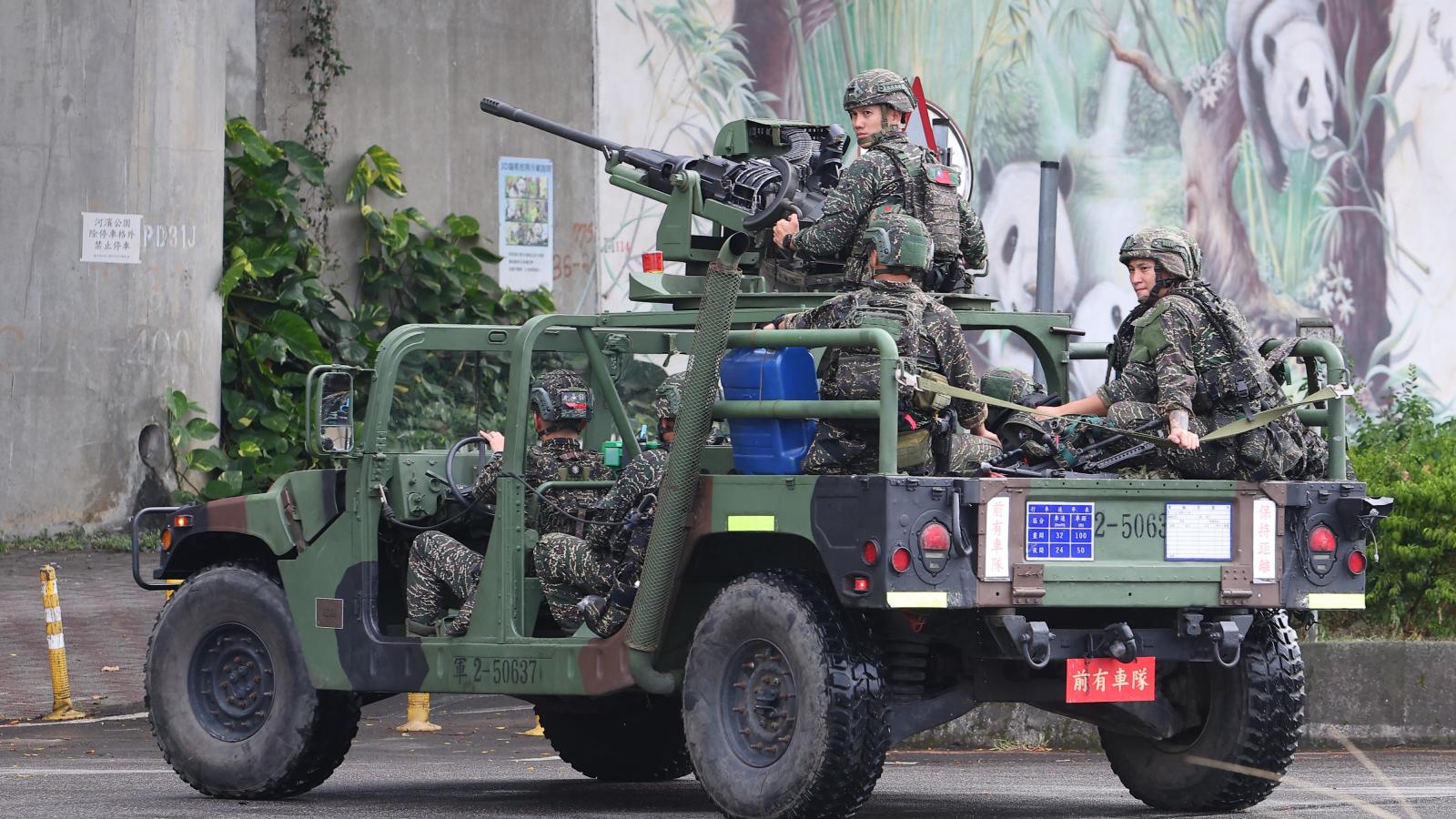
The 'Han Kuang 42' live-fire exercise, launched on August 5, spans 10 days and 9 nights, continuing last year’s expanded scale. Key drills include command continuity under attack, reserve mobilization, infrastructure protection, and civil-military coordination under blockade scenarios. Taiwan’s military emphasizes that this year’s drills are more realistic than ever, with a new focus on validating 'decentralized command' and 'total defense' for the first time.
Meanwhile, China’s official stance remains predictably hardline. Prior to the exercise, Chinese Defense Ministry spokesperson Jiang Bin stated: 'No matter how the DPP authorities perform, they cannot escape the inevitable end of Taiwan independence.' He criticized internet slowdowns as 'manufacturing war anxiety' and an attempt to 'force Taiwanese people onto the Taiwan independence war chariot.' State media and some Chinese military commentators labeled the drills as 'political theater' and 'election mobilization,' asserting that 'the PLA already possesses overwhelming superiority, and Taiwan’s exercises are nothing but self-deception.'
Public sentiment on Chinese social media: Polarized but consistent
Searching 'Han Kuang Exercise' on Chinese social platforms Weibo and Douyin reveals moderate热度, but comment sections show strikingly uniform sentiment. Some Chinese 'Little Pink' netizens mocked: 'Another movie being filmed,' 'Parts falling off, escape hatches detaching—Taiwan’s military capability is clearly inadequate,' and 'Slowing down the internet to torment civilians—is this military training or civilian torture?'
Some Chinese university professors linked the exercise to year-end local elections, arguing the DPP is using 'war anxiety' to consolidate votes. The internet slowdowns, concentrated in northern and central blue-camp counties, were interpreted as 'selective punishment.'
Some Chinese military enthusiasts analyzed the drills technically, dismissing exercises like 'blocking the Danjiang Bridge,' 'anti-blockade escort,' and 'civilian factories converting to drone production' as 'armchair strategies.' They pointed out that Taiwan’s eastern supply lines would be difficult to sustain under a joint PLA blockade, and that Taiwan’s own ammunition and energy reserves are limited.
Yet on Xiaohongshu and Douyin, some users hailed the exercise as 'Taiwan’s Shield,' framing it as a democratic stand. Such views were, as usual, swiftly deleted or led to account suspensions.
In recent years, whether it’s PLA flights around Taiwan, large-scale military drills, U.S. arms sales, or Taiwan’s Han Kuang exercises, new military news emerges almost monthly across the strait. A Beijing-based anonymous scholar in government舆情 (public opinion) work noted this reflects 'crisis fatigue'—events remain significant, but public emotional engagement has waned compared to the past.
Discussions on Chinese social media about the 'Han Kuang Exercise.' (From Sina Weibo)
Discussions on Chinese social media about the 'Han Kuang Exercise.' (From Sina Weibo)
Discussions on Chinese social media about the 'Han Kuang Exercise.' (From Sina Weibo)
Discussions on Chinese social media about the 'Han Kuang Exercise.' (From Sina Weibo)
China calls Han Kuang a 'scripted show,' but official military scholars see deeper implications
Although China did not issue an immediate official response to the 'Han Kuang Exercise,' some mainland military scholars noted on social media: 'Past Han Kuang drills were often criticized as “scripted,” but now more exercises focus on urban defense, reserve mobilization, drone usage, command systems under communication blackouts, and how local governments maintain basic operations. Taiwan is not just adding equipment—it is learning how to prolong resistance and enhance societal resilience.'
They added, 'This shift is also influenced by recent experiences from the Russia-Ukraine war.'
Some anonymous civilians pointed out: 'They (the DPP) are practicing societal operations under internet blackout, which shows they clearly understand that in actual combat, command centers, ports, and industrial facilities could be paralyzed in the first wave.'
However, what truly captured attention in China was the reported full observation and shallow participation by U.S. military personnel in the exercise. Kao Li-hsiung previously acknowledged that U.S.-Taiwan military cooperation is 'closer than outsiders imagine,' and the presence of 'English teachers' (U.S. personnel) and reverse briefing mechanisms during drills was interpreted in China as 'deepening U.S. involvement.'
Taiwan rehearses war; China sees politics
Taiwanese society increasingly views the Han Kuang exercise as 'peacetime preparedness.' Especially since last year, with extended drill durations and increased civil defense participation, 'total defense' and 'societal resilience' have become central to official narratives.
Analysts note that this year’s biggest change isn’t the number of new weapons, but the government’s intent to verify whether local governments, military, and civilian systems can continue operating even if central command is attacked.
The Han Kuang 42 exercise is still ongoing. Blocking the Danjiang Bridge, cross-island troop movements, anti-blockade escort drills, and real-world internet slowdown tests will continue. For Taiwan, this is a major test of command flexibility and societal resilience; for China, it reflects an ongoing escalation in the cross-strait strategic game.
FACT BOX
- Source: PR Times
- Category: Event