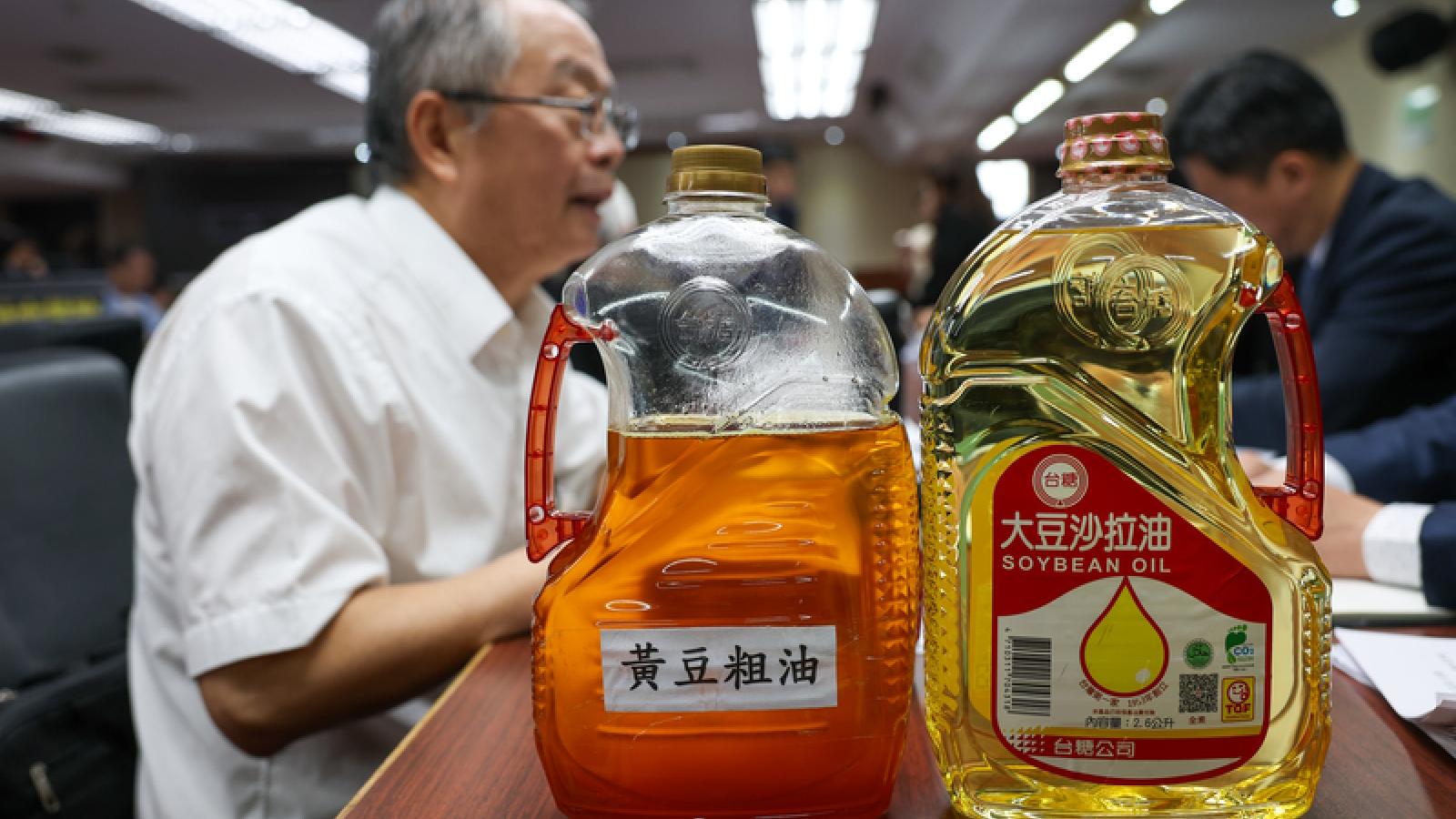
Regarding the incident involving carcinogenic oil from Chung Lien Oils, Chen Hongda, Director Prosecutor of Taiwan’s Supreme Prosecutors Office, has repeatedly questioned Taisugar’s reporting responsibilities, sparking a public dispute with Tainan Mayor Huang Wai-jhe.
Mayor Huang reiterated his stance today, asking: 'If you buy expired instant noodles at a convenience store, besides informing the store, do you have a legal obligation to report it to the local health authority?' In response, Chen Hongda issued a seven-point rebuttal, asserting that legal discussions must return to statutory provisions rather than being replaced by everyday analogies. A nation governed by law does not presuppose responsibility but ensures all administrative actions align with legal text, legislative intent, and institutional principles.
In May, Taisugar planned to purchase crude oil from Chung Lien Oils but discovered excessive levels of benzopyrene—a carcinogen—before taking delivery and immediately rejected the shipment. However, the opposition party has accused Taisugar of failing to report the incident to the Tainan City Government, where its headquarters are located. Chen Hongda has repeatedly emphasized that Taisugar had a legal duty to report.
Previously, Huang argued: 'Where is the oil? Whose oil is it?' He stressed that the oil was never Taisugar’s property, as the company had already informed Chung Lien that the goods were substandard, meaning Chung Lien should bear responsibility. Today, he again used an analogy: 'If you find expired instant noodles at a convenience store, besides reporting to the store, do you have a legal duty to report to the local health bureau?'
Does Taisugar have a reporting obligation? Chen cites legal clauses: The key isn’t 'who owns the oil'
In response to Huang’s remarks, Chen Hongda offered seven professional legal points:
One, the real issue isn’t 'who owns the oil,' but whether 'Taisugar qualifies as a food business legally obligated to report.' Huang repeatedly emphasizes: 'The oil belongs to Chung Lien Oils' and 'Taisugar did not take delivery.' However, legal reporting obligations are not determined by ownership transfer. Article 8 of the Tainan City Food Safety Management Ordinance states: 'When a food business discovers upstream-supplied food that may endanger consumers’ lives, bodies, or health, it must proactively report within 48 hours.' The clause refers to 'upstream-supplied food' and does not require conditions such as 'completed delivery,' 'ownership acquired,' or 'entered factory premises.' Therefore, as long as the situation meets the legal definition of 'upstream supply' and poses potential health risks, a statutory reporting obligation may arise. Thus, the primary discussion should focus on whether legal elements are met—not ownership.
Two, comparing this case to 'a consumer finding expired instant noodles at a convenience store' misrepresents the legal relationship. Chen points out that Mayor Huang’s analogy assumes consumers lack reporting duties, so food businesses like Taisugar should too. This comparison is inappropriate because consumers are not food businesses. Article 8 of the ordinance specifically targets 'food businesses.' Food safety laws impose higher vigilance and active reporting duties on food businesses precisely because they control supply chain information, unlike ordinary consumers. Therefore, equating consumer duties with those of food businesses is legally invalid.
Three, I have never advocated 'immediate punishment,' only 'investigation and accountability under law.' Mayor Huang stated that penalties should not be rushed before the truth is clear. Chen fully agrees. However, his consistent public stance is: If an investigation confirms Taisugar met the elements of Article 8 but failed to report, it should be penalized according to law. This position is grounded in legal provisions, not a call for punishment without due process. Investigation and penalty under law are fundamental principles of administrative legality.
Four, 'not taking delivery' does not automatically exempt one from administrative liability. Administrative obligations often do not rely on civil ownership. For example, occupational safety responsibility isn’t solely based on ownership. Environmental pollution liability isn’t either. Food safety management responsibility is built upon supply chain oversight duties. Therefore, 'not yet received' cannot directly lead to 'no legal obligation.' Chen stresses that the real question is whether the law includes this scenario within its scope.
Five, while local governments may consult central authorities on legal interpretation, local ordinances must still be applied independently. Chen acknowledges that local governments may seek guidance from central agencies when legal application is unclear. However, such guidance letters are merely administrative opinions. If the local ordinance’s wording is sufficiently clear, local governments must apply it based on law—not replace the ordinance itself with central administrative views. The core of rule-by-law administration is always the law, not guidance letters.
Six, my concern is legal interpretation, not political stance. Chen clarifies that Mayor Huang accused him of overriding law with political bias. He firmly denies this. All his public comments cite legal texts, local ordinances, and administrative law principles, focusing on three questions:
- Does a statutory reporting obligation exist? - Should there be a legal investigation? - Should legal penalties apply?
He has never commented on political parties or expressed political positions. Labeling legal discussions about government conduct as 'political' undermines rational discourse in a rule-of-law society.
Seven, what matters more is food safety risk management, not blame-shifting. The purpose of mandatory reporting in food safety law is not post-incident accountability but early risk detection to prevent harm from spreading. Therefore, the crucial discussion is whether food businesses, upon learning of significant food safety risks in upstream products, should promptly inform regulators to enable timely action. This is the core value of the reporting system in food safety law.
Chen concludes by reaffirming his belief: Legal issues must return to legal discussion. The real question in this case isn’t 'who owns the oil' or 'where the oil is,' but: When a food business knows upstream-supplied food may endanger consumer health, does it have a legal duty to report? If yes, it must act accordingly. If no, a full legal argument must be provided—not replaced by analogies about ownership, delivery status, or buying expired instant noodles. A nation governed by law seeks not to presuppose responsibility, but to ensure all administrative actions return to the letter of the law, legislative intent, and institutional spirit.
FACT BOX
- Source: PR Times
- Category: News