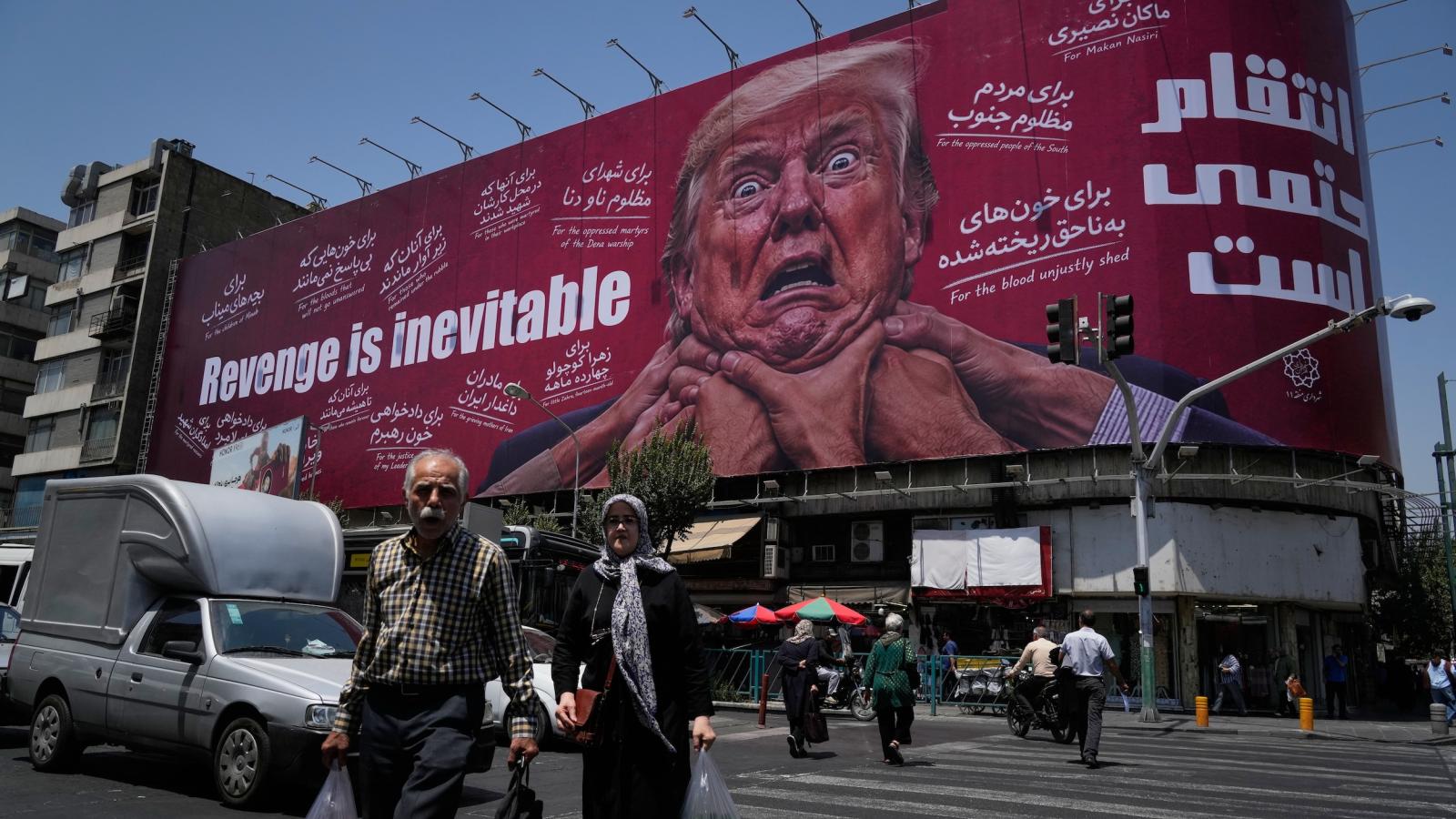
The war between the United States, Israel, and Iran has not ended. U.S. President Trump recently stated that negotiations between the U.S. and Iran are underway, focusing on reopening the Strait of Hormuz, and warned that Iran would face a 'heavy blow' if it reneges again. However, Iran's Foreign Ministry denied any talks with the U.S.
In response, Hsieh Jin-He, chairman of Wealth & Trust Media, analyzed Iran's political structure, pointing out that while Trump negotiates with the administrative system, the Khamenei family's Revolutionary Guard, which controls military power, refuses to comply—creating an unsolvable deadlock.
Hsieh posted on Facebook that Trump is trapped in Iran's war scenario. News frequently reports Trump claiming that the U.S. and Iran are about to reach an agreement and that Iran has accepted peace terms, only for him to immediately issue threats to 'bomb Iran to rubble.' This inconsistency leaves people confused—whom should they believe? 'In fact, no one truly understands Iran's political situation!'
Is Iran a major power? Hsieh reveals the economic gap: 90% of wealth is held by the Khamenei family.
Hsieh pointed out that Iran, with a land area of 1.65 million square kilometers and a population of 93.5 million, is considered a 'major country.' However, its total economic output is only $300.2 billion—less than half of Israel's $739.8 billion, despite Israel having only 10 million people.
In terms of total economic output, Israel ranks 26th globally, while Iran ranks 53rd. Even the United Arab Emirates, which intuitively seems like a 'small country,' has a GDP of $635.9 billion, ranking 30th worldwide. Iran has vast land and a large population, but weak economic strength.
Hsieh bluntly stated, '90% of the country's wealth is concentrated in the hands of the Khamenei family.' The nine siblings of Iran's Supreme Leader Khamenei hold wealth globally and control the Revolutionary Guard, wielding life-and-death authority. Iran elects a president, parliament members, and a speaker through democratic mechanisms, but they hold no real power. Trump negotiates peace with the administrative system, but the Revolutionary Guard refuses to accept it, resulting in an unsolvable deadlock in Iran.
Not just Iran—dictators monopolize national wealth. Hsieh: The vicious cycle never ends.
Hsieh noted that Iran's economy, under sanctions, faces severe challenges. The currency 'rial' has plummeted—1 U.S. dollar now exchanges for 1.1 to 1.84 million rials. A pound of beef costs 10 million rials. Millions are unemployed, and inflation is out of control. Yet the Revolutionary Guard maintains strong control, leaving people powerless.
Iran's economic crisis drags on, but oil prices haven't skyrocketed—hovering around $80. Trump can do nothing but stand by helplessly.
Hsieh mentioned that Turkey in West Asia has seen a similar collapse—the lira plunged from 1.386 to 47.577 per dollar. Former Venezuelan President Maduro, after being detained in the U.S., was found to have 127 tons of gold and 60,000 to 70,000 bitcoins in Swiss bank accounts—revealing that Venezuela's oil revenues had flowed entirely into Maduro's family accounts.
Hsieh lamented, 'Authoritarian dictators use force to control people, and national resources flow entirely into their families' hands. This vicious cycle never ends!'
More exclusive Wind Media reports: · Trump's statements constantly denied by Iran—U.S.-Iran talks in disarray—mediator Qatar reveals negotiation progress · U.S.-Iran peace talks drag on: Tehran slaps down Trump, saying 'no talks with the U.S.'—experts analyze Iran's confidence
FACT BOX
- Source: PR Times
- Category: News