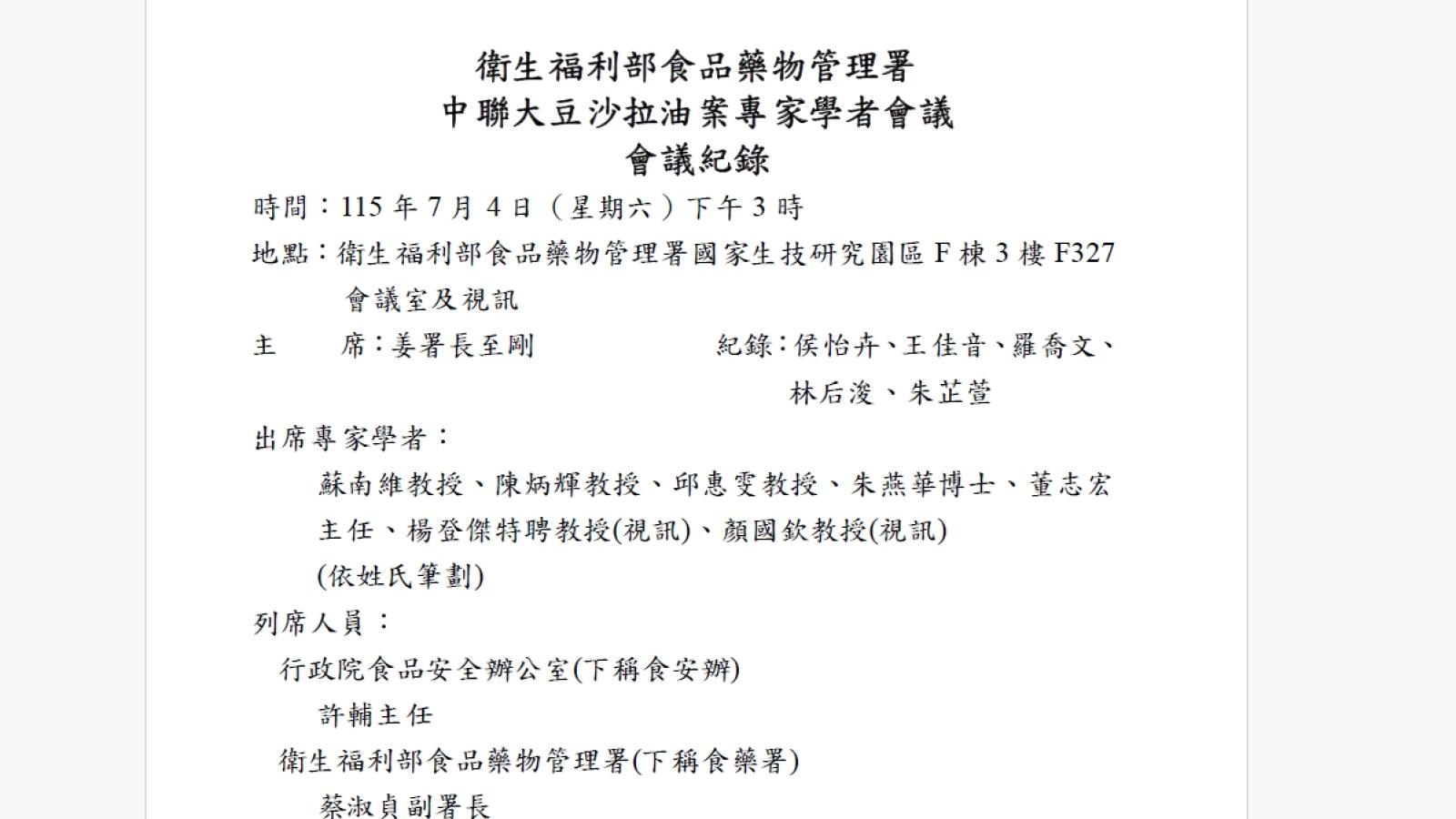
After much anticipation, the minutes of the July 4 meeting have finally been released—and the revelations have shocked the public. Senior officials from Taiwan’s Ministry of Health and Welfare appeared naive, particularly the Taiwan Food and Drug Administration (TFDA), which fully accepted Chung Lian Oil’s one-sided narrative without conducting an on-site factory inspection. Reading through the 17-page document sends chills down the spine.
As the regulatory authority with administrative enforcement power, the TFDA failed to seize original logbooks, inspect import invoices, or conduct on-site audits at the factory in the immediate aftermath of the incident. Instead, it grandly organized an expert panel discussion, inviting top executives from Chung Lian Oil to present theories blaming 'excess moisture in Brazilian soybeans' and 'climate-related cross-contamination' as acts of God.
Officials and experts sat in air-conditioned rooms, listening attentively and even offering improvement suggestions, creating a bizarrely warm and supportive atmosphere. One must ask: Was the TFDA simply too naive to see through the company’s manipulation, or was it deliberately creating a safe haven for the company under the guise of administrative guidance? No wonder opposition lawmakers are shouting: 'The Ministry must not become a door god!'
In a rule-of-law society, food safety regulation must follow the iron rule: 'Verify first, consult later.' Regulatory agencies should act like detectives, relying on objective physical evidence. Yet the TFDA performed a backwards absurdity, directly accepting Chung Lian Oil’s claims that 'process parameters remained normal' and 'exceedances were only confirmed in late June with voluntary reporting.'
Without on-site audit data, invited experts were forced to work with highly curated, misleading information. When the input is garbage (Garbage In), the output—risk assessments—becomes meaningless junk (Garbage Out).
Far from protecting public health, this meeting objectively served as a legal shield for Chung Lian Oil to later claim 'full cooperation with administrative guidance.'
It was only due to subsequent third-party independent investigations and a major criminal search operation by Taichung prosecutors that the truth came to light. The revelations make the July 4 meeting appear even more ironic.
First, the lie about raw material acceptance. Chung Lian claimed 'natural disaster contamination,' but investigations found the company had unilaterally relaxed its heat-damaged grain acceptance standard by tenfold—from 0.5% to 5%—clearly sacrificing source control for higher intake.
Second, the lie about process control. Chung Lian insisted processes were stable, but original data revealed its degumming parameters had exceeded limits since April, and bleaching stages involved cost-cutting shortcuts, with activated clay far below required levels.
Third, the lie about voluntary reporting. Chung Lian portrayed itself as a responsible notifier, but prosecutors uncovered downstream vendors had reported exceedances as early as May. Senior management chose to conceal and delay disclosure for nearly a month.
Whether the TFDA was truly too incompetent to detect the lies, or complicit in a tacit performance of 'administrative theater,' this meeting has exposed the bureaucracy’s incompetence and negligence. The incident reveals a critical flaw in the TFDA’s crisis response: regulatory oversight must not be based on 'trusting businesses,' but on 'verifying with on-site data' (Trust, but verify). Listening to corporate excuses before helping them debug only undermines expert authority and deeply damages public trust in the food safety system.
FACT BOX
- Source: PR Times
- Category: News