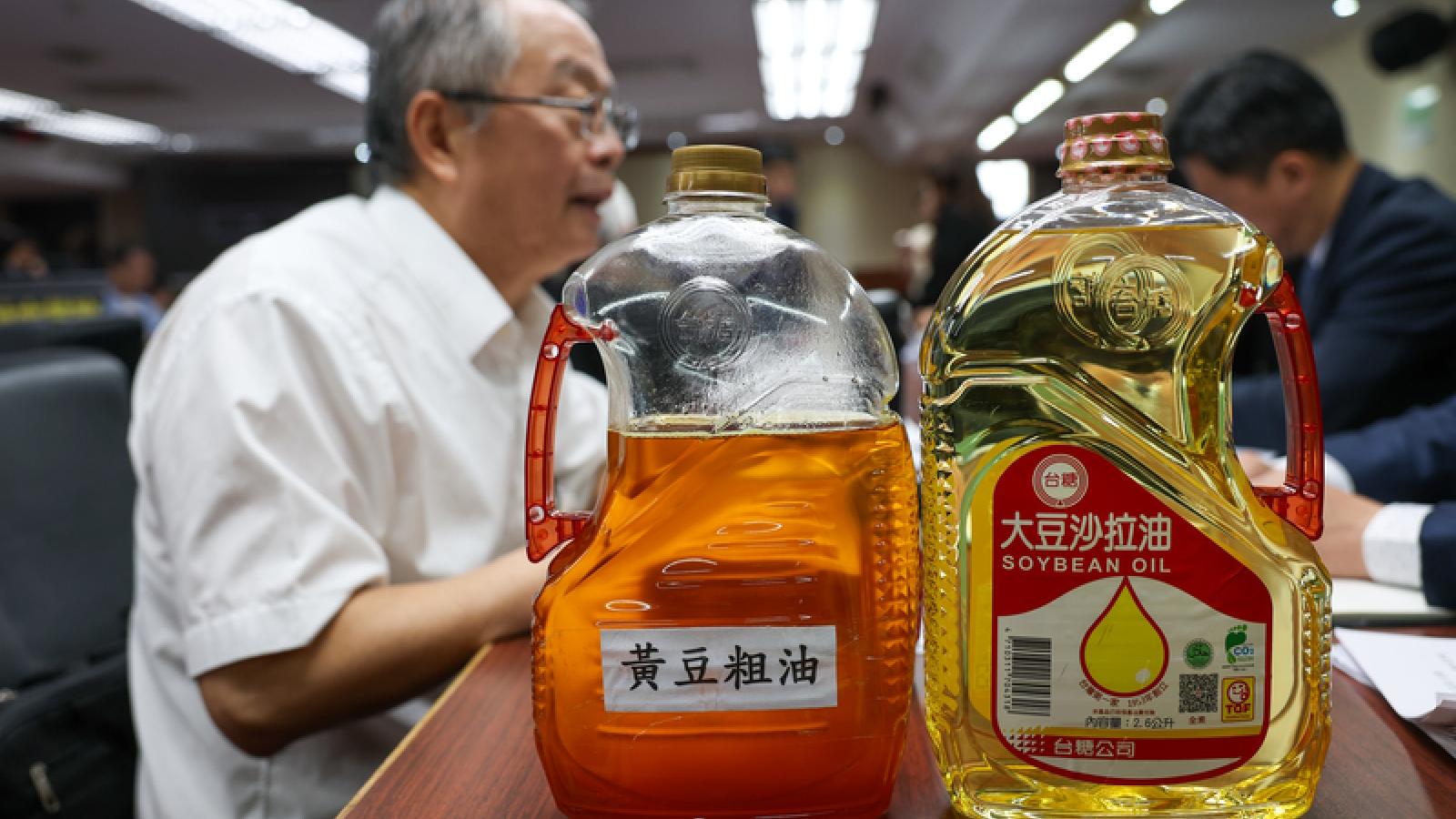
Taisugar's concealment caused Taiwanese people to consume toxic oil for an additional two months!
Zhonglian Oils, a major edible oil manufacturer, was found to have used soybean crude oil containing excessive levels of benzopyrene (BaP), a known carcinogen. Despite senior executives at Zhonglian and Taisun Company being aware of the超标 levels, Zhonglian's management maliciously suppressed the information, failed to initiate a voluntary recall, and continued shipping products—even after frontline workers reported in April that 'the beans were rotten' and 'the oil felt sticky when processed.'
Prosecutors only launched a major raid in July, leading to the detention of four key executives, including Zhonglian's CEO Yu Ling-chong and former Taisun CEO Shen Yi-chun, who were accused of evidence tampering and collusion.
Recently, during an investigation, Taichung District Court revealed that state-owned Taisugar had sampled the oil on May 11, 2026, and confirmed by May 15 that a batch of crude oil purchased from Fumao Oil and processed by Zhonglian contained benzopyrene levels as high as 14.7 ppb—far exceeding the legal limit of 2 ppb. Despite being a public enterprise with a duty to protect public health, Taisugar chose only to reject and return the oil without notifying health authorities. This triggered fierce criticism from opposition parties and the public, especially with elections approaching, accusing the central government and state enterprises of covering up the toxic oil scandal to protect the DPP's image at the expense of public health.
The KMT legislative caucus and several politicians questioned why Taisugar, as a state-owned enterprise, failed to comply with Article 7 of the Food Safety Act, which mandates reporting of any hazardous food products or raw materials. In contrast, private companies like Nan Chiao were previously fined NT$3 million for failing to report similar issues. Yet, the Ministry of Economic Affairs (MOEA) defended Taisugar, claiming it had no reporting obligation—highlighting a clear double standard and cover-up culture.
Finally, a voice of integrity emerges from the judiciary.
Under DPP rule for the past decade, the judiciary has become one of the least trusted institutions. Thus, despite ongoing investigations, the public remains skeptical. The pattern of 'loud thunder, light rain'—high-profile actions followed by weak outcomes—has become the public's perception of judicial decisions on non-DPP cases. Yet, some in the judiciary have refused to stay silent.
After Taisugar's failure to report was exposed, the MOEA claimed that 'reporting obligations should not be infinitely expanded.' In response, Chen Hung-ta, Director Prosecutor of the Taiwan High Prosecutors Office, immediately stated: 'Reporting is not a favor from the administration—it is a legal obligation.' He further warned: 'The greatest danger to a rule-of-law society is not the absence of laws, but the failure to enforce them, or using administrative interpretations to nullify laws.'
Chen's remarks were not only a rebuke of the MOEA's defense of Taisugar but also a broader critique of the Lai administration's practices over the past two years—such as refusing to co-sign passed legislation, misallocating budgets, or using administrative discretion to reinterpret laws—effectively undermining legislative authority.
Over the past two years, the Lai administration has sparked constitutional controversies by refusing to implement laws passed by the legislature (e.g., amendments to the Fiscal Revenue and Expenditure Allocation Act), citing 'practical difficulties' or withholding co-signature. Additionally, crackdowns on online content and speech have raised concerns about administrative overreach, threatening Taiwan's cherished freedoms of expression and human rights.
In this context, Prosecutor Chen Hung-ta's willingness to speak out—despite risking his career—has earned widespread public praise.
State-owned enterprises have become political spoils, riddled with scandals—how much longer can the people endure?
Since the DPP took power, every 'Tai-' prefixed state-owned enterprise—Taisugar, Taifong, Taipen, Taipower, Taisalt, Taiwan Bank, Taiwan Tobacco and Liquor, Taiship, and Taiwan Railways—has become a haven for political patronage. Are these positions merely retirement perks for loyalists or 'fat cats' for green-camp politicians? How many board chairs, directors, or independent directors are appointed based on merit rather than political loyalty?
Of these nine 'Tai-' enterprises, only Taiwan Tobacco and Liquor has avoided major scandals under DPP rule—each of the others has faced significant corruption cases. No wonder Taisugar chose to cover up the scandal, and when exposed, was still shielded by the MOEA—truly a case of 'snakes and rats in cahoots.'
Former Taisalt chairman Chen Chi-yu was accused of using 'Taisalt Green Energy' to funnel profits and drain company assets, causing a NT$400 million loss, yet was released on bail. Wu Nai-jen, former Taisugar chairman, was convicted of breach of trust and received only a nine-month sentence. He and Chun Lung Company were ordered to jointly compensate Taisugar over NT$180 million in damages and interest—but for 12 years, they have evaded payment and avoided detention.
Most shockingly, in 2013, when Lai Qing-de was mayor of Tainan, he held a tearful press conference vowing to 'stake his political life' on Wu Nai-jen's innocence, promising to resign and leave politics if Wu was found guilty.
Yet today, Wu's conviction has been upheld by the Supreme Court, and he continues to avoid detention under 'health reasons.' Lai has completely ignored his promise, showing no integrity. That such a person is now president is a tragedy for Taiwan! Should the people continue to support this government—or cast votes that perpetuate such wrongdoing?
*Author is an independent media creator
FACT BOX
- Source: PR Times
- Category: News