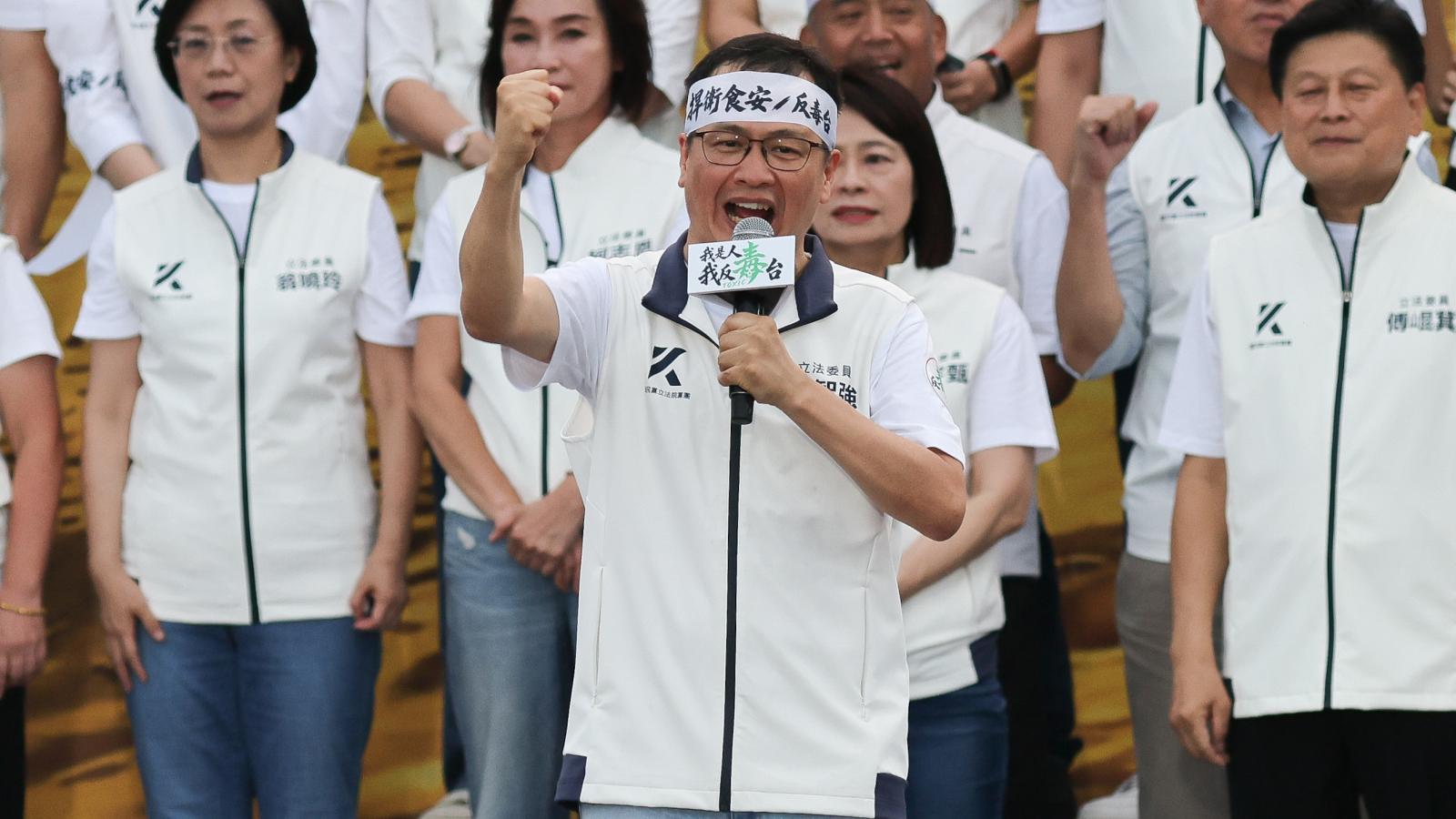
Food safety has never been merely a technical or legal dispute, but rather the most fundamental line of public trust in government. When a nation's government faces serious public safety concerns, its core responsibility should be to disclose the truth and conduct rigorous investigations—not to become a public relations or legal department for implicated organizations and companies. Yet, reviewing the recent food safety scandals, the ruling authorities' responses—from top to bottom—have been filled with disheartening double standards and protectionism.
Back in 2014, Lai Qingde, then mayor of Tainan, actively promoted the strictest food safety self-governance ordinance in Taiwan, vowing to protect citizens' health and refusing to compromise with illegal businesses. Time has passed, and the former 'Mayor Lai' is now 'President Lai.' However, when facing current food safety controversies and state-owned enterprise crises, what the public and opposition hear is no longer a declaration of strict punishment, but repeated justifications and cover-ups by regulatory agencies on behalf of implicated companies. The stark contrast in positions is truly disheartening.
In the Zhonglian Oils benzopyrene (a carcinogen)超标 case, Taisugar detected benzopyrene levels as high as 14.7 ppb in crude oil as early as May—seven times the legal limit—yet treated it merely as a commercial defect for return or replacement, failing to report it to health authorities. Prosecutors further discovered that Zhonglian had internally flagged abnormalities in Brazilian soybean raw materials as early as April, describing the quality as 'terrible and strange,' yet allegedly concealed the issue, causing unaware consumers to ingest toxic oil.
Instead of holding the parties accountable, the Ministry of Economic Affairs and the Food and Drug Administration (FDA) resorted to legalistic distinctions such as 'raw materials are not final products' and 'no legal obligation to report,' even publicly praising Taisugar as a 'well-behaved company conducting high-standard self-inspections.' Senior executives of the implicated firms even attended government improvement meetings without consequence.
This self-justifying administrative logic was swiftly rejected by the judiciary. Chen Hongda, Director Prosecutor of the Supreme Prosecutors Office, clearly stated that discovering food safety hazards carries a legal obligation to report—it is not a favor granted by administrative agencies. He warned that if the Executive Yuan arbitrarily narrows legal interpretations and selectively applies provisions of the Food Safety Act meant for prevention, its standards would fall below even those of local self-governance ordinances.
The ruling authorities once harshly criticized local governments for inadequate enforcement. Now, however, when faced with Taisugar's failure to report—an entity under the jurisdiction of Tainan and Kaohsiung—they twist legal interpretations to provide continuous cover, raising suspicions of deflecting attention and concealing the ruling party's and state-owned enterprises' dereliction of duty.
While responsible ministries are busy protecting their own and shifting blame, the Executive Yuan and Presidential Office remain silent, failing to address public concerns about state-owned enterprises' lack of food safety vigilance. With the source still unclear, central and local governments, as well as different ministries, are already mired in mutual blame-shifting, fully exposing the government's failure in crisis management.
Looking back at the ruling party's development, it indeed began with the初心 of fighting for democracy and standing with the disadvantaged. But after long-term power consolidation and prolonged tenure in high office, the system has become highly bureaucratic. Policy thinking has gradually shifted to prioritizing 'protecting official positions' over public sentiment, drifting further from grassroots voices.
When the public feels anxiety and anger over food safety concerns, the leadership remains indifferent. They care more about state enterprises' financial losses and administrative accountability than the health and safety of citizens.
Where is the leadership and accountability of the Presidential Office and Executive Yuan in the face of major food safety crises? Power should not cause one to forget their original purpose. The government must immediately step out of the bureaucratic echo chamber and directly confront public skepticism about food safety and governance integrity. Only by ending protectionism, restoring the spirit of the rule of law, and implementing objective, fair oversight and transparent information disclosure can the nation's food safety defenses be rebuilt and public trust restored.
*The author is an overseas Taiwanese working in journalism.
FACT BOX
- Source: PR Times
- Category: News