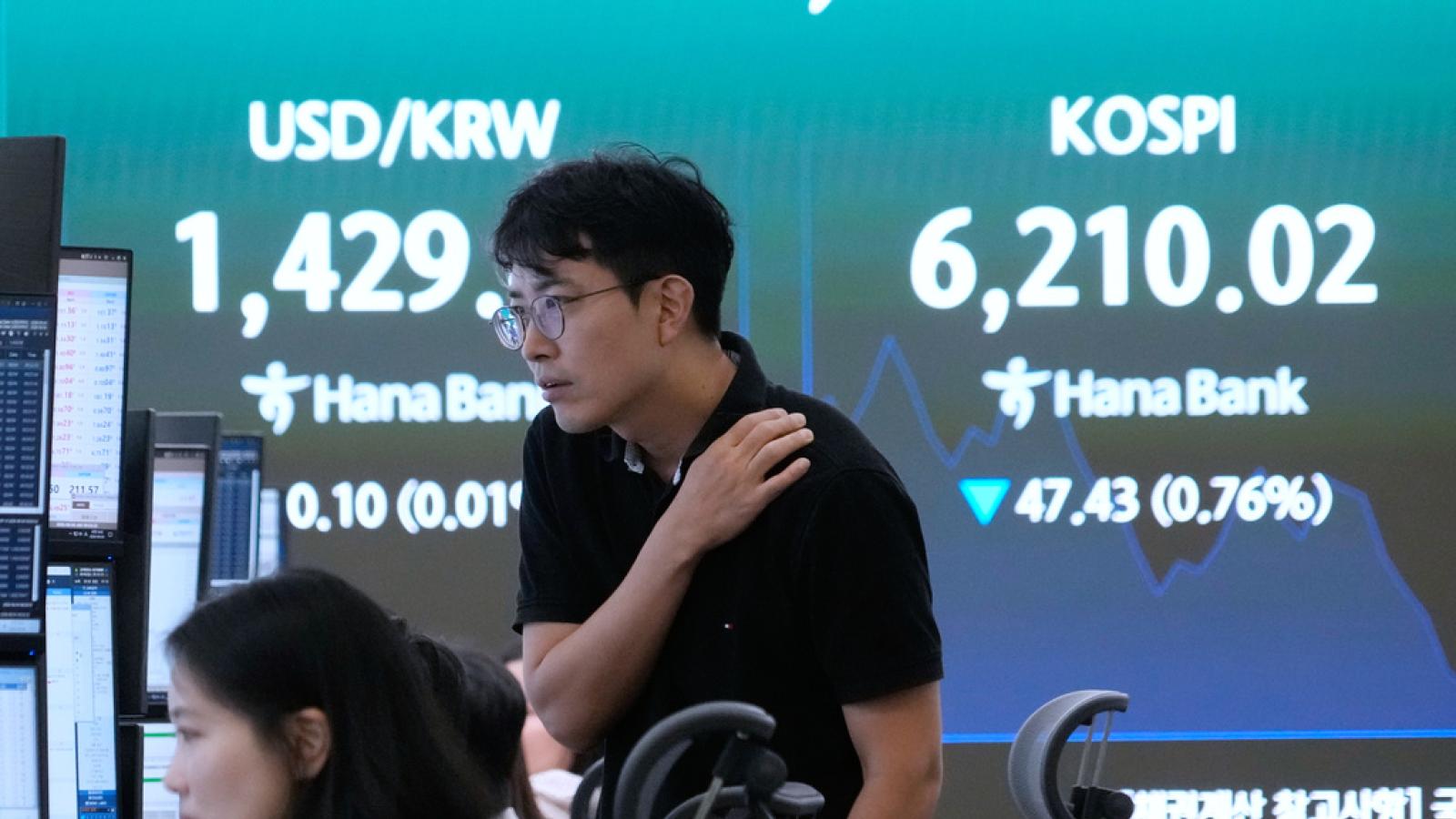
As global demand for artificial intelligence (AI) drives a strong recovery in the semiconductor market, South Korea—home to two major memory chip suppliers—is reaping significant fiscal benefits after years of severe budget deficits. Soaring corporate profits, rising wages, and a surge in stock market trading volume have collectively pushed income tax, corporate tax, and securities transaction tax revenues sharply higher, providing much-needed relief to Seoul's finances.
According to the latest data released by South Korea's Ministry of Economy and Finance, national tax revenue for the first half of 2026 reached 223 trillion won (approximately NT$5.05 trillion), a significant 17.4% increase compared to the same period in 2025. Income tax rose by 10.4 trillion won, corporate income tax by 4.3 trillion won, and value-added tax (VAT) increased by 4.9 trillion won. The booming stock market further fueled a substantial rise in securities transaction tax, which jumped by 5.2 trillion won (approximately NT$117.67 billion) year-on-year.
Initially, Seoul set its 2026 national tax revenue target at 390 trillion won (approximately NT$8.83 trillion). However, after chip exports far exceeded expectations, the target was revised upward in April to 415.4 trillion won (approximately NT$9.4 trillion). With semiconductor giants scheduled to file their advance corporate income tax payments for the first half by the end of August, tax revenue is expected to climb even higher.
The 'two giants' referred to are memory chip leaders Samsung Electronics and SK Hynix, whose combined operating profit for the first half of 2026 reached 245 trillion won (Samsung: 146.7 trillion won, SK Hynix: 98 trillion won). The combined profit of just these two companies amounts to roughly one-third of the South Korean government's annual budget. According to estimates by KB Securities, the amount of corporate tax these two chip leaders will prepay this month could surpass 50 trillion won (approximately NT$1.13 trillion).
Benefiting from robust semiconductor exports and supplementary budget injections, the South Korean government has recently raised its 2026 full-year economic growth forecast from 2% to 3%. Park Hong-keun, Minister of Economy and Finance, confirmed on a recent program that 2026 national tax revenue will surpass 400 trillion won (approximately NT$9.05 trillion) for the first time, potentially approaching 450 trillion won. If the semiconductor boom continues, tax revenue in 2027 could even challenge the 500 trillion won mark (approximately NT$11.3 trillion), setting a new record.
Looking back at 2023 and 2024, the South Korean government faced severe tax revenue shortfalls of 56.4 trillion won and 30.8 trillion won, respectively. Now, with this windfall of tax revenue, the key challenge for Seoul will be how to efficiently and strategically allocate these funds for long-term national benefit.
To this end, the Ministry of Planning and Budget announced the establishment of a 'Future Response Fund' to invest in strategic future industries—such as artificial intelligence, semiconductors, and biotechnology—as well as youth welfare programs. Minister Park emphasized that the government must not use these additional revenues for short-term consumption or myopic spending. The creation of this fund aims to ensure prudent allocation of surplus tax revenue and enable smarter long-term strategic investments, thereby creating greater business opportunities and future potential.
FACT BOX
- Source: PR Times
- Category: News
- Products / services: DRAM