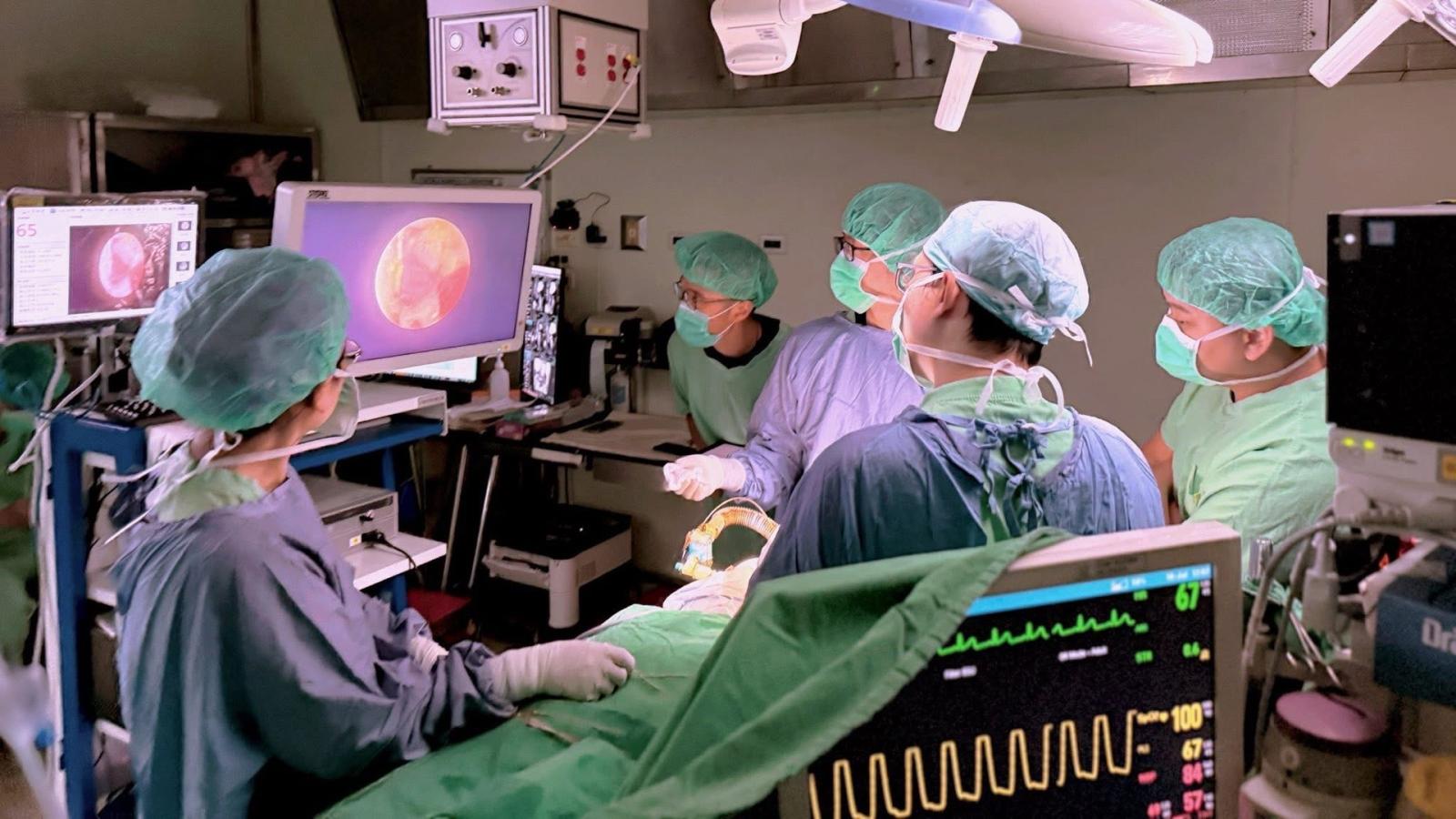
A 19-year-old female patient experienced right temporomandibular joint (TMJ) pain and difficulty opening her mouth after accidentally biting down on a hard object during a Mid-Autumn Festival barbecue several years ago. Despite receiving conservative treatments at other hospitals, including occlusal splints and right TMJ joint irrigation, she continued to suffer from persistent pain and restricted mouth opening. After being referred to Linkou Chang Gung Memorial Hospital, she underwent a 'minimally invasive endoscopic disc repositioning and suturing surgery,' resulting in significant improvement in both pain and mouth opening capacity.
Dr. Lin Yen-Hung, Director of the Department of Oral and Maxillofacial Surgery at Linkou Chang Gung Memorial Hospital, explained that the temporomandibular joint, located in front of the ears, is responsible for essential functions such as opening the mouth, chewing, and speaking. When the articular disc becomes displaced, the joint degenerates, or surrounding tissues become inflamed, symptoms such as pain, limited mouth opening, joint clicking, and changes in bite alignment may occur. In severe cases, patients may even be unable to eat normally.
However, many people assume that symptoms like a stiff jaw, difficulty opening the mouth, or pain while chewing are simply due to stress or clenching, and believe they will improve over time. But when symptoms become severe enough to interfere with eating and overall health, medical intervention may be necessary.
Dr. Lin emphasized that compared to traditional open surgery, the 'minimally invasive endoscopic TMJ disc repositioning and suturing surgery' developed by Linkou Chang Gung requires only two 3mm incisions on the face and one 3mm incision in the external auditory canal. Using an endoscope, surgeons can clearly visualize the joint structure and, with the aid of patented instruments developed in-house, precisely reposition and suture the displaced articular disc. Simultaneously, laser technology is used to remove adhesions and inflamed tissues, effectively reducing pain and improving mouth opening function, while minimizing the risk of facial nerve injury and shortening recovery time.
By the end of 2025, the oral and maxillofacial surgery team at Linkou Chang Gung had performed over 400 such minimally invasive endoscopic TMJ surgeries, achieving a 97% success rate in articular disc repositioning.
Dr. Lin's team conducted a study analyzing 139 TMJ joints from 80 patients and found that patients who underwent laser-assisted surgery had a 4.4 times higher probability of successful disc repositioning compared to traditional methods. Moreover, patients who received treatment during the early stage—when the disc was still repositionable—had a 5.9 times higher success rate than those treated at a later stage, confirming that early diagnosis and early intervention significantly enhance treatment outcomes.
These findings have been published in two internationally renowned medical journals: the International Journal of Oral & Maxillofacial Surgery (September 2025) and the Journal of Cranio-Maxillo-Facial Surgery (June 2026).
Given that many patients worry whether minimally invasive surgery is still effective when their mouth opening is already severely restricted, Dr. Lin's team conducted a study on 46 patients who had undergone the minimally invasive endoscopic disc repositioning surgery. The results showed that patients with preoperative mouth opening of 20–24 mm experienced an average postoperative increase of 11 mm; those with 25–29 mm increased by 7.5 mm; and those with 30–34 mm improved by 2.7 mm.
Dr. Lin stated that these results confirm that the smaller the preoperative mouth opening, the greater the postoperative improvement. This research has also been accepted for publication in the Journal of Dental Sciences in May 2026.
Dr. Lin emphasized that TMJ disorders have complex causes, and each case requires an individualized treatment strategy. The Department of Oral and Maxillofacial Surgery at Linkou Chang Gung Memorial Hospital has established a comprehensive stepwise treatment model, ranging from conservative therapies such as medication, physical therapy, and occlusal splints, to joint irrigation, minimally invasive endoscopic surgery, and total TMJ replacement for end-stage patients, enabling personalized and precise treatment based on disease severity.
Dr. Lin advised the public to chew slowly, avoid hard foods and excessive gum chewing, maintain proper posture, avoid resting the chin on the hand or forward head posture, and be mindful of habitual teeth clenching or nighttime bruxism. If symptoms such as persistent joint clicking, chewing pain, difficulty opening the mouth, or changes in bite alignment occur over a long period, individuals should not dismiss them as minor issues but seek medical attention early. Delaying treatment until joint structures are severely damaged not only makes treatment more difficult but may also result in missing the optimal treatment window.
FACT BOX
- Source: PR Times
- Category: News