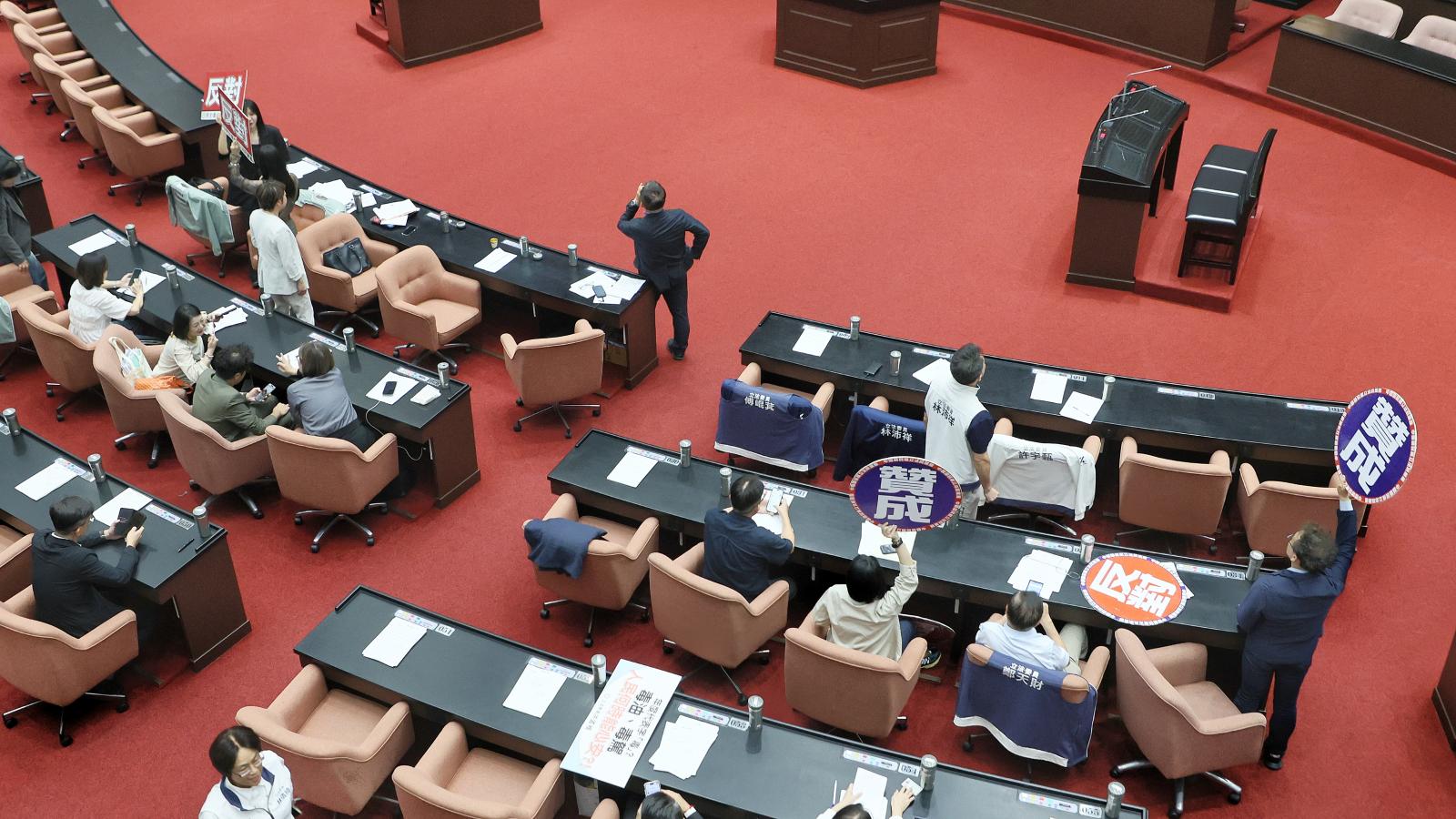
On July 24, the Legislative Yuan passed in third reading the 'Taiwan Child Growth and Future Account Act,' jointly proposed by opposition parties, and officially delivered the third-reading resolution this afternoon (7th) to the Executive Yuan and Presidential Office, requesting the President to promulgate the bill. However, the Executive Yuan had previously stated it would continue advancing related measures based on its existing policy plans. In response, the Executive Yuan announced this evening that it had received the Legislative Yuan's document, reaffirming that proposing policy guidelines and compiling the central government budget are constitutional powers vested in the Executive Yuan, and that it will take appropriate constitutional actions to uphold its constitutional responsibilities.
President Lai Qingde unveiled the 'New National Strategy for Taiwan's Population—Family Support Chapter' on May 27, which includes an 'Allowance for Children Aged 0 to 18' of NT$5,000 per person per month, expected to accumulate to at least 'NT$1.08 million + N' by age 18. Meanwhile, the Kuomintang and Taiwan People's Party had earlier proposed the 'Special Act on Taiwan's Future Account,' which, combined with related proposals by DPP legislator Kuo Kuo-wen, underwent questioning on January 12, a public hearing on April 2, and clause-by-clause review on May 27. After cross-party negotiations broke down, the opposition parties pushed the bill through on the afternoon of July 24 using their numerical advantage.
On the day the Legislative Yuan passed the 'Taiwan Child Growth and Future Account Act' in third reading, Executive Yuan spokesperson Lee Hui-chih responded in the evening, reiterating that the executive team had already proposed the 'New National Strategy for Taiwan's Population,' and that proposing policy plans and compiling government budgets are constitutional powers of the Executive Yuan. She emphasized that the executive team's policies are comprehensive, balanced, and systematically designed based on international experience and fiscal assessments, aiming to support all citizens and promote national development under the premise of sustainable public finances, and thus will continue advancing related measures according to existing policy plans.
After the Legislative Yuan formally sent the resolution to the Executive Yuan and Presidential Office this afternoon, requesting the President to promulgate the bill, Lee Hui-chih responded this evening, stating that the Executive Yuan had received the third-reading document of the 'Taiwan Child Growth and Future Account Act' around 4:30 p.m. today. According to the Constitution, proposing policy guidelines and compiling the central government budget are constitutional powers of the Executive Yuan, and the Executive Yuan will take appropriate actions in accordance with the Constitution to fulfill its constitutional responsibilities.
Lee Hui-chih: Growth Allowance Already Included in 2027 Budget
Lee Hui-chih reiterated that to enable all citizens to share in economic growth and address challenges such as low birth rates and demographic shifts, the Executive Yuan promoted the 'New National Strategy for Taiwan's Population—Family Support Chapter' in May. Based on the four major strategies of 'increased subsidies, reduced burdens, greater flexibility, and enhanced care,' the government is building a comprehensive support system from birth to adulthood, launching 18 measures across five areas: 'secure childbearing and parenting, strengthened childcare, enhanced education, workplace friendliness, and housing relief,' upgrading 'subsidy-based parenting' to 'publicly supported parenting.'
Lee pointed out that the 'New National Strategy for Taiwan's Population—Family Support Chapter' is an important policy initiative launched by the government after careful consideration of national economic development. It not only reflects the constitutional authority granted to the Executive Yuan to plan national development but also demonstrates responsible governance through budgetary allocation to ensure policy implementation. The funding for the 'Allowance for Children Aged 0 to 18,' NT$5,000 per month per person, has already been included in the 2027 central government budget, and eligible children are expected to start receiving payments directly from next year.
Lee Hui-chih: Opposition Version Widens Wealth Gap; Executive Yuan Version Supports Vulnerable
Lee explained that unlike the opposition version, which allows personal savings and enables wealthier families to save and receive more, thereby widening the wealth gap, the Executive Yuan version includes the 'Child Development Account for Vulnerable Families,' ensuring every child accumulates at least NT$1.08 million from age 0 to 18, with a 1:1 matching contribution for disadvantaged families—truly helping the vulnerable and realizing fairness and justice. Additionally, the government is promoting 'Parental Leave 6+3,' allowing each parent to receive an additional three months of leave after completing six months of parental leave benefits. Marriage leave has been extended to 14 days, maternity leave from 8 to 12 weeks, and prenatal check-up and postnatal companion leave increased from 7 to 14 days, expanding family support. Related bills have already been submitted to the Legislative Yuan for review.
Lee emphasized that the 'New National Strategy for Taiwan's Population—Family Support Chapter' proposed by the Executive Yuan is a comprehensive, interconnected policy framework, not a fragmented subsidy. 'Regarding the Legislative Yuan's overreach beyond constitutional boundaries, infringing on the Executive Yuan's constitutional powers to propose policy guidelines and compile budgets, the Executive Yuan will take necessary constitutional actions to safeguard constitutional order.'
FACT BOX
- Source: PR Times
- Category: News