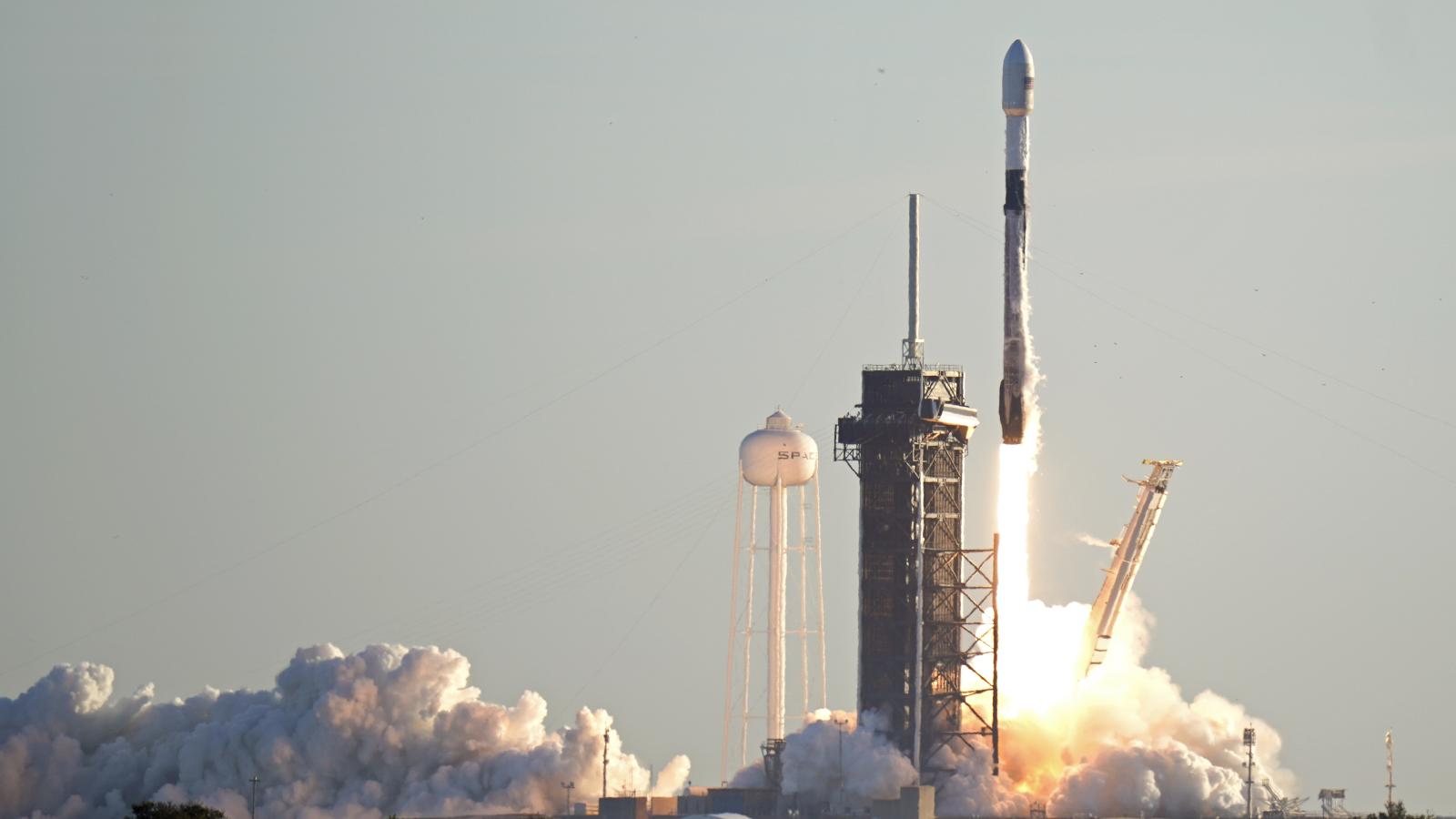
An uncontrolled SpaceX rocket is believed to have struck the Moon, creating a crater near a prominent lunar landmark and providing scientists with a unique research opportunity that could benefit future missions. The upper stage of the Falcon 9 rocket impacted near the Moon's Einstein crater on Wednesday (March 5) at approximately 8,700 km/h (5,400 mph). The brief, intense flash it produced was difficult for amateur astronomers to capture, even with high-end telescopes, though major observatories in the Americas are analyzing the data. Fully understanding what happened and what we can learn may take days or even weeks. But for planetary geologists, this accidental collision is a scientific gift. SpaceX's Falcon 9 rocket is a reusable model that has flown multiple space missions. Its design allows some parts to return to Earth, while others are discarded in space. This particular rocket launched from Florida, USA, in January last year, carrying two lunar landers into space. Its mission was to fire the upper stage powerfully, propelling the two landers out of Earth orbit and onto a trajectory toward the Moon—a mission successfully completed. The now-empty upper stage—about the size of a five-story building and weighing at least 4,000 kg—was left on a long, looping orbit, drifting between Earth and the Moon. Over the next 18 months, the subtle gravitational pulls of Earth, the Moon, and the Sun, along with the slight push of sunlight, exerted minute influences on it. Astronomers tracking the rocket debris eventually calculated that these tiny forces had nudged it onto a collision course with the Moon, accelerating daily. The impact occurred at approximately 01:35 Eastern Time (05:35 GMT) on Wednesday, during daylight hours for many parts of the world. The resulting faint flash was extremely weak and nearly impossible to see, even through telescopes. Amateur astronomers observing in darkness had almost no chance of spotting the flash—it lasted less than a second and occurred in a sunlit region of the Moon. They also had little chance of seeing a dust plume stretching up to 100 km, lasting several minutes. Moreover, even spacecraft orbiting the Moon were not in the right place at the right time to witness the impact directly. South Korea's Danuri orbiter had the best chance, passing near the impact site shortly before the event. The team told Korean media that any images would be released only after researchers complete their analysis. In the coming days, NASA's Lunar Reconnaissance Orbiter will move into position to photograph the impact site, enabling before-and-after comparisons. Scientific data and possibly the first images will come from powerful telescopes in the Americas, where the sky was still dark. Detecting a 14-meter object striking the Moon's surface from 385,000 km away is challenging but not impossible. Image processing to clean up the data may take hours, days, or even weeks, as scientists review and analyze the information. However, new crater images from lunar orbiters are highly anticipated. Because researchers know precisely the rocket's size, speed, and impact location, this collision has transformed from a random accident into a rare, controlled experiment. For planetary scientists, it's a dream scenario, allowing them to test models of how impacts excavate craters, eject debris across the surface, and trigger seismic waves within the Moon. This has practical value. Understanding how much rock and dust an impact throws up will help engineers design safer landers and future lunar bases, calculate how far debris can travel, and assess how strongly the ground might shake nearby. Material ejected from beneath the lunar surface provides new clues about lunar geology and supplements scientists' understanding of how the Earth-Moon system formed around 4.5 billion years ago. This is not the first time a human-made object has hit the Moon. Since 1959, dozens of spacecraft have impacted the Moon, some accidentally, many intentionally for scientific purposes. The Soviet Luna 2 probe was the first, followed over the decades by NASA's 1960s Ranger probes, several Apollo-era rocket stages, and more recently, the 2009 LCROSS mission—which deliberately crashed into the Moon to search for water ice. The last confirmed accidental impact occurred in 2022, believed to be the leftover booster from a Chinese lunar mission launched as early as 2014—reminding us that such space debris has been silently accumulating above our heads for over half a century. We used artificial intelligence to assist in translating this article. Its original version was in English. BBC journalists reviewed the translation before publication.
FACT BOX
- Source: PR Times
- Category: News
- Organizations: SpaceX / NASA