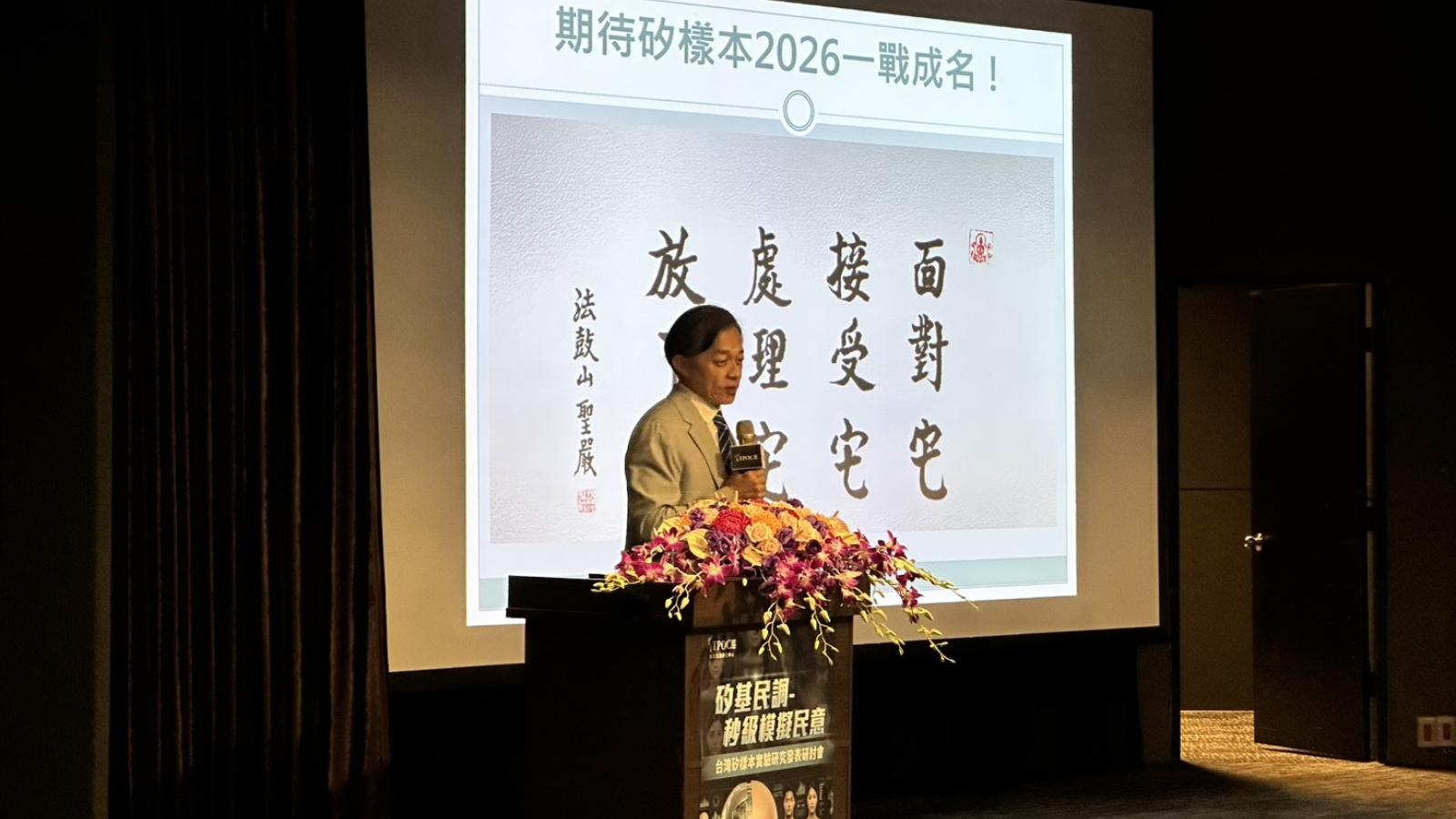
As the AI era arrives, traditional telephone-based public opinion polls face challenges such as a 90% refusal rate, high costs, and an inability to respond instantly to sudden events. Can AI technology make opinion polling more accurate? On the 7th, TPOC Taiwan Issues Research Center held a major seminar titled 'Silicon-Based Polling – Real-Time Simulation of Public Opinion' at the NTU Conference Center, unveiling for the first time the experimental results of its 'Taiwan Silicon Sample (AI Agent)', which integrates large language models (LLM), social science, and big data.
Chuang Po-chung, Professor of Journalism at Chinese Culture University, described the situation as 'like being in love—hopeful yet fearful.' He pointed out that with traditional survey response rates below 10%, random sampling is already under threat. While the results from TPOC’s 3,000 silicon samples may reflect population-level truths, Chuang cautioned that AI agents are better suited for theoretical simulation rather than directly replacing sample-based measurement. He also warned that feeding only specific social media content could lead to echo chamber bias and external validity issues.
The event brought together leading professors in political science, communication, and statistics to jointly examine the empirical applications of silicon-based polling in election forecasting and public policy decision-making. Zhao Yu-juan, R&D Director at TPOC, stated that silicon-based polling shifts opinion research from 'carbon-based' to a new paradigm, offering advantages such as extremely low marginal cost and the ability to simulate tens of thousands of samples within minutes.
To ensure academic rigor, TPOC built 3,000 AI virtual citizens embedded with 28 detailed attributes—including demographic structure, social experiences, media consumption habits, 'split-ticket voting tendencies,' and 'non-response tendencies'—to ensure the sample fully represents population characteristics. The team also integrated long-term social listening and舆情 (public sentiment) systems, delivering real-time news and topics to agents based on their profiles to accurately simulate how individuals shift opinions after exposure to information.
To mitigate AI-generated randomness and bias, the team established a strict 'Six Validation Rules' framework, including checks for population structure alignment, persona internal validity, comparison with real human data, stimulus-response and causal validity, bias and distortion audits (e.g., detecting AI over-rationality or social desirability bias), and stability and sensitivity testing—ensuring highly reliable simulation outcomes.
Lin Yu-cheng, TPOC Data Analyst and Project Director, demonstrated three key decision-making applications of silicon-based polling: 'Daily Election Tracking,' enabling real-time, ultra-low-cost monitoring of public sentiment; 'Campaign Scenario Testing,' overcoming the limitation of traditional polls that can only ask once—for example, simulating four parallel universes to compare the impact of an 'education bureau apology' versus a 'mayor's personal apology' on election outcomes, allowing precise crisis communication strategies; and 'Deliberative Democracy for Public Policy,' where AI-driven deep dialogue tests trade-offs between values like 'resident safety' and 'ecological protection' to identify the greatest common denominator of public opinion in advance.
Lin Tse-min, Associate Professor of Government at the University of Texas at Austin, highlighted risks such as 'ecological fallacy' and 'AI sycophancy,' but praised TPOC for incorporating geographic, temporal, and party vote data into the model and training it with real-time public sentiment—an approach he sees as key to reducing inference risks and enhancing simulation accuracy.
Meanwhile, Yu Chen-hua, Researcher at NCCU Election Research Center and Professor of Political Science, and Chuang Po-chung both used the phrase 'hopeful yet fearful like falling in love.' Chuang reiterated that with response rates below 10%, random sampling is compromised, and while TPOC’s 3,000-agent sample may approximate true population values, AI agents are best used for theoretical modeling, not direct measurement replacement, and must avoid echo chamber effects from selective media input.
Hsieh Pang-chang, Academic Distinguished Chair Professor at Fu Jen Catholic University, emphasized that survey research is undergoing a paradigm shift. He predicted that 'hybrid surveys' combining human respondents and AI agents will become the industry standard, requiring Bayesian modeling and other statistical techniques for human-AI calibration. Polling will evolve from macro-level silicon samples to high-granularity 'digital twin' individual cognitive agents. However, he stressed that real human samples remain the irreplaceable gold standard for moral judgment and authentic emotional validation.
FACT BOX
- Source: PR Times
- Category: Survey