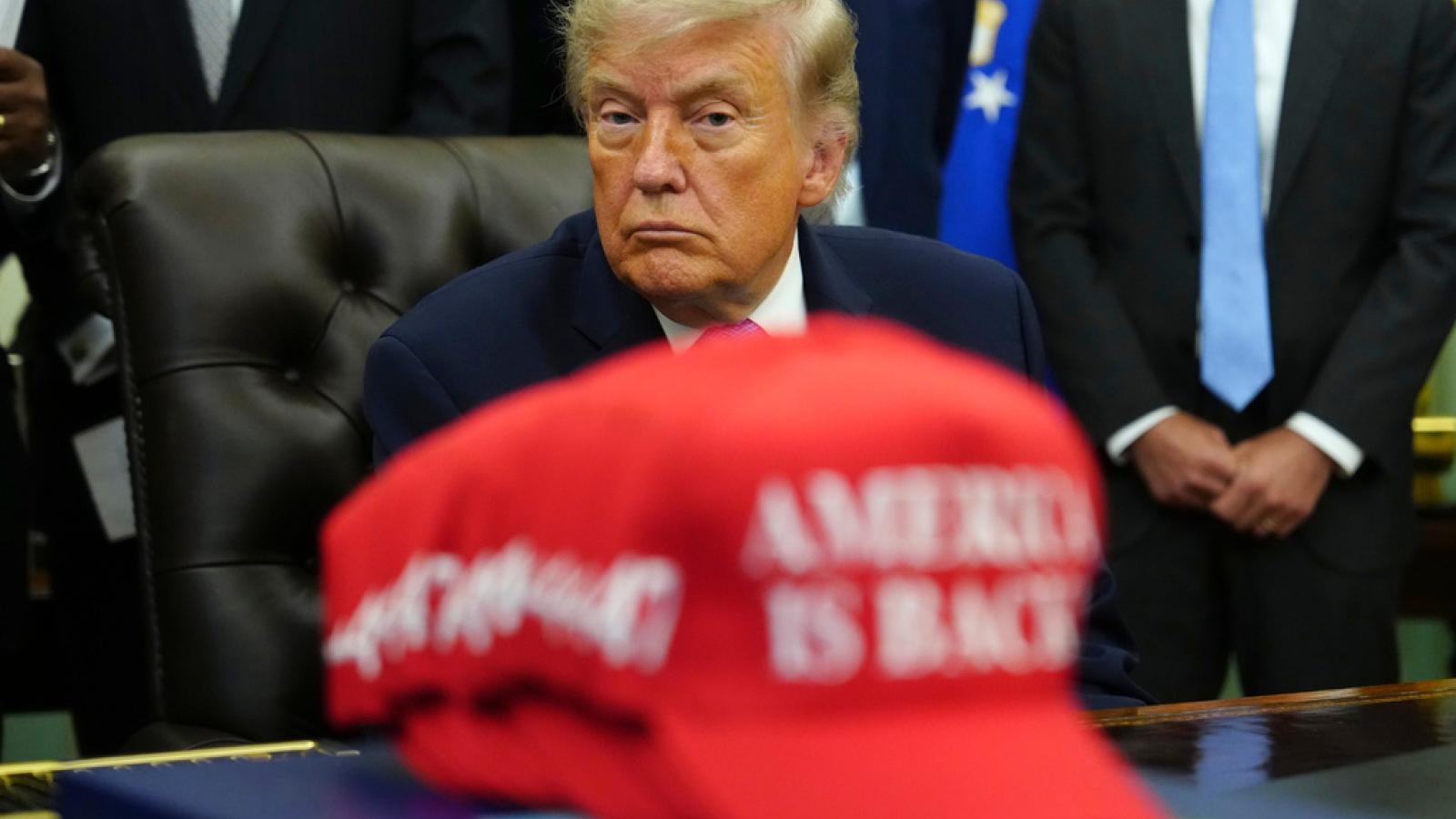
The story of 'Little Red Riding Hood' usually begins like this: 'Little Red Riding Hood's' mother lets her deliver food to her grandmother who lives in the forest and warns her not to leave the main road. She meets a gray wolf in the forest and tells the wolf that she is going to her grandmother's house. The wolf tricks 'Little Red Riding Hood' into picking flowers while he rushes to the grandmother's house and eats her. Then, the wolf disguises himself as the grandmother lying in bed, waiting for 'Little Red Riding Hood' to arrive.......... 'MAGA' (Make America Great Again - Let America be great again!) - from a campaign slogan to a symbol of American politics, has undergone a process of historical borrowing, symbolization, and movement. It both crystallizes the demands of a specific group and profoundly reshapes the American political landscape. In fact, 'Let America be great again!' was not invented by Trump. As far back as the 1980 presidential election, Reagan used 'Let America be great again!' multiple times as a campaign slogan. The content of this slogan was a call to return to traditional values such as family, work, neighborhood, peace, and freedom, and to launch a 'great crusade' to rebuild America. In 2016, Trump 'borrowed' this slogan (fortunately, Reagan did not register this slogan at the time, so Trump did not plagiarize.), and simplified it to 'MAGA.' Through legal procedures, Trump turned a political slogan into his own commercial asset. Although the slogan was not his original creation, he successfully bound 'MAGA' to his personal brand by being the first to register it and actively defending his rights. His use gave this old slogan new, more personal vitality and successfully registered it as a trademark. (The United States Patent and Trademark Office - USPTO officially approved the registration of this trademark on July 14, 2015. Its registration number is 4-773-272). However, it was the famous red baseball cap that truly made 'MAGA' a visual cultural symbol. This cap was released during the 2016 election campaign, with its eye-catching red color and large white uppercase 'MAGA' letters, making it highly recognizable. It was not only a campaign product but quickly became an 'identity' and 'loyalty' visual symbol for Trump supporters. This cap achieved tremendous commercial success. According to Jared Kushner's memoir, during the 2016 election campaign, this cap and related products brought in about $80,000 in revenue per day. It spread from election rallies to protest sites, international diplomatic occasions, and its influence even spilled over American borders, becoming the subject of imitation and satire. 'MAGA' evolved from a slogan and a cap into a political symbol, behind which lies profound socio-political change. Carrying the anger of the 'forgotten,' the rise of the MAGA movement is rooted in the dissatisfaction of some American citizens with the status quo. These groups include manufacturing workers who have suffered losses in the process of globalization (especially in the 'Rust Belt states'), and low-educated white groups who feel cultural impact. They believe they have been forgotten by political and economic elites. The MAGA slogan promises to reverse the trend of national decline, responding to their economic anxieties and cultural loss. Experts point out that the core supporters of MAGA are whites who feel their social status is shaken and evangelical Protestants, with a deep-seated concern about changes in the American population structure and the possible loss of the dominant position of traditional white culture. The MAGA movement is not only economic but also cultural. It has positioned itself as a leader in opposing 'woke culture' (including policies of diversity, equality, and inclusion, and LGBTQ issues), opposing the so-called 'deep state' and globalism. This has caused MAGA to transcend specific policies and evolve into a political expression of conservative cultural identity and lifestyle. Trump and the MAGA movement have profoundly changed the Republican Party, transforming it from a traditional conservative party into one that emphasizes populism, nationalism, and 'America First.' It has successfully turned class conflict into identity politics and cultural conflict, becoming an important driving force for American political polarization. The path of MAGA's symbolization is the result of the combined action of Trump's personal brand, the populist wave, economic anxiety, and cultural conflict. It is no longer a simple slogan but has become a flag for a political movement aimed at redefining 'who Americans are' and 'where America should go.' Recently, Trump has sparked another wave of 'MAGA' cap fever, not only using this iconic red baseball cap as a political symbol but also developing it into a highly profitable business. From White House cabinet meetings to the Amazon e-commerce platform, this cap priced at $55 (approximately NT$1,600) has become a unique window for observing the current political ecology and deep social fissures in the United States. At the same time, Trump's business empire is expanding. His team recently opened a store on the Amazon platform, listing 54 products, including the classic 'Make America Great Again' (MAGA) cap, which topped the Amazon men's novelty baseball cap bestseller list. This cap, designed to celebrate America's 250th anniversary, features iconic images such as Mount Rushmore and the eagle. Critics believe this is an unprecedented commercialization of the presidential position for profit. Data shows that since Trump took office, his personal net worth has soared to approximately $65 billion. Just as Trump's MAGA caps are selling like hotcakes, a parody product - a red baseball cap with the words 'Make America Go Away' printed on it - is also becoming popular on both sides of the Pacific. This cap was originally designed by the owner of a retro clothing store in Copenhagen, Denmark, as an anti-Trump protest symbol against his threat to seize Greenland. The cap is written in Danish with 'Enough,' and on the side in English with 'Make America Go Away,' and features the flag of Greenland. Surprisingly, demand for this cap has surged, with the most orders coming from the United States. The Associated Press analysis points out that this phenomenon deeply reveals the deepening political divide in American society. Don't underestimate this little red hat; it has split the once most admired country in the world into two worlds. One 'MAGA' cap, one 'Make America Go Away' cap (or called the anti-MAGA cap), together constitute the two sides of one coin in today's American society. They strongly show the backlash of liberals, globalists, and some ordinary citizens tired of political polarization. They view this cap as a resistance to American unilateralism, expansionism, and Trump's personal style, expressing their hope that America will return to a multilateral framework. Commentators point out that the 'Make America Go Away' phenomenon ultimately points to a fundamental contradiction in American identity. Is America a local country or a global empire? The answer to this question may not be printed on any cap. But the hot sales of these two diametrically opposed caps undoubtedly provide the most straightforward footnote to the current complex political mentality in America. Multiple recent polls show that due to the compounded adverse effects of Trump's multiple policies, the frenzied crackdown on undocumented immigrants, the indecisive war after the invasion of Iran, and the unrelenting high inflation, the American economy and people's livelihoods are in dire straits. 'People are suffering' is becoming an increasingly real description for more families. Trump's approval rating has dropped to the lowest point in his presidency. Since Trump took office, his tough immigration policies, including large-scale deportations of illegal immigrants, have had a structural impact on the American labor market. Under the tightening of immigration policies and the impact of domestic population aging, the available labor force in the United States is decreasing, and the momentum of employment growth is significantly slowing down. According to a Reuters report, since Trump returned to the White House, the size of the American labor force and the number of employed people have both decreased. Although companies have not carried out large-scale layoffs, recruitment activities have clearly cooled down, and the number of manufacturing jobs is even lower than at the end of the Biden administration. The Trump administration uses tariffs as an 'economic weapon,' attempting to force the return of manufacturing by increasing import costs. However, the side effects of this policy are now backfiring on American consumers, with tariffs pushing up the prices of some goods, coupled with the construction boom of AI infrastructure, further raising the costs of energy, equipment, etc. As of May this year, the core inflation in the United States has risen by 3.4% year-on-year, far exceeding the Fed's 2% target. Voters are increasingly dissatisfied with Trump's handling of the economy. He, who promised to solve the price problem during the election, now faces the cruel reality of persistently high prices. The nearly five-month-long US-Iran war has become another straw that is dragging down Trump's popularity. The obstruction of shipping in the Strait of Hormuz has been continuously weakening the buffering capacity of the global physical oil market. As of August 1, taking Hawaii in the United States as an example, the price of gasoline has risen to around $6 per gallon, and American farmers' spending on diesel fuel has increased by $1.4 billion compared to last year. In the latest poll, two-thirds of the respondents in the United States are against the US military action against Iran. This fiscal year, the US government has paid $82.7 billion in debt interest, a figure that even exceeds defense spending. At the same time, the yield on 30-year Treasury bonds has reached near 20-year highs.
FACT BOX
- Source: PR Times
- Category: News