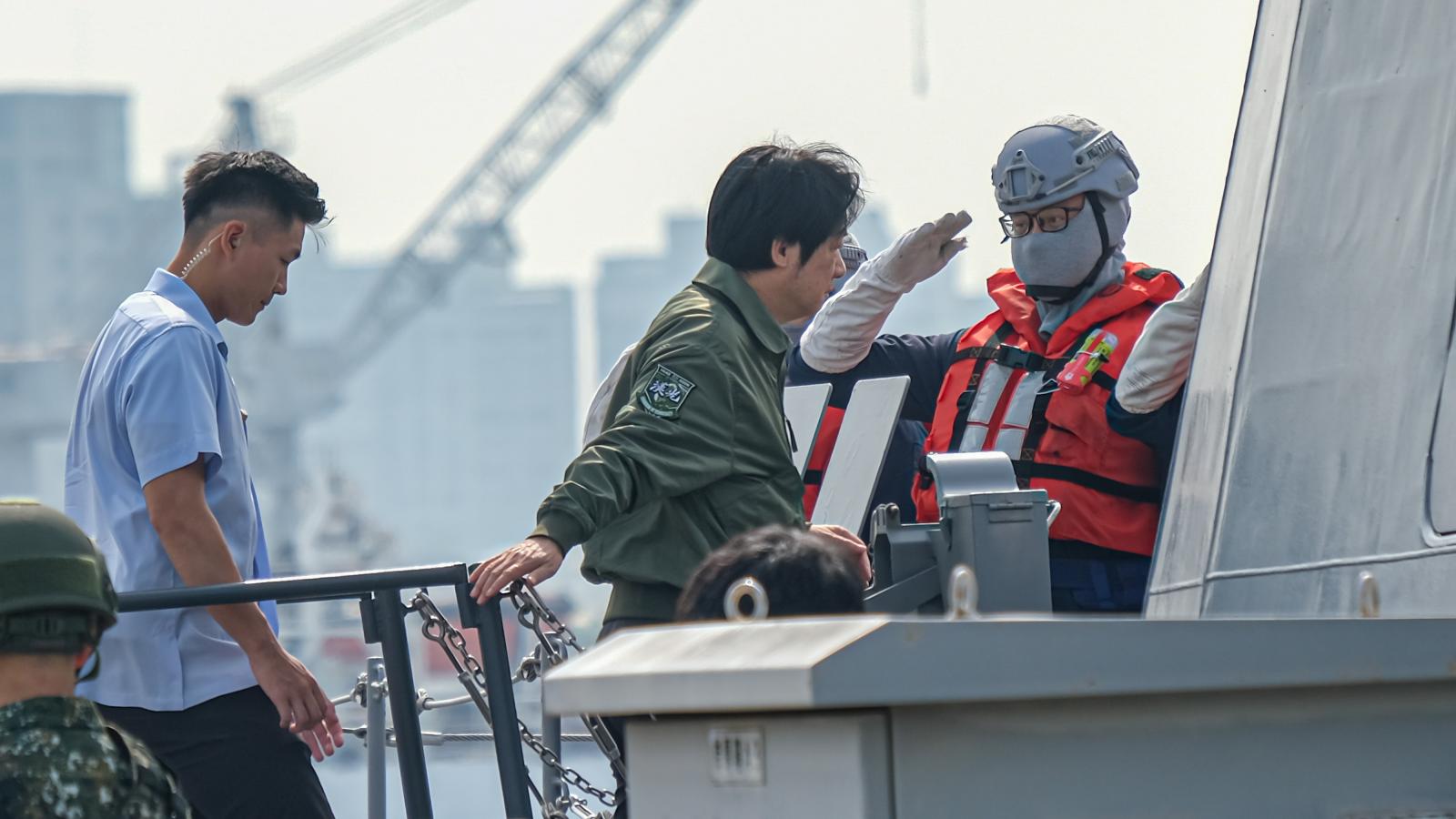
The Navy's Coastal Operations Command was established in July and has been deployed for operational validation in this year's Han Kuang 42 exercise. President Lai Qingde visited Kaohsiung today (8th) to observe the live demonstration of 'coastal strike and near-shore defense' operations. Notably, President Lai boarded the Kuang Hsiu-class missile boat with hull number '64', a move of significant symbolic importance. The Navy has formed the 62nd Task Force to carry out coastal strike missions.
During today's drill, the Navy collaborated with the Coast Guard's Anping-class patrol vessel, the Bali, to verify its capability to transition swiftly from peacetime to wartime operations. The Navy directly took command of the Anping-class vessel, equipped it with Hsiung Feng II and Hsiung Feng III anti-ship missiles, and conducted anti-surface warfare missions. Meanwhile, four additional Kuang Hsiu-class missile boats executed emergency departure drills. President Lai, aboard the missile boat with hull number '64', issued a broadcast command: 'I am on the bridge of missile boat 64. You have received orders to urgently depart port and execute the coastal strike mission.'
The media briefing event for the 'Han Kuang 42 Exercise Live Drill' was held on the 8th, featuring the Kuang Hsiu-class missile boats. (Photo: Liu Weihong)
President Lai stated that the purpose of the Han Kuang exercise is to test command coordination, wartime responsiveness, and national defense capabilities through live troops, real locations, and actual equipment. Facing external threats and challenges, the government continues to strengthen national defense and provides full support to military and coast guard personnel. He encouraged all participants to actively respond during the exercise, enhance coordination, and build solid combat capabilities to safeguard national sovereignty and public safety.
In the coastal strike and near-shore defense operations, the Navy used Zuoying Base as the scenario. The Coastal Operations Battalion deployed mobile radar vehicles, mobile missile launchers, missile boats, coast guard vessels, and near-shore defense special forces, integrating various types of drones for target acquisition and precision strikes to enhance kill chain efficiency. This demonstrated the Navy's multi-layered, multi-wave combat power and the Marine Corps' amphibious capabilities.
The media event also showcased the M109 assault boat. (Photo: Liu Weihong)
On-site, President Lai listened to mission briefings from personnel and simultaneously monitored TAK system feeds. First, the Marine Corps used land-based surveillance drones for reconnaissance, followed by a simulated dive attack using medium-sized suicide attack drones provided by the Armaments Bureau. Subsequently, the Marines launched micro surveillance drones from the M109 assault boat for close-in coastal reconnaissance, followed by a simulated attack using small suicide drones.
The media event captured President Lai Qingde (center), Defense Minister Ku Li-hsiung (second from right), and National Security Council Secretary-General Joseph Wu (right) receiving mission briefings from military personnel. (Photo: Liu Weihong)
Notably, in this drill, the Marine Corps' M109 assault boat was formally integrated into the Coastal Operations Command's operational structure, forming the 62nd Task Force as required by combat needs. Its primary mission includes maritime mobility, force preservation, and counterattacking and eliminating enemy naval forces, symbolizing the Navy's upgrade to an actual combat-level strategic formation. The Navy Command stated that in response to evolving threat environments and international dynamics, all naval personnel will conduct mission-oriented, realistic training to enhance defensive resilience and high-readiness combat capabilities, ensuring national security.
FACT BOX
- Source: PR Times
- Category: Event