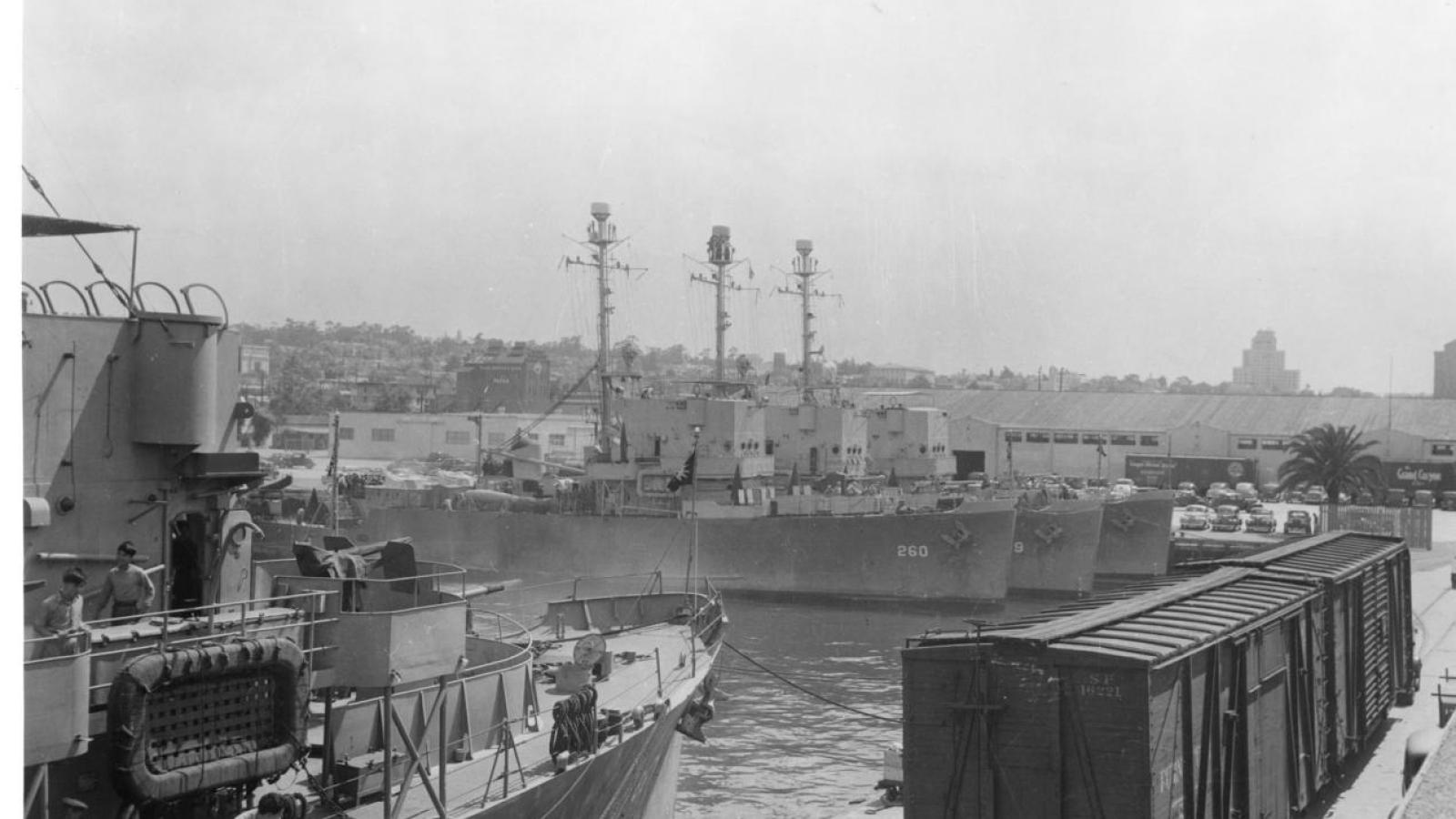
Recently, while researching at the U.S. National Archives, I discovered numerous valuable historical documents regarding the U.S. Navy's attitude toward China. These documents reveal that admirals such as Preble, King, Nimitz, Kirk, Goldsborough, and Melson strongly supported the Nationalist Government led by Chiang Kai-shek. The main reason was that, compared to the U.S. Army's focus on Europe, the U.S. Navy was a 'Pacific faction' that prioritized Asian strategic situations and thus supported the Republic of China, which could help the U.S. contain potential challengers. This potential challenger was the CCP today and Japan 80 years ago, making support for the Republic of China a consistent strategic goal of the U.S. Navy for decades. The U.S. Navy not only strongly advocated for aiding China but also took the lead in the post-war reconstruction of the Republic of China's Navy, gifting eight ships, known as the 'Eight Ships,' to the Republic of China's Navy. Even the work of receiving the South China Sea islands was completed by Chinese naval personnel who had received 'Eight Ships' training in the U.S. However, one thing that puzzles me is that the Republic of China's Navy also sent personnel to Britain for training. Personnel from the Nationalist Navy trained by the Royal Navy had the opportunity to participate in European campaigns, including the Normandy landings, as interns and gain combat experience. However, personnel from the 'Eight Ships' trained by the U.S. Navy never had the opportunity to gain combat experience, not even the chance to board U.S. Navy ships and participate in the Pacific counteroffensive. Imagine if the 'Eight Ships' were allowed to join the U.S. Navy task force, even if it was just patrol ships like the Yongxing or Yongtai, which had no combat power, how much it would have boosted the morale of the Chinese Navy. For example, in the 1944 Battle of Leyte Gulf, the Yongxing or Yongtai would have been very suitable to join the 77th Task Force. Not only would it have declared to the world that the Republic of China's Navy did not miss the counteroffensive against Japan, but it would also have established prestige among Filipino Chinese. Why wasn't this done? Was it because the Chinese naval personnel training in Miami did not have enough time? Or, according to Admiral Preble's earliest suggestion, the post-war Republic of China's Navy, with the support of the U.S., would focus on defending China's coastlines and would not need to have the far-sea capabilities of advancing into the blue ocean? According to the ONI documents I recently found in the U.S. National Archives, the answer is likely the latter, because the U.S. Navy had already grasped that the Chinese naval officers' territorial ambitions for the Ryukyu Islands. The Min (Fujian) Navy, led by Admiral Chen Shaokuan, advocated taking the Ryukyus, which was closely monitored by the U.S. Navy's military attaché office. (U.S. National Archives) The Min (Fujian) Navy called for the recovery of the Ryukyus. Before the war, the Republic of China's Navy had many factions, the strongest of which was the Min (Fujian) Navy led by Admiral Chen Shaokuan. The Min (Fujian) Navy originated from the Fujian Naval Academy established during the late Qing Dynasty's Self-Strengthening Movement. Since the Min (Fujian) Navy personnel were all graduates of the Mawei Naval Academy, they were also known as the Mawei Navy. They transformed into the Republic of China's Navy during the Wuchang Uprising and pledged allegiance to the Nationalist Government after the Northern Expedition, although they maintained a semi-independent status despite calling themselves the Central Navy. The 1st and 2nd Fleets, mainly composed of the Min (Fujian) Navy, the 3rd Fleet mainly composed of the Northeast Navy, and the 4th Fleet mainly composed of the Guangdong Navy were all annihilated by the Imperial Japanese Navy in the early stages of the War of Resistance. However, Chen Shaokuan, as the Minister of the Navy and the Commander-in-Chief of the Navy, commanded the naval forces, who had almost no ships left, to fight alongside the army using mines and coastal artillery. At the same time, he did his best to maintain naval education to ensure that the traditions of the Min (Fujian) Navy would never be interrupted. Another characteristic of the Min (Fujian) Navy was that, including Chen Shaokuan himself, they all received training from the Royal Navy. Chen Shaokuan even boarded a Royal Navy ship and participated in the Battle of Jutland during World War I. This confirmed that Chen Shaokuan's personnel had a strong pro-British color, and Britain was seen by the U.S. as a potential rival in the competition for the support of Chinese and Southeast Asian Chinese. Therefore, the Min (Fujian) Navy personnel were never welcomed by the U.S. Navy from the beginning. A more important point was that the U.S. Navy noticed that Lu Shuofen, a researcher at the Naval Defense Research Institute and former deputy captain of the Zhongshan gunboat, spent a lot of effort studying the issues of Taiwan and the Ryukyus from 1943 to 1944, concluding that the Ryukyu Islands were incorporated into the Chinese territory during the Hongwu era of the Ming Dynasty and should be regarded as China's 'lost territory.' Under this logic, the Ryukyus should be returned to China like Taiwan and Penghu after the war, which was clearly different from Chiang Kai-shek's advocacy of joint trusteeship by China and the U.S. at the Cairo Conference. The main reason why Chiang Kai-shek did not want the Ryukyus was that he believed that the Ryukyus were only a 'protected state' of the Chinese Empire in the past and could not be truly part of China like Taiwan and Penghu. In addition, even if all the ships of the four factions of the Republic of China's Navy were combined, their total displacement was less than 70,000 tons, while the Imperial Japanese Navy was more than 20 times that of the Chinese Navy. In other words, China alone had no possibility of landing and occupying the Ryukyus and could only rely on the U.S. military to drive out the Japanese forces. The U.S. Navy, through the relationship between Melson and Dai Li, tried to control the development of the post-war Republic of China's Navy. (U.S. National Archives) Why support Dai Li to take over the Navy? Chen Shaokuan, as a student of the Royal Navy, certainly knew that China's meager navy had no chance of helping the National Revolutionary Army complete the task of occupying the Ryukyus. International geopolitics is about strength, and the Min (Fujian) Navy naturally knew that the U.S. would certainly station troops on the island after occupying the Ryukyus, especially the main island of the Ryukyu Islands, Okinawa, which could only be within the U.S. sphere of influence. The U.S. Navy pointed out that at that time, there were indeed two opinions within the Nationalist Government regarding the sovereignty of the Ryukyu Islands. One faction, from a realistic perspective, advocated respecting the U.S.'s right of occupation, as the Chinese Navy would not have the strength to challenge the U.S. Navy for half a century, so it was better to show respect first and make demands when the situation changed in the future. The other faction believed that the Ryukyu Islands should be immediately recovered as a victorious country, and according to the analysis of the U.S. Navy Intelligence Bureau, this faction was mainly the Min (Fujian) Navy. In other words, China had not yet stabilized, and the army and air force were still facing the Japanese 'Ichigo Operation' offensive, but the Min (Fujian) Navy was already prepared to confront the U.S. military for the Ryukyu Islands, and at that time, the U.S. military had not yet completed the attack on Okinawa. With just a few small ships of the Min (Fujian) Navy, the Chinese sea power after the victory of the War of Resistance would not be taken seriously by the U.S. Navy, which controlled the global ocean. However, the U.S.'s strategic direction at that time was to support China rather than suppress China, so what should be done? So far, I have not found any documents to support my judgment, but even if my judgment is correct, there may not be any direct historical evidence to verify my judgment. The only thing that can be confirmed is that the U.S. Navy strongly supported Dai Li to become the Commander-in-Chief of the Navy of the post-war Republic of China. Dai Li was a head of intelligence, and his only contact with naval affairs was that he and Melson jointly led the Sino-American Cooperative Organization during the war. Otherwise, it can be described as 'an outsider directing an insider.' Dai Li needed the support of the U.S. Navy to enhance his prestige in front of Chiang Kai-shek, and at the same time, he was ignorant of sea power and would not challenge the status quo of the U.S. occupying the Ryukyus. At least, he would be part of the faction that temporarily respected the U.S. military's occupation of the Ryukyus. At that time, the mainland had not yet fallen, and the U.S. seemed to have no plan to permanently occupy the Ryukyu Islands. It is believed that the Ryukyu Islands would first be under the trusteeship of China and the U.S., and when the time was ripe, they would become an independent country close to the Republic of China. The personnel who received training in the U.S. for the 'Eight Ships' laid the foundation for the new navy of the post-war Republic of China. (U.S. National Archives) The current foundation of the Republic of China's Navy Of course, if Dai Li really controlled both the navy and the intelligence system, he would be a threat not only to the Communists and other local strongmen of the Kuomintang but also to 'Principal' Chiang Kai-shek. Therefore, in the 1946 plane crash, there are still many conspiracy theories circulating, in addition to the U.S. or the Communists staging a fake air disaster to assassinate him, many old military officers believe that it was Chiang Kai-shek, the chairman, who wanted Dai Li to die. However, even if Dai Li died, Chiang Kai-shek still appointed Gui Yongqing, who was also from the 'Revival Society' and was almost as ignorant of the navy as Dai Li, to take over the navy and thoroughly suppress the Min (Fujian) faction. In the end, the result that the U.S. Navy hoped to see still occurred within the Republic of China's Navy. Of course, Gui Yongqing's method of purging the Min (Fujian) personnel was too cruel, and during the navy's retreat to Taiwan, it triggered the 'White Terror' incident, quickly losing the hearts of the people. In addition, Gui Yongqing and Chiang Ching-kuo's political work system personnel had a conflict, and in the end, although he was promoted to Chief of the General Staff by the old principal Chiang Kai-shek, he died of a heart attack in 1954 during his term. The death of Gui Yongqing, like the death of Dai Li, is full of conspiracy theories, but no matter what the cause of death was, the father and son Chiang finally completely controlled the Republic of China's Navy, which was centered on the 'Eight Ships' personnel, and became the key force to defend the seas of Taiwan, Penghu, Kinmen, and Matsu today. Chen Shaokuan and Sa Zhenbing, the bigwigs of the Min (Fujian) Navy, knew that if they went to Taiwan, the best outcome would be to have a job like Wei Jimin as the principal of the Naval Academy, and the worst would be to be 'White Terrored' by Gui Yongqing. Even Wei Jimin himself, if it were not for Chen Cheng's protection, would probably have been annihilated under Gui Yongqing's purge. Therefore, for the vast majority of the bigwigs of the Min (Fujian) Navy who graduated from the Mawei Naval Academy, staying in mainland China was a more prudent choice.
FACT BOX
- Source: PR Times
- Category: Survey