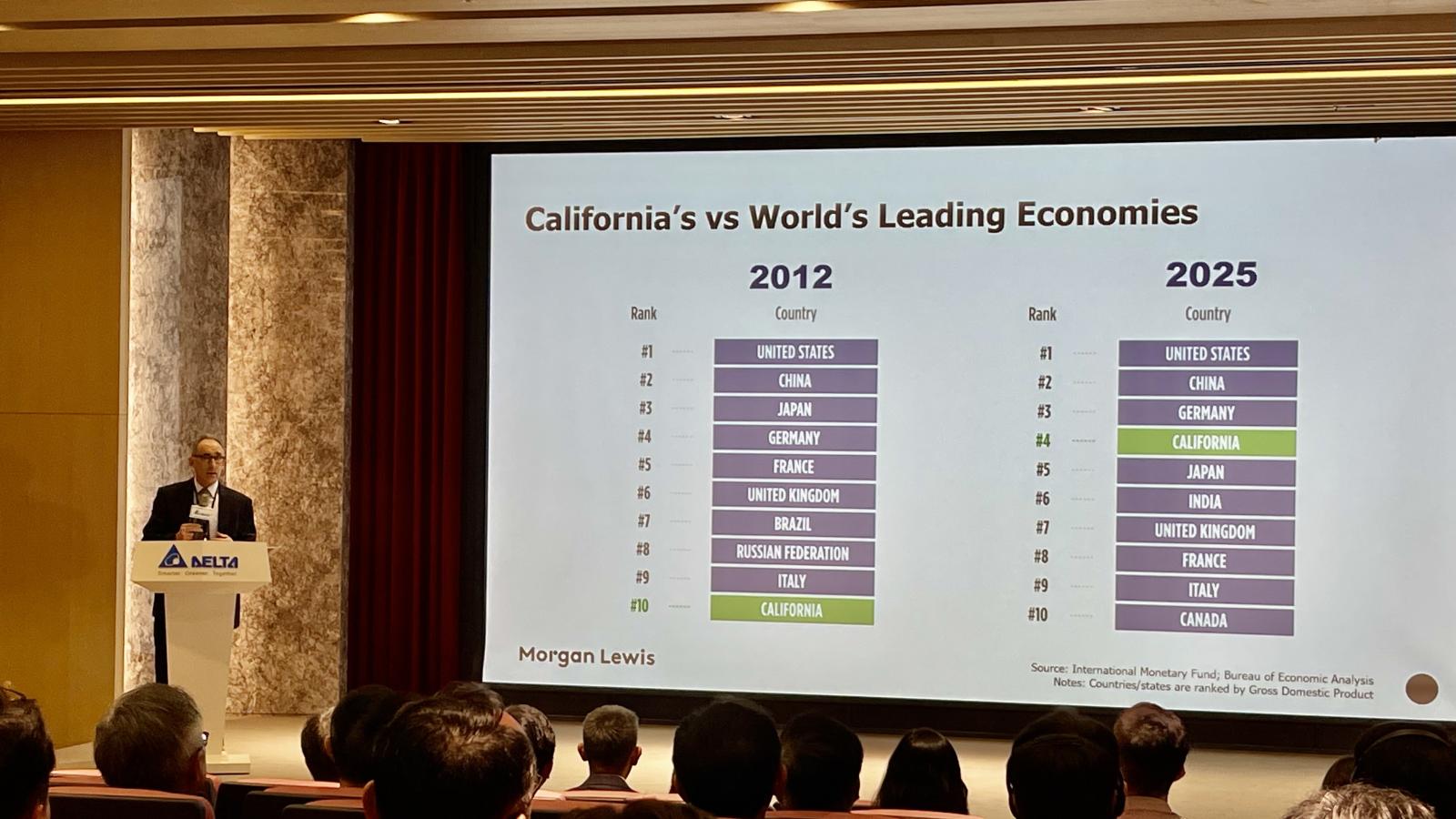
California's economy ranked 10th globally in 2012 but has since leapt to 4th place, surpassing Japan, India, the UK, France, Italy, and Canada. The state’s aggressive push for green power demonstrates that economic growth and renewable energy goals can go hand in hand. Over the next decade, more than 30% of new U.S. electricity demand is projected to come from AI and data centers, creating massive business opportunities for companies with AI and energy management solutions.
Former White House National Economic Council advisor William D. Kissinger stated, “California currently generates 67% of its electricity from renewables—progress is ahead of schedule, making it very likely the grid will reach full decarbonization by 2045.” Despite President Trump’s skepticism toward climate change and support for fossil fuels, California law mandates 100% renewable electricity by 2045.
Kissinger, an energy and power market reform expert from California, delivered a keynote speech on the 7th at Delta’s 55th anniversary 'Sustainable AI Summit.' He emphasized, “The situation is changing—we must do everything we can to combat climate change.”
California passed legislation in 2002 setting a 2045 target for 100% grid decarbonization, with an interim goal of 60% renewable generation by 2030. That target has already been exceeded, with current levels at 67%. The biggest challenge now is managing excess solar generation, requiring robust energy storage systems.
Delta introduced its innovative AI containerized data center—a compact solution fitting within a single parking space, drastically reducing construction time. (Photo by Sheh Chin-Fang)
'AI and data centers' have become critical keywords—not only as engines of economic growth but also as symbols of vast commercial potential. Kissinger noted, “Nationwide surveys show that over the next decade, at least 30% of new electricity demand will stem from AI and data centers, opening new development opportunities. Transmission capacity is expected to grow by 50–100%, necessitating major investments in power infrastructure.”
Cheng Ping: Microgrids Will Play a Key Role
Electrification is a crucial strategy for combating climate change. Delta Electronics Chairman and CEO Cheng Ping stated on the 7th, “The upcoming COP31 climate summit will feature a host country proposal to reach 35% global electrification by 2035. Currently, the U.S. stands at about 22%, the EU doubled its target to 46% in July, and Taiwan is around 35%. For complex and diverse power supply and demand, intelligent microgrids will play a pivotal role.”
AI development is growing exponentially, causing a massive spike in electricity demand. Across the U.S., community resistance and protests have emerged against new AI data center installations. In the future, AI companies establishing data centers should ideally prepare their own power supply, requiring sophisticated microgrid management technology.
Delta applied creative thinking to design its 'AI Containerized Data Center,' integrating high-performance AI servers, uninterruptible power systems (UPS), power distribution, and advanced cooling into a standard shipping container. It requires only the space of one parking spot and reduces construction time from 1–2 years to mere weeks or months, enabling rapid response to enterprise needs.
Delta Electronics Chairman & CEO Cheng Ping (left 1), William Kissinger (left 2), and Delta Brand Director Kuo Shan-Shan (right 1). (Provided by Delta)
Policy Flexibility: California Won’t Easily Shut Down Its Last Nuclear Plant
With AI driving explosive electricity demand, where will future power come from? Although California’s renewable energy progress is ahead of schedule and solar generation often exceeds demand, the state is not rushing to shut down its last remaining nuclear plant.
Kissinger pointed out that nuclear power is unpopular in California. The two units at the sole remaining plant were originally scheduled for closure in 2024 and 2025. However, in 2023, the governor made a political decision to delay shutdown by five years. Given the soaring electricity demand from AI, the plant may operate for another 30 years.
Energy transition is a long-term goal, not something achievable overnight. California’s experience shows that governments must set long-term, rigorous, and practical green energy targets enshrined in law, so businesses and citizens can invest with confidence—without fear of policy reversals due to political shifts.
Moreover, policies must evolve and remain flexible in response to external changes. Despite public opposition to nuclear power, California’s leadership swiftly decided to extend operations due to the AI investment boom and surging power demand. This quick decision avoids potential blackouts and greater public backlash.
California’s model of aggressive green energy development alongside strong economic growth offers valuable lessons for Taiwan. It also presents significant business opportunities for Taiwan’s AI and energy management firms. Furthermore, California’s cautious approach to closing its last nuclear plant provides a reference point for Taiwan, which faces resource constraints and chronic power shortages.
*Author is a senior media professional.
FACT BOX
- Source: PR Times
- Category: News