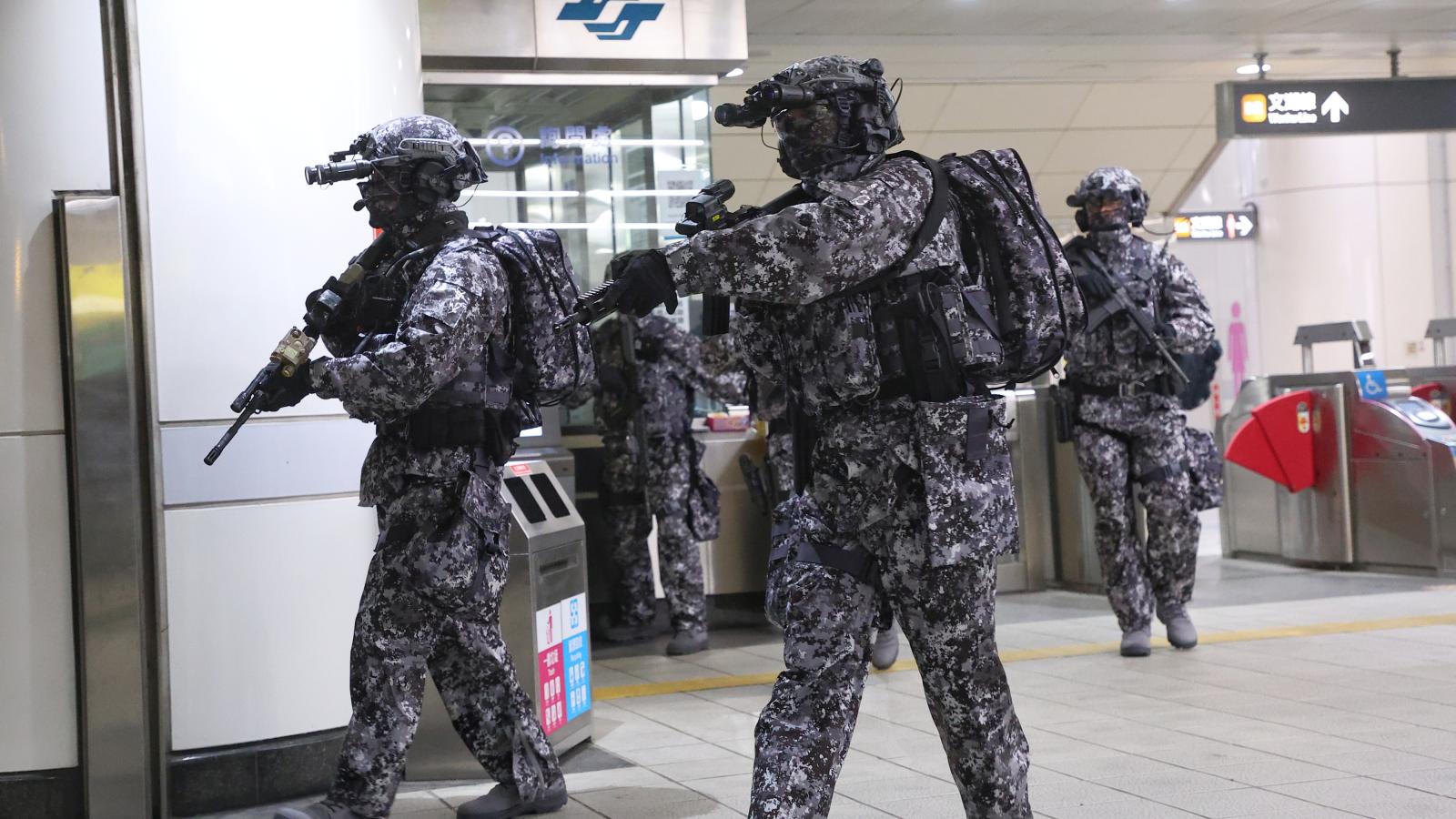
In the early hours of today (9th), the 202nd Military Police Command, responsible for guarding Taiwan's central government district, conducted rapid troop deployment using the Taipei MRT Bannan Line. Departing from the Zhonghua Barracks, troops marched tactically through the rain to Ximen Station, then boarded a specially arranged late-night train to Nangang Exhibition Center Station, reinforcing positions guarding Nangang Bridge. Notably, soldiers wore new 'urban camouflage' combat uniforms composed of black, gray, and white digital patterns instead of traditional green camouflage.
The military's Han Kuang 42 exercise entered its fifth day, continuing as scheduled despite Typhoon Baitang's outer circulation bringing strong winds and heavy rain to northern Taiwan. Taipei experienced sustained gusts of 7 to 9 levels, with open areas recording up to level 10 gusts. This marks the third public instance of military forces using the Taipei MRT for drills, following initial exercises during Han Kuang 41 in 2025 and joint defense drills in July 2026.
Han Kuang Exercise: Reinforcing Rapid Response Amid Typhoon Night
The Han Kuang drills entered the 'Joint Anti-Landing Operations and Coastal Strikes' phase on the 8th. The Tamsui and Keelung River systems have long been considered potential invasion routes for Chinese PLA forces aiming to reach Taipei's political and economic center. According to Storm Media, anticipating enemy forces engaging near Nangang Bridge—a key transportation link crossing the Daking Stream, a tributary of the Keelung River—the 202nd Military Police Command deployed additional troops and resupplied ammunition and rations to reinforce existing units.
At around 1:00 AM, a medium tactical vehicle delivered ammunition to the advance unit stationed outside the Nangang Exhibition Center Station's passenger service center. Around 1:00 AM, troops from the 202nd Military Police Command departed Zhonghua Barracks, marching tactically through rain and wind as Typhoon Baitang's storm zone approached Taiwan. By 1:30 AM, they boarded a special late-night train that had been waiting at Ximen Station, simultaneously transporting additional supplies via MRT. Storm Media observed that after boarding at Ximen Station, the reinforcement troops arrived at Nangang Exhibition Center Station in under 15 minutes, then split into two groups upon exiting to reach tactical positions and reinforce defensive lines.
Despite strong typhoon winds violently shaking media tents and continuous heavy rain, troops carrying rifles and shoulder-launched Hongshun anti-armor rocket launchers continued drills until approximately 2:00 AM. On-site military officers explained that the night drill focused on practicing rapid troop and supply transfers using MRT underground routes, with scenarios including direct troop transport via MRT trains with supplies carried manually when power is available, and using diesel-powered MRT engineering vehicles to transport supplies when power is disrupted.
Notably, unlike last year's Han Kuang 41 exercise, troops wore urban camouflage uniforms composed of black, gray, and white digital patterns instead of traditional green digital camouflage. In fact, during last year's Han Kuang exercises, Taiwan's Army Aviation and Special Forces Command previously revealed urban digital camouflage combat uniforms through sniper equipment. The military stated at the time that the urban camouflage design referenced international combat uniform trends and Taiwan's operational scenarios, currently in a trial phase, with future unit deployments to be determined based on actual needs across different military branches.
The green-dominant combat uniforms previously used by military police responsible for protecting Taiwan's highest political, economic, and military core areas were considered unsuitable for urban warfare, a discussion that began during former President Tsai Ing-wen's administration. According to Storm Media, after trial implementation of gray-dominant urban camouflage combat uniforms last year, the military officially began issuing them to select units this year. Besides the military police units publicly debuting today, other military branches and units have also received urban camouflage uniforms, though in smaller quantities, with military police currently the primary recipients.
Regarding this drill, the Military Police Command stated that to strengthen Taipei garrison defense effectiveness, it coordinated and directed responsible combat, security, and logistics support units, jointly conducting troop mobility and logistics resupply missions with the Taipei City Government, Taipei Metro Corporation, and Taipei City Police Department, utilizing MRT underground routes in response to enemy threats. They also integrated command and control systems including common operational picture and communication redundancy to build urban defense resilience.
The Military Police Command explained that this drill, based on requirements to strengthen urban defense resilience and implement civil-military integration, combines battlefield scenarios to train troops to integrate and leverage existing public infrastructure and systems according to tactical needs, executing defense missions. The Command also emphasized that facing increasingly complex security situations, the military must continuously refine training according to enemy threats and operational scenarios, effectively integrating military, government, and civilian resources to maximize defense success probability and effectiveness.
FACT BOX
- Source: PR Times
- Category: Event